NURSING FACILITY SERVICES PROVIDER IN IOWA
By Fatumata Kaba · 2025-07-22 · 5 min read
Nursing Facility Services in Iowa offer comprehensive, medically necessary, around-the-clock care within a licensed residential setting for individuals who require skilled nursing or rehabilitative support. These services are funded under the Iowa Medicaid State Plan and represent a higher level of care than what is typically available through home and community-based services (HCBS), ensuring that residents with complex clinical needs receive 24-hour supervision and professional medical intervention.
Operating a nursing facility requires rigorous adherence to state and federal regulations, as these entities serve as the backbone of the long-term care continuum. Providers must navigate a complex intersection of licensing, certification, and clinical oversight to ensure compliance with standards enforced by the Iowa Department of Inspections, Appeals, and Licensing (DIAL) and the Iowa Medicaid Enterprise (IME).
What Are the Governing Agencies for Nursing Facilities in Iowa?
The regulatory framework for Iowa nursing facilities is multi-layered, involving state and federal oversight to ensure patient safety and program integrity. The Iowa Department of Inspections, Appeals, and Licensing (DIAL) serves as the primary state entity responsible for licensing, conducting surveys, and investigating complaints to ensure facilities meet established safety codes and quality standards.
Iowa Medicaid Enterprise (HHS-IME) oversees the financial and administrative aspects of the program. This agency manages Medicaid funding, processes claims, determines eligibility, and sets reimbursement policies for nursing facility services. Furthermore, facilities must adhere to the federal mandates established by the Centers for Medicare & Medicaid Services (CMS). CMS provides the overarching conditions of participation (CoPs) that dictate resident protections, quality of care expectations, and the regulatory environment for both Medicare and Medicaid billing.
What Clinical Services Must a Nursing Facility Provide?
To be considered a qualified provider, a nursing facility must offer a robust suite of medical and personal care services designed to meet the holistic needs of its residents. These services are delivered based on an individualized care plan, which is developed by an interdisciplinary team and subjected to regular clinical reviews to ensure it remains aligned with the resident’s evolving condition.
Approved facilities typically deliver the following essential services:
- Skilled nursing care, including specialized wound care, IV therapy, and professional medication administration.
- Personal care assistance with Activities of Daily Living (ADLs), such as bathing, dressing, eating, toileting, and mobility support.
- Continuous 24-hour monitoring and supervision to ensure resident safety.
- Rehabilitative therapies, encompassing physical, occupational, and speech therapy.
- Comprehensive social services, mental health support, and structured recreational programming.
- Nutrition and dietary services, including the preparation of specialized meals tailored to clinical dietary needs.
- Access to end-of-life and palliative care when appropriate.
How Do Providers Obtain Licensing and Medicaid Enrollment?
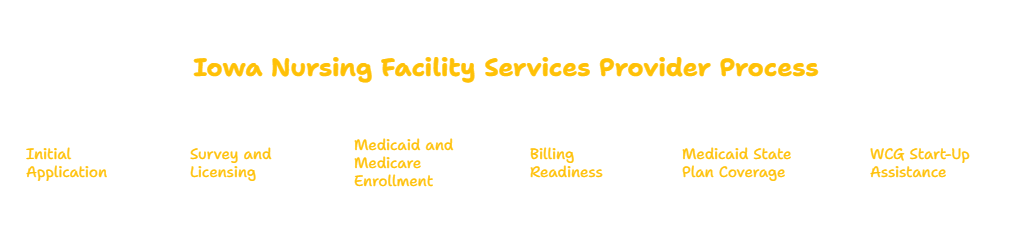
The path to becoming a licensed and enrolled provider is a systematic process that begins with formal business registration. Prospective operators must register their business with the Iowa Secretary of State and secure necessary tax identifiers, including an EIN from the IRS and a Type 2 NPI. Following these initial steps, the provider must apply for a Nursing Facility License through DIAL, which includes undergoing a pre-licensure survey and a Life Safety Code inspection to verify that the physical environment is safe for residents.
Once the facility is licensed, the focus shifts to Medicaid and Medicare enrollment via IME and the CMS PECOS system. This stage requires meticulous attention to detail, as the facility must demonstrate its capacity to manage complex billing processes. Before billing can commence, the facility must establish a RUGs-based billing system, configure Minimum Data Set (MDS) assessments, and finalize all necessary administrative and clinical policies to ensure compliance with federal claims requirements.
What Are the Mandatory Staffing and Credentialing Requirements?
Staffing a nursing facility in Iowa requires a leadership team that is not only qualified but also holds the specific state-mandated certifications. The Nursing Home Administrator must be licensed by the Iowa Board of Nursing Home Administrators and possess demonstrable experience in long-term care management. Similarly, the Director of Nursing (DON) must hold an active Iowa RN license and possess significant leadership experience in skilled nursing environments.
Beyond leadership, the facility must maintain a sufficient number of licensed nursing staff (RNs and LPNs) and Certified Nurse Aides (CNAs) to meet resident care ratios. All nursing staff must maintain active licenses and undergo regular clinical competency evaluations. Furthermore, all personnel, regardless of their role, are required to complete specialized training in abuse, neglect, and exploitation prevention, HIPAA confidentiality, resident rights, and emergency response. Ongoing in-service education is mandatory to keep staff updated on best practices and regulatory shifts.
What Documentation Is Required for Successful Operations?
Administrative readiness is defined by the quality and completeness of a facility’s documentation. A comprehensive Policy & Procedure Manual is the most critical asset for any administrator. This manual must explicitly cover resident admission, discharge and transition protocols, infection control measures, emergency preparedness plans, and HIPAA compliance. It should also detail the internal procedures for staff hiring, credentialing, and ongoing performance monitoring.
In addition to policy documents, providers must maintain organized files for:
- Legal documentation, including Articles of Incorporation and business registration records.
- Proof of adequate insurance coverage, specifically general liability, professional liability, and workers’ compensation.
- Current licensure from DIAL and, where applicable, CMS Medicare certification.
- Detailed Medicaid and Medicare billing procedures, including audit-ready documentation that maps clinical service delivery to submitted claims.
Frequently Asked Questions
What is the typical timeline to launch a nursing facility in Iowa?
The launch process generally takes between 9 to 14 months. This includes 3–6 months for business formation and licensing preparation, 2–4 months for facility setup and staff recruitment, 90–120 days for DIAL/CMS approvals, and 30–60 days for final billing configuration and facility opening.
Who is eligible for Medicaid-covered nursing facility services?
Eligible individuals must meet the state-defined Nursing Facility Level of Care criteria, undergo a mandatory PASRR Level I and Level II screening to address any behavioral or developmental needs, and demonstrate a medical necessity for skilled care that cannot be satisfied through HCBS waiver programs.
What role does the MDS assessment play in operations?
The Minimum Data Set (MDS) is a standardized clinical assessment tool used to record a resident’s physical, psychological, and social functioning. It is essential for developing the care plan and serves as the foundation for the RUGs-based billing system, directly impacting the reimbursement rates a facility receives from Medicaid.
Launching and operating a nursing facility in Iowa requires a synthesis of operational excellence, clinical diligence, and strict adherence to state and federal regulatory frameworks. Success depends on the ability to integrate high-quality, 24-hour care with robust administrative systems that satisfy the oversight requirements of DIAL, IME, and CMS.
Last verified October 2024. This information is for educational purposes only and does not constitute legal or professional advice. Requirements may change; consult with the Iowa Department of Inspections, Appeals, and Licensing and Iowa Medicaid Enterprise for the most current regulatory guidance.