NURSING FACILITY SERVICES PROVIDER IN ILLINOIS
By Fatumata Kaba · 2025-07-19 · 5 min read
Nursing Facility Services in Illinois represent a highly regulated, essential component of the state’s long-term care infrastructure, providing 24-hour skilled nursing, rehabilitation, and personal care to individuals with complex medical needs. Establishing and operating such a facility requires navigating a rigorous multi-agency approval process to ensure that clinical environments meet federal and state health and safety standards for the most vulnerable populations.
What Are the Governing Agencies and Regulatory Frameworks?
The regulatory landscape for Illinois nursing facilities is a collaborative effort between state and federal entities, designed to prioritize resident safety and quality of care. The Illinois Department of Healthcare and Family Services (HFS) serves as the primary administrator of Medicaid funding, overseeing the financial mechanisms of the program, including provider reimbursement rates and the transition of care models.
Complementing HFS, the Illinois Department of Public Health (IDPH) acts as the primary licensing and enforcement body. IDPH is responsible for issuing nursing home licenses, conducting comprehensive facility inspections, and ensuring that providers strictly adhere to state and federal safety regulations. At the federal level, the Centers for Medicare & Medicaid Services (CMS) provides the overarching regulatory framework, ensuring that all facilities meet the quality, safety, and resident rights standards outlined in 42 CFR Part 483.
- Illinois Department of Healthcare and Family Services (HFS): Administers Medicaid funding and oversees reimbursement rates.
- Illinois Department of Public Health (IDPH): Licenses facilities, conducts inspections, and enforces health and safety standards.
- Centers for Medicare & Medicaid Services (CMS): Provides federal oversight to ensure compliance with Medicaid and Medicare regulations.
How Does a Facility Qualify for Medicaid and Medicare Certification?
The path to becoming an approved nursing facility provider begins with formalizing the business entity and demonstrating operational readiness. Before a facility can accept residents under state-funded programs, it must be legally registered with the Illinois Secretary of State and secure all necessary business credentials, including a valid Taxpayer Identification Number (EIN) and a Type 2 National Provider Identifier (NPI).
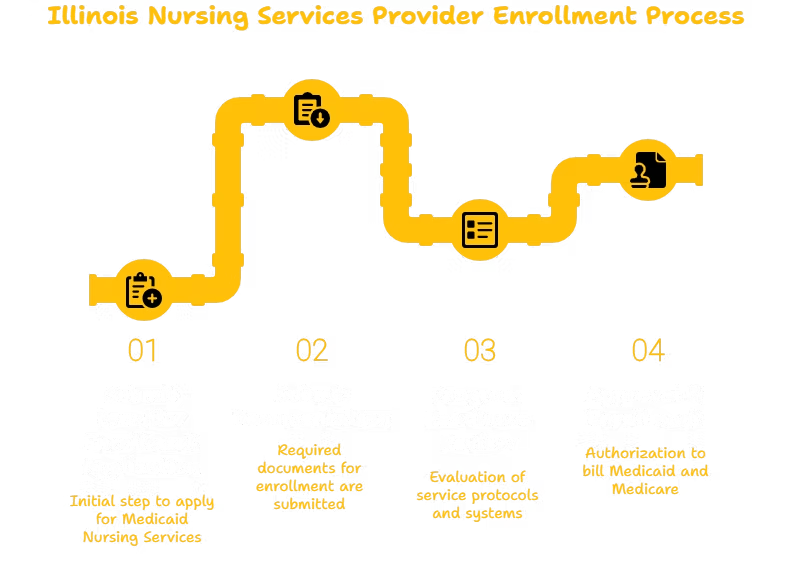
Once the business structure is established, the provider must navigate the Certificate of Need (CON) process for any new construction or significant facility expansion. Following this, the facility must apply for its license through the IDPH and complete the rigorous enrollment process via the Illinois Medicaid Provider Enrollment Portal (IMPACT) and the CMS Medicare Enrollment system (PECOS). Failure to maintain comprehensive professional and malpractice liability insurance during this phase can result in the immediate denial of enrollment applications.
What Clinical and Operational Standards Must Be Met?
Nursing Facility Services are defined by an interdisciplinary approach to care. Approved providers are mandated to deliver 24-hour skilled nursing services, which include medication management, chronic disease oversight, and specialized wound care. These services must be structured within an Individualized Care Plan that is tailored to each resident’s unique functional and cognitive requirements, ensuring the delivery of high-quality care in a secure, institutional setting.
Beyond clinical intervention, facilities must provide robust support for Activities of Daily Living (ADLs), such as bathing, dressing, and mobility assistance. Nutritional support, rehabilitation therapies (physical, occupational, and speech), and social services are also core requirements. The facility must demonstrate that its operational policies—ranging from emergency preparedness and infection control to resident rights and abuse prevention—align with federal 42 CFR Part 483 regulations.
- Skilled Nursing: 24-hour care, IV therapy, and post-surgical recovery.
- Support Services: ADL assistance, nutritional planning, and behavioral health support.
- Rehabilitation: Physical, occupational, and speech therapy services.
- Compliance: Ongoing adherence to federal Nursing Facility regulations and quality assurance benchmarks.
What Are the Staffing and Training Requirements?
The success of a nursing facility is largely dependent on the competency and credentials of its clinical and administrative staff. Every facility is required to have a Licensed Nursing Home Administrator (LNHA) who holds proper licensure through the Illinois Department of Financial and Professional Regulation (IDFPR). This individual is responsible for the overall operational integrity and compliance of the facility.
The clinical department must be led by a Director of Nursing (DON), who is a Registered Nurse (RN) with proven management experience in long-term care. Supporting the clinical leadership are licensed nursing staff (RNs and LPNs) and Certified Nursing Assistants (CNAs). All personnel must undergo rigorous background checks and health screenings. Furthermore, the facility must ensure that all staff members participate in ongoing training, including abuse prevention, dementia care, infection control, and HIPAA compliance, to remain in good standing with state surveyors.
What Is the Expected Timeline for Launching Operations?
Launching a nursing facility is a complex, multi-year project that requires careful coordination. The process begins with business formation and the Certificate of Need (CON) process, which typically spans three to six months. Following this, the construction or physical preparation of the facility, including the hiring of key leadership staff, takes an additional six to 12 months. This period is critical for establishing the physical plant standards required for licensure.
After the facility is prepared, it must undergo the IDPH licensure application and pre-licensure survey process, which can take two to four months. Final certification by CMS and enrollment in the billing systems typically requires another three to six months. In total, providers should anticipate an extended project life cycle, necessitating sufficient capital reserves and project management expertise to navigate each phase successfully.
Frequently Asked Questions
What is the difference between the Medicaid State Plan and the Supportive Living Program?
The Medicaid State Plan Nursing Facility Benefit is designed for individuals who require 24-hour skilled nursing care and meet a specific nursing home level-of-care criteria. Conversely, the Supportive Living Program (SLP) is a waiver-based model intended for individuals who can reside in a more independent, semi-supported environment but still require assistance with certain personal care services.
How does a provider ensure compliance during a survey?
Compliance is maintained through the consistent application of facility policies, regular internal audits, and rigorous documentation practices. Providers must maintain a comprehensive Policy & Procedure Manual that covers all aspects of daily operations, ensuring that the staff is prepared for both scheduled and unannounced surveys conducted by the IDPH.
Can Medicare cover the full duration of a stay in a nursing facility?
Medicare Part A typically covers short-term post-acute skilled nursing services following a qualifying hospitalization, generally limited to a maximum of 100 days. Long-term care needs beyond this period are generally funded through the Illinois Medicaid State Plan for those who meet financial and clinical eligibility requirements.
Key Takeaway: Establishing a nursing facility in Illinois is a highly technical undertaking that hinges on strict adherence to state and federal licensing standards, rigorous staffing protocols, and the successful integration of Medicaid and Medicare billing systems. Prospective providers must prioritize regulatory compliance and clinical excellence to ensure long-term operational viability.
Last verified: 2024. This information is intended for educational purposes and does not constitute legal or professional advice. Requirements for Medicaid and Medicare programs are subject to change; always consult the Illinois Department of Healthcare and Family Services (HFS) and the Illinois Department of Public Health (IDPH) for the most current regulatory guidance.