NURSING FACILITY PROVIDER IN UTAH
By Fatumata Kaba · 2026-03-31 · 5 min read
Operating a Nursing Facility in Utah requires adherence to a rigorous framework of state licensing, federal certification, and Medicaid enrollment standards designed to ensure 24-hour skilled care for individuals with complex medical needs. Providers must successfully navigate the oversight of the Utah Department of Health and Human Services (DHHS) and the Centers for Medicare & Medicaid Services (CMS) to establish a compliant, supportive, and safe environment for residents.
Understanding the Regulatory Landscape for Utah Nursing Facilities
The regulatory environment for Nursing Facilities in Utah is multifaceted, requiring coordination between state agencies and federal mandates. Oversight is primarily handled by the Utah Department of Health and Human Services (DHHS), specifically the Bureau of Health Facility Licensing, Certification, and Resident Assessment. This bureau is responsible for initial licensing, ongoing inspections, and ensuring that facilities maintain high standards of resident care and legal compliance.
Beyond state licensure, facilities must comply with federal CMS standards to qualify for Medicare and Medicaid reimbursement. The Utah Division of Integrated Healthcare (DIH) acts as the bridge for Medicaid participation, managing enrollment and ensuring that provider operations meet the state’s specific clinical and administrative requirements. Understanding the jurisdictional roles of these agencies is the first step in successful facility operations.
- Utah Department of Health and Human Services (DHHS): Primary licensing and regulatory body for health facilities.
- Centers for Medicare & Medicaid Services (CMS): Federal authority setting quality and participation standards.
- Utah Division of Integrated Healthcare (DIH): Administers Medicaid program participation and reimbursement.
Core Services and Resident Care Models
Nursing Facilities provide a structured, clinical environment for individuals who require ongoing medical supervision that cannot be safely managed in home-based settings. The core mandate of these facilities is to provide 24-hour skilled nursing, rehabilitation, and personal care services. These services are delivered through an interdisciplinary team approach, where individualized care plans are crafted based on the resident's specific health trajectory.
Services include, but are not limited to, medication administration, chronic disease management, and specialized therapies such as physical, occupational, and speech-language pathology. Facilities are also responsible for nutritional management, behavioral health support, and coordinating care to ensure that residents receive holistic treatment. Effective care coordination is essential, particularly when managing transitions for residents who may eventually move to community-based settings through waiver programs.
Navigating the Licensure and Certification Pathway
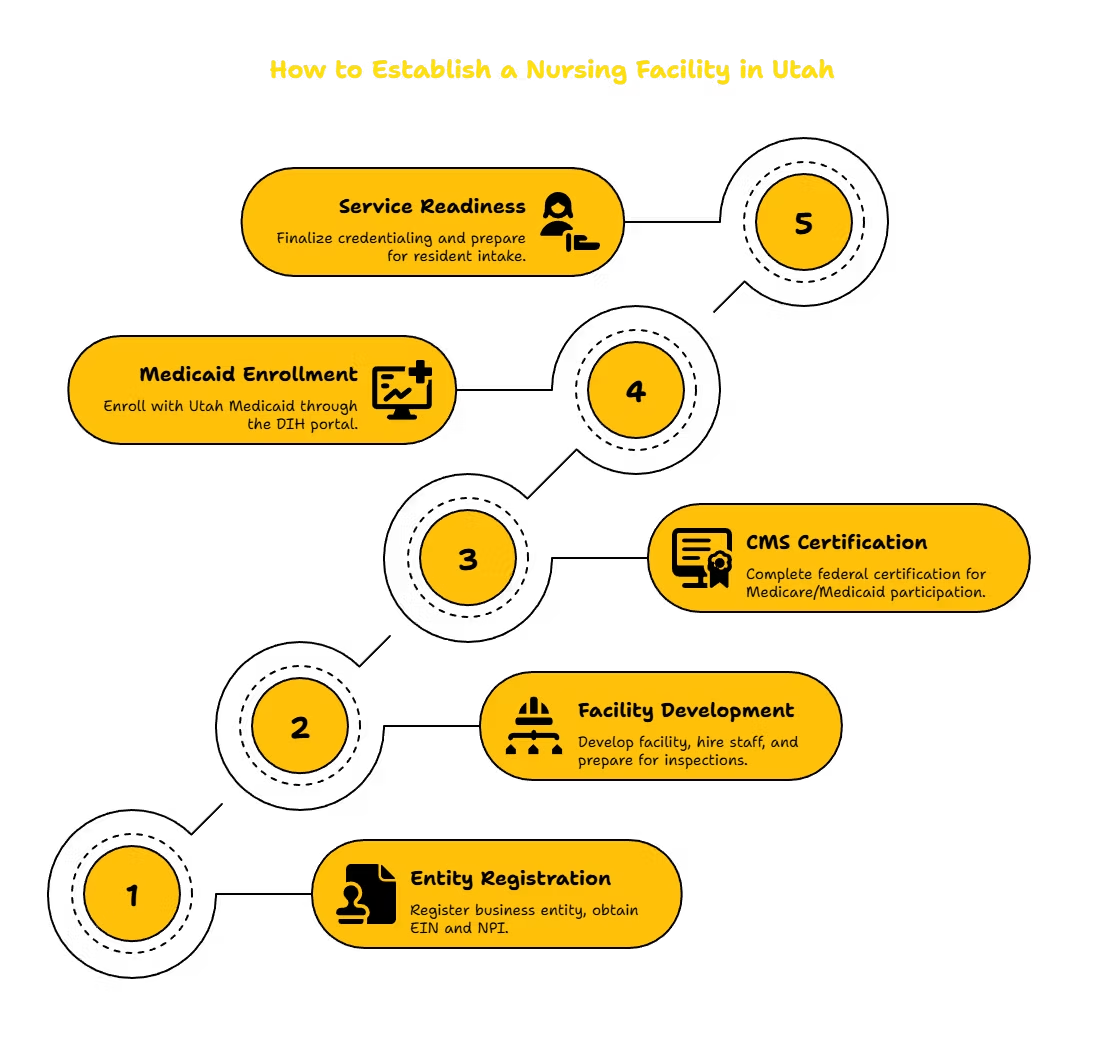
The process of launching a Nursing Facility in Utah involves a systematic progression from initial business registration to final clinical credentialing. Founders must first establish a legal business entity, obtain a federal Employer Identification Number (EIN), and secure a Type 2 National Provider Identifier (NPI). This foundational step is followed by a formal application for a Nursing Facility license through the Bureau of Health Facility Licensing.
Once state licensure is in progress, the facility must seek federal certification via CMS-671 and CMS-855A forms. This involves passing a Life Safety Code survey and a comprehensive initial compliance inspection. Once state and federal requirements are satisfied, the provider must enroll with the Utah Medicaid program through the DIH portal, ensuring that all clinical staff are appropriately credentialed and that all required operational manuals are finalized.
- Entity Foundation: Legal registration, EIN, and Type 2 NPI.
- Licensure: Submission and approval through the DHHS Bureau.
- Certification: Completion of CMS forms and adherence to federal survey standards.
- Enrollment: Finalizing Medicaid provider agreements via the DIH portal.
Developing Essential Operational Documentation
A comprehensive Policy & Procedure Manual serves as the backbone of a compliant Nursing Facility. Regulators assess this manual to verify that the facility has established clear, actionable protocols for daily operations, emergency response, and resident rights. Documentation must be granular enough to guide staff through standard procedures while remaining flexible enough to address unique clinical challenges.
Critical areas of documentation include detailed infection control protocols, medication management systems, and defined procedures for admission and discharge. Additionally, the manual must outline strategies for fall prevention, pressure ulcer monitoring, and HIPAA-compliant data handling. These policies are not merely administrative requirements; they are essential tools for maintaining quality assurance and ensuring that the facility is prepared for both routine and unannounced state surveys.
Staffing Standards and Clinical Oversight
Staffing a Nursing Facility in Utah requires strict adherence to professional licensing and competency standards. The Director of Nursing (DON) must be a Utah-licensed Registered Nurse (RN) with proven clinical and administrative leadership experience. The facility must provide 24/7 coverage, utilizing a mix of Registered Nurses, Licensed Practical Nurses (LPNs), and Certified Nursing Assistants (CNAs) to ensure continuous care and resident safety.
In addition to nursing staff, facilities must provide access to specialized roles such as social workers, dietitians, and licensed therapists. Every staff member, regardless of their role, must undergo rigorous background checks, licensure verification, and regular competency assessments. Continuous education in HIPAA compliance, infection control, and emergency procedures is mandatory to maintain the high standard of care expected by state and federal regulators.
Frequently Asked Questions
How long does the launch process for a Utah Nursing Facility typically take?
The total estimated launch time for a Nursing Facility is between 6 and 12 months. This includes 1–2 months for entity registration, 3–6 months for facility development and staffing, 2–3 months for CMS certification and state inspections, and 1–2 months for Medicaid enrollment and final readiness.
What role does a Nursing Facility play in Medicaid waiver programs like the New Choices Waiver (NCW)?
Nursing Facilities serve as a vital clinical setting for individuals who may eventually transition into home- and community-based care. The New Choices Waiver (NCW) is specifically designed to assist eligible residents in successfully transitioning from a facility to community living, with facilities collaborating with state care coordinators to assess waiver eligibility.
What are the primary requirements for the Director of Nursing (DON)?
The DON must be a Utah-licensed Registered Nurse. They are required to hold significant administrative and clinical leadership experience to oversee the facility's nursing staff, manage care plans, and ensure that the facility maintains constant compliance with state and federal clinical standards.
Key Takeaway
Establishing and maintaining a Nursing Facility in Utah is a significant undertaking that requires strict adherence to administrative, clinical, and regulatory protocols. By prioritizing compliant documentation, professional staffing, and diligent cooperation with the DHHS and CMS, providers can ensure the delivery of high-quality care that meets both the needs of their residents and the requirements of the Utah Medicaid system.
Waiver Consulting Group provides expert guidance through the entire startup lifecycle, including licensing, CMS certification, policy development, and clinical compliance, ensuring your facility is prepared for successful operations. Last verified: 2024. WCG is a consulting firm and is not a government agency; our services are intended to assist providers in navigating complex regulatory environments and do not guarantee agency approval or licensure.