North Carolina Now Requires Accreditation to Enroll in Innovations Waiver Services
By Fatumata Kaba · 2026-07-16 · 6 min read
North Carolina has fundamentally shifted its Medicaid Innovations Waiver enrollment requirements, transitioning from a post-enrollment compliance model to a strict prerequisite-based system. As of the April 20, 2026, NCTracks Provider Permission Matrix update, provider agencies must hold valid national accreditation at the exact moment they apply to enroll in specific Innovations Waiver services.
For provider organizations—both established entities looking to expand their service array and new entrants entering the North Carolina market—this regulatory update necessitates a complete restructuring of the administrative launch timeline. Failing to secure the appropriate accreditation prior to initiating the NCTracks application process will result in immediate rejection, as accreditation is no longer a remedial requirement to be fulfilled after approval.
Understanding the Shift in Provider Enrollment Requirements
The updated NCTracks Provider Permission Matrix now treats national accreditation as a foundational eligibility criterion rather than an operational benchmark to be achieved within the first year of service delivery. By mandating that proof of accreditation be submitted during the initial enrollment request, the state is standardizing quality oversight before a provider is even authorized to bill for Innovations Waiver services.
This policy change is designed to ensure that every agency serving North Carolina’s most vulnerable populations operates under a recognized national quality framework from day one. For agencies that are accustomed to state-level oversight without immediate accreditation, this transition requires a shift in internal operations, resource allocation, and long-term strategic planning. Compliance is now inextricably linked to the initial application gate.
This shift represents a broader movement toward value-based care in North Carolina. By requiring accreditation upfront, the state ensures that providers have undergone rigorous external audits of their clinical, administrative, and safety protocols. This "quality-first" gatekeeping is intended to reduce administrative churn and ensure that participants receive services from organizations that have already demonstrated commitment to recognized industry benchmarks.
Navigating the Official North Carolina Enrollment Sequence
Success in the North Carolina Innovations Waiver ecosystem depends on strict adherence to the state-mandated sequence of operations. Deviation from this order of operations almost invariably leads to processing delays or permanent enrollment blocks within the NCTracks portal, which is the primary gateway for Medicaid reimbursement in the state.
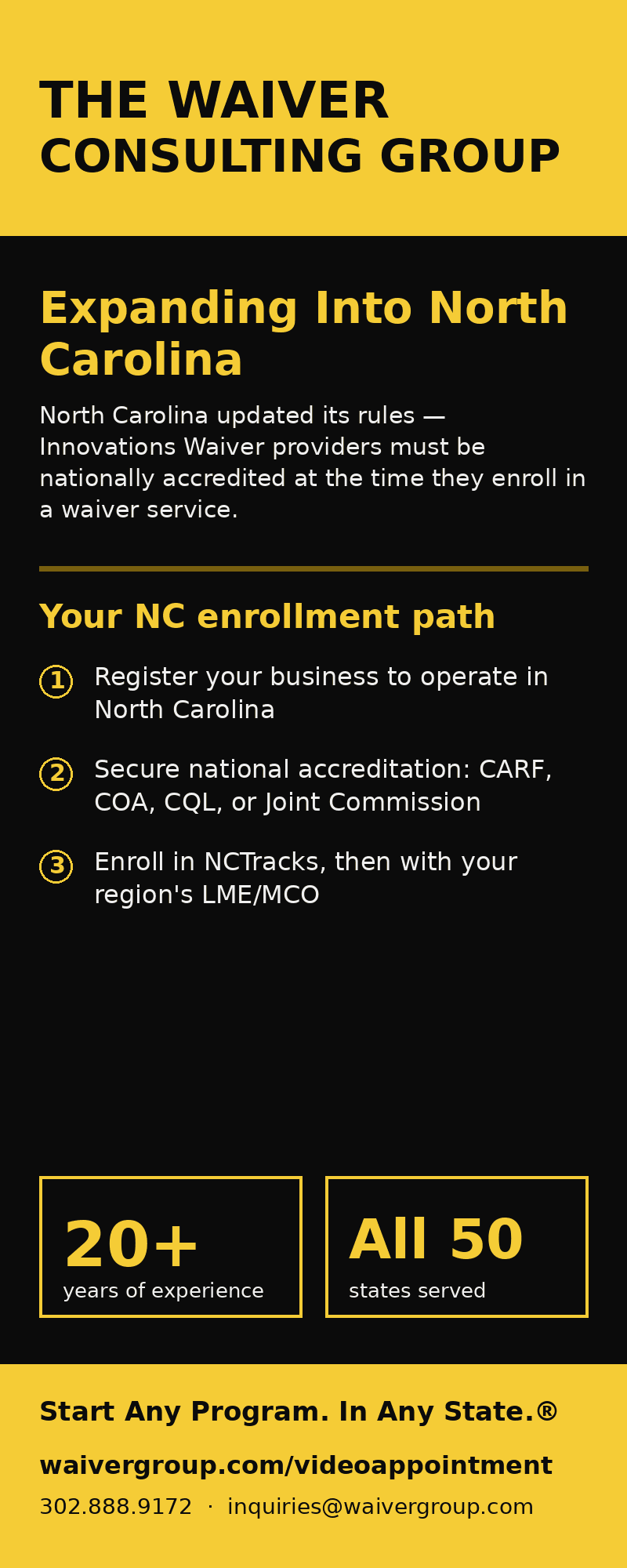
- Register your business entity with the North Carolina Secretary of State and ensure compliance with all tax-related requirements regarding your EIN.
- Secure formal, active national accreditation from an approved body, specifically CARF, COA, CQL, or the Joint Commission.
- Obtain all necessary individual professional credentials, such as the Licensed Recreational Therapist credential from the North Carolina Board of Recreational Therapy Licensure.
- Submit your provider enrollment application via NCTracks, ensuring all accreditation documentation is attached and accurate.
- Complete the secondary enrollment process with the regional LME/MCO Tailored Plan relevant to your service area.
Providers must treat these steps as a non-linear but highly interdependent process. Because the NCTracks application system now triggers automated validation checks against accreditation databases, any attempt to bypass the second step will result in an automated failure message. Maintaining clean, updated documentation for each phase is essential for navigating the review process smoothly.
Why Accreditation Timelines Must Dictate Your Launch Date
The most common pitfall for provider agencies is the misalignment of the projected service launch date with the reality of the accreditation lifecycle. Because the accreditation process often spans several months—encompassing self-assessment, policy development, and external survey visits—it cannot be treated as a secondary or concurrent project.
Providers who schedule their business operations, real estate leasing, and hiring efforts before securing their accreditation certificate often find their expansion stalling at the final stage of enrollment. To mitigate this risk, leadership must treat the accreditation process as the critical path item in their project management schedule. By establishing the accreditation timeline first, agencies can create realistic milestones that prevent administrative bottlenecks in the NCTracks portal.
It is advisable for agency administrators to build a buffer into their launch timeline. Given that accreditation surveys often require lead times for scheduling and subsequent report issuance, providers should anticipate that the accreditation window could take six to nine months, depending on the volume of current demand at the accrediting body and the complexity of the agency’s service array.
Selecting the Right National Accreditation Body
North Carolina explicitly recognizes specific national accreditation bodies that meet the standards for Innovations Waiver services. Choosing between CARF (Commission on Accreditation of Rehabilitation Facilities), COA (Council on Accreditation), CQL (The Council on Quality and Leadership), or the Joint Commission involves evaluating which organization best aligns with your agency’s service model and clinical focus.
Each accrediting body possesses unique standards, survey methodologies, and reporting requirements. It is essential for administrators to conduct a thorough gap analysis to determine which accreditation body matches their internal policies. For instance, an agency focused heavily on person-centered supports might find specific value in the CQL framework, while an agency with a clinical-heavy model may gravitate toward the standards maintained by the Joint Commission or CARF.
Regardless of the choice, the accreditation must be active and verifiable at the time of your NCTracks submission to satisfy the current North Carolina mandate. Furthermore, administrators should verify that the specific service category they are seeking enrollment for is covered under the scope of the accreditation obtained. Misalignment between the accredited scope and the desired waiver service is a common cause for denial during the state’s verification phase.
Managing LME/MCO Tailored Plan Coordination
Once the NCTracks enrollment phase is successfully navigated through the submission of your accreditation documentation, the focus shifts to the local level. The LME/MCO (Local Management Entity/Managed Care Organization) Tailored Plan responsible for your specific geographic region requires its own set of onboarding protocols to authorize the delivery of specific services to waiver participants.
Coordinating with the Tailored Plan requires clear communication regarding your approved service array and your status as a newly accredited provider. Agencies should engage early with the provider relations departments of these entities to ensure they understand local operational expectations. Regional variations in service delivery requirements can complement—but never replace—the overarching state requirements for accreditation and enrollment.
Building a relationship with the Tailored Plan is essential for long-term viability. While state accreditation is the prerequisite for entry, the LME/MCO manages the utilization management and care coordination aspects of the Innovations Waiver. Understanding their specific clinical documentation standards and billing submission expectations will facilitate a smoother integration once the provider agency is officially credentialed and active within the network.
Frequently Asked Questions
Does the accreditation requirement apply to all Innovations Waiver services?
The NCTracks Provider Permission Matrix dictates which services require national accreditation. Providers must check the specific code and service category they intend to offer within the matrix to determine if accreditation is a mandatory prerequisite for that particular enrollment category.
Can I submit my application while my accreditation survey is still pending?
No. The current North Carolina policy mandates that accreditation must be in place at the time of enrollment. Submitting an application without active accreditation status will cause the enrollment request to fail the initial screening phase in NCTracks.
Which accrediting bodies are recognized for Innovations Waiver compliance?
North Carolina currently recognizes CARF, COA, CQL, and the Joint Commission. It is critical to ensure that the accreditation you pursue is one of these specific, state-sanctioned bodies to ensure your enrollment application is accepted by the Department of Health and Human Services.
Key takeaway: In North Carolina, national accreditation is now a prerequisite for Innovations Waiver enrollment, not a follow-up step. Agencies must prioritize securing this credential before attempting to navigate the NCTracks portal to ensure compliance and avoid enrollment delays.
Start Any Program. In Any State.®
Book a video consultation: waivergroup.com/videoappointment · 302.888.9172 · [email protected]
Last verified: May 2026. This article is for informational purposes only and does not constitute legal or professional advice. Requirements for Medicaid waivers and provider enrollment are subject to change by state and federal authorities; always consult the official NCTracks provider portal and relevant LME/MCO policies for the most current information applicable to your specific situation.