NON-RESIDENTIAL HOMEBOUND SERVICES PROVIDER IN TENNESSEE
By Fatumata Kaba · 2025-10-22 · 5 min read
DELIVERING IN-HOME PERSONALIZED SUPPORT FOR INDIVIDUALS UNABLE TO PARTICIPATE IN COMMUNITY OR DAY PROGRAMS
Non-Residential Homebound Services in Tennessee are specialized Medicaid-funded supports designed for individuals with intellectual and developmental disabilities (I/DD) or complex medical needs who cannot safely or consistently attend traditional congregate day programs. By transitioning habilitative and engagement services into the private residence, these programs ensure that vulnerable participants continue to receive meaningful daytime structure, skill-building, and person-centered support in a controlled, home-based environment.
Understanding the Governing Framework and Regulatory Oversight
The delivery of homebound services is strictly regulated to ensure that high standards of care are maintained within private settings. At the state level, TennCare—Tennessee’s Medicaid agency—serves as the primary authority, overseeing the Employment and Community First (ECF) CHOICES program. TennCare is responsible for defining the scope of allowable services and determining the eligibility criteria for benefit groups that permit in-home delivery models.
Complementing TennCare’s role, the Tennessee Department of Intellectual and Developmental Disabilities (DIDD) acts as the operational lead for provider quality. DIDD manages the enrollment of qualified entities and ensures that all services comply with Home and Community-Based Services (HCBS) standards. Nationally, the Centers for Medicare & Medicaid Services (CMS) provides federal oversight, ensuring that Tennessee’s waiver programs remain aligned with federal mandates for habilitative care and disability support.
Core Service Components and Habilitative Goals
Unlike traditional personal care or respite, non-residential homebound services are inherently habilitative. The goal is to provide structured engagement that fosters independence and cognitive or physical development. Because these services replace attendance at a community-based day program, providers must design a curriculum that replaces the social and developmental benefits of those settings with equivalent in-home opportunities.
Core activities facilitated by Direct Support Professionals (DSPs) include:
- Skill-Building: Focused instruction on activities of daily living, including personal hygiene, meal preparation, and household management.
- Cognitive Development: Implementation of therapeutic exercises, memory-retention games, and structured routine planning.
- Engagement Strategies: Facilitation of remote or in-home activities, such as adapted reading programs, music therapy, and virtual socialization.
- Wellness Routines: Supportive assistance with health-focused tasks, including guided walking, prescribed stretching, and medication reminders.
- ISP Implementation: Strict adherence to the Individual Support Plan (ISP) to ensure all goal-based interventions are tracked and documented consistently.
Navigating the Provider Enrollment and Approval Process
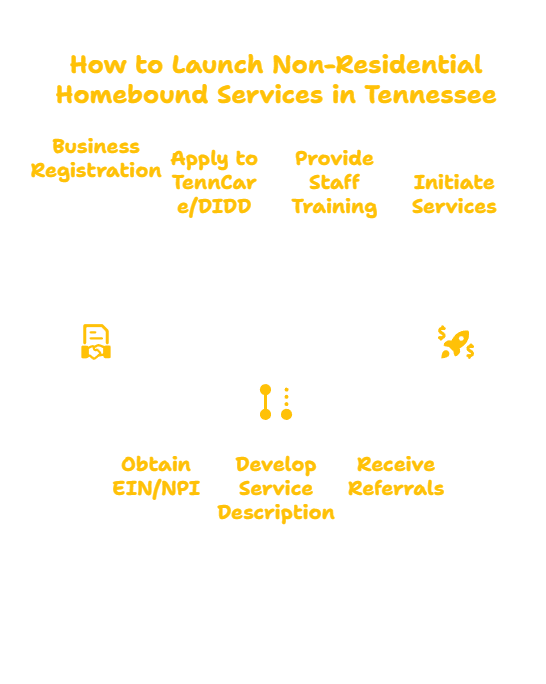
Establishing an agency to provide homebound services requires a methodical approach to state-level registration. The process begins with securing the legal foundation of the business, including incorporation, obtaining an Employer Identification Number (EIN), and securing a Type 2 National Provider Identifier (NPI). These foundational steps are mandatory before any application can be submitted to state authorities.
Once the business entity is established, providers must apply for enrollment specifically as a Community-Based Day Service provider under the ECF CHOICES program. The application process requires the submission of a detailed service description that specifically addresses how the agency will provide "homebound" services. Applicants must also provide comprehensive documentation, including proof of liability and workers’ compensation insurance, alongside a robust Policy & Procedure manual that outlines how the organization will maintain safety and quality standards while operating in private homes.
Staffing, Training, and Clinical Documentation Requirements
The quality of homebound care rests entirely on the competency of the staff. Agencies must employ qualified Direct Support Professionals (DSPs) who possess, at a minimum, a high school diploma or GED and current certifications in CPR and First Aid. Beyond these basic requirements, staff must demonstrate a clear aptitude for working in home-based settings, where the absence of a large team necessitates strong individual judgment and strict adherence to safety protocols.
Comprehensive training is not optional; it is a regulatory requirement. All staff must be trained in the nuances of person-centered planning, HIPAA compliance, and the specific ISP goals of each participant they serve. Furthermore, providers are responsible for developing and maintaining detailed documentation tools. Daily activity logs, progress notes, and ISP goal-tracking templates must be kept current to verify that the service provided is indeed habilitative in nature rather than purely custodial.
Program Eligibility and Applicable Waiver Categories
Access to non-residential homebound services is restricted to participants enrolled in specific Medicaid waiver programs, primarily the ECF CHOICES program. Specifically, Benefit Groups 4, 5, 6, and 7 are generally targeted for those with the most significant needs or those who are considered medically fragile. These benefit groups provide the flexibility necessary to shift funding from community settings to the participant’s private residence.
In addition to ECF CHOICES, certain 1915(c) waiver programs may include provisions for in-home habilitation under specific circumstances. For children and young adults, the State Plan Early and Periodic Screening, Diagnostic, and Treatment (EPSDT) benefit may also serve as a pathway for home-based services if the intervention is deemed medically necessary as an alternative to traditional day programs. Providers should work closely with Managed Care Organizations (MCOs) to confirm the specific funding source for each referral.
Frequently Asked Questions
How does homebound service differ from personal assistance?
While personal assistance focuses on meeting basic physical needs and maintaining the home environment, homebound services are strictly habilitative. Homebound services focus on the implementation of goal-based ISP objectives, cognitive growth, and structured daily engagement, requiring more advanced staff training and documentation of progress toward specific milestones.
What is the typical timeline to begin providing services?
The launch process generally spans several months. Business registration and initial staffing typically take 1–2 months. The TennCare and DIDD provider enrollment process requires an additional 2–3 months. Finalizing internal policy manuals and staff training usually occurs in the 30–60 days preceding the initiation of services, depending on how quickly the agency receives participant referrals from MCOs.
Are there specific requirements for the home environment?
Yes. Providers must conduct an initial and ongoing assessment of the home environment to ensure it is safe for the delivery of habilitative services. This includes establishing emergency protocols, verifying that the home meets health and safety standards, and ensuring the environment is conducive to the specific goals outlined in the participant's ISP.
Key Takeaway
Success as a homebound services provider requires a rigorous commitment to the regulatory standards set by TennCare and DIDD, combined with a robust clinical approach to in-home habilitation. By maintaining meticulous documentation, investing in high-quality staff training, and aligning service delivery with the person-centered goals of the ECF CHOICES program, providers can fill a critical gap in care for Tennessee’s most vulnerable populations.
Last verified: October 2023. Disclaimer: This information is for educational purposes only and does not constitute legal or professional medical advice. Always consult with the Tennessee Department of Intellectual and Developmental Disabilities (DIDD) and TennCare regarding current policy updates and specific state requirements.