NON-MEDICAL TRANSPORTATION SERVICES PROVIDER IN WEST VIRGINIA
By Fatumata Kaba · 2026-04-14 · 5 min read
ENABLING ACCESS TO COMMUNITY, WORK, AND SUPPORT SERVICES FOR MEDICAID WAIVER PARTICIPANTS THROUGH SAFE, DEPENDABLE TRANSPORTATION
Non-Medical Transportation (NMT) services in West Virginia act as a vital bridge between Medicaid Home and Community-Based Services (HCBS) waiver participants and the community, facilitating access to employment, social integration, and essential daily living activities. Unlike Non-Emergency Medical Transportation (NEMT) services, which are strictly clinical in nature, NMT providers focus on supporting the participant’s independence as defined by their Person-Centered Service Plan (PCSP). Establishing an NMT agency requires rigorous adherence to state regulatory standards, careful coordination with the Bureau for Medical Services (BMS), and a commitment to the safety and reliability required to support vulnerable populations.
What Are the Governing Agencies and Regulatory Frameworks?
The regulatory landscape for NMT services in West Virginia is structured to ensure accountability and high standards of care for all waiver participants. The West Virginia Department of Health and Human Resources (WVDHHR) maintains overall administrative responsibility for the state’s Medicaid waiver programs. Their oversight ensures that provider participation aligns with state health objectives and that service delivery remains consistent with federal Medicaid requirements.
The Bureau for Medical Services (BMS) serves as the primary entity managing Medicaid funding and reimbursement structures. BMS is responsible for the formal enrollment of NMT providers, the creation of billing policies, and the enforcement of operational regulations. Additionally, Acentra Health (formerly Kepro) plays a critical role in the daily operation of these services. By performing functional assessments and overseeing utilization reviews, they ensure that the transportation services provided are both necessary and authorized within the scope of an individual’s PCSP. Providers must remain in constant communication with these entities to ensure billing accuracy and compliance.
What Defines Authorized Non-Medical Transportation Services?
NMT services are designed to maximize the independence of waiver participants by providing reliable transit to destinations that foster community engagement and personal growth. Authorized trips are not open-ended; they must be clearly defined in the participant's PCSP and serve a specific purpose that aligns with the participant's goals for community participation or self-sufficiency.
Typical destinations and purposes for approved NMT services include:
- Day habilitation or specialized employment sites.
- Community-based events, recreational activities, and socialization opportunities.
- Essential life management tasks, such as grocery shopping, pharmacy visits, or banking.
- Adult day programs and support centers that provide necessary social or developmental care.
- Any other specific destination identified as a goal within the participant’s approved service plan.
How Do Agencies Complete the Provider Enrollment Process?
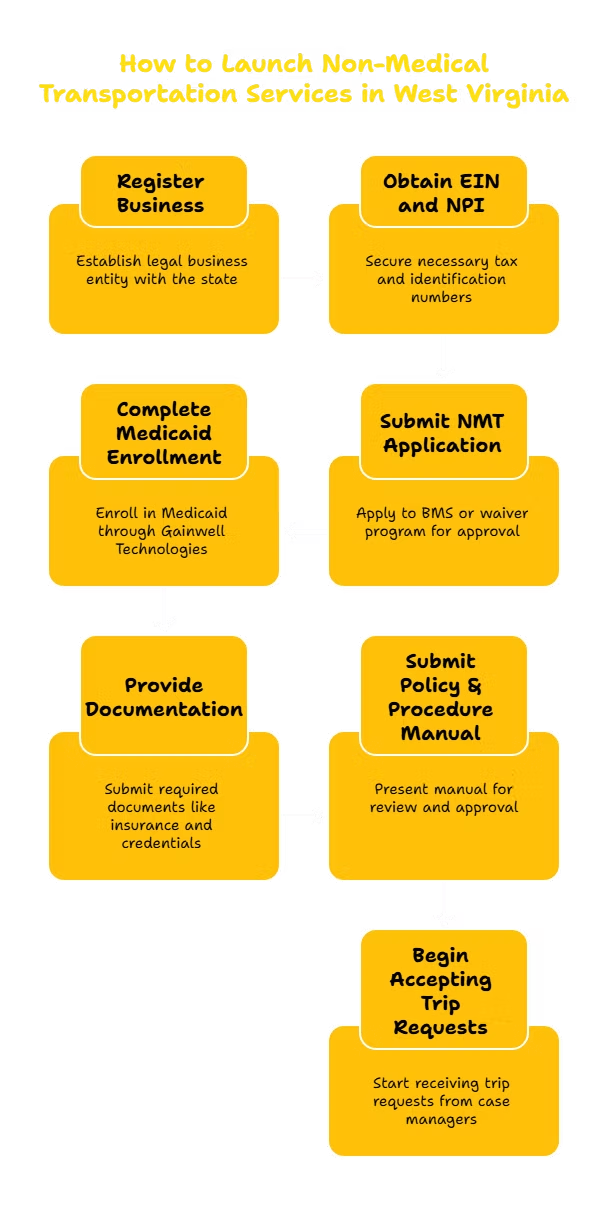
Launching an NMT agency is a multi-step regulatory endeavor that begins with formalizing the business entity. Before approaching state agencies, entrepreneurs must register their business with the West Virginia Secretary of State, obtain an Employer Identification Number (EIN), and secure a Type 2 National Provider Identifier (NPI). These are the foundational credentials required to interface with the state’s fiscal systems.
Once the business is legally established, the provider must navigate the enrollment hierarchy. This involves submitting an NMT provider application directly to BMS or through the specific waiver program (such as the I/DD or Aged and Disabled Waiver). Following this, the agency must complete the Medicaid enrollment process via Gainwell Technologies. Throughout this timeline, which typically spans several months, the provider must maintain meticulous records, including automobile liability insurance, proof of vehicle inspections, and comprehensive policy documentation, before they can begin accepting trip requests from support coordinators or case managers.
What Documentation and Staffing Standards Must Be Maintained?
Operational success depends on the ability to demonstrate compliance through documentation. At a minimum, an agency must possess a robust Policy & Procedure Manual. This manual serves as the operational blueprint, detailing daily vehicle safety checklists, emergency and incident response protocols, and strict HIPAA confidentiality policies. Without a documented, board-approved, or compliant set of internal policies, an agency cannot fulfill its mandate to provide safe and secure transport.
Staffing requirements are equally stringent to ensure the safety of participants. Every transportation driver or aide must undergo thorough background checks via WV CARES and maintain a clean driving record. Drivers should be well-versed in transporting individuals with varying physical and developmental disabilities, and they are expected to hold CPR/First Aid certifications. Ongoing training—covering emergency preparedness, abuse prevention, and defensive driving—is essential for all staff members, whether they are performing the driving duties or managing logistics from a dispatching role.
Which Medicaid Waiver Programs Support NMT?
It is critical for providers to understand which specific Medicaid waivers authorize NMT services, as coverage eligibility is strictly tied to the participant's enrolled program. Not all Medicaid services support NMT; for example, standard state plan services often exclude NMT, focusing instead on NEMT brokers for medical appointments.
- Aged and Disabled Waiver (ADW): Provides for non-medical rides essential for community integration.
- I/DD Waiver: Facilitates transport specifically for habilitation and employment activities.
- Personal Options Program: May provide for mileage reimbursement under self-directed service structures.
- Traumatic Brain Injury Waiver (TBIW): Transportation is provided based on the specific needs documented in the participant’s PCSP.
Frequently Asked Questions
Can an NMT provider transport individuals to medical appointments?
NMT is distinct from Non-Emergency Medical Transportation (NEMT). While NMT is focused on community, employment, and social integration, NEMT is generally handled through separate medical brokerage systems. Providers must ensure the trip purpose aligns with the specific NMT authorization in the participant's PCSP.
What is the typical timeline to become a fully operational NMT provider?
The timeline involves several phases: 2–4 weeks for business formation, 1–2 months for Medicaid enrollment and manual submissions, and 30–45 days for credentialing drivers and verifying vehicle compliance. Agencies should expect a total launch period of approximately 3 to 5 months.
What if a driver does not have a CPR/First Aid certification?
While industry standards emphasize these credentials for the safety of participants with disabilities, agencies should refer to their specific program requirements as outlined by BMS. However, obtaining these certifications is highly recommended as a best practice for risk management and professional service delivery.
Key Takeaway: Successfully operating an NMT agency in West Virginia requires a disciplined approach to documentation, strict adherence to BMS enrollment timelines, and a unwavering focus on participant safety and regulatory compliance.
Last verified: October 2023. Disclaimer: This information is for educational purposes only and does not constitute legal or professional advice. Always consult with the West Virginia Bureau for Medical Services or qualified legal counsel when establishing a healthcare agency.