NON-MEDICAL TRANSPORTATION SERVICES PROVIDER IN VERMONT
By Fatumata Kaba · 2026-04-09 · 5 min read
ENSURING SAFE, RELIABLE ACCESS TO COMMUNITY SERVICES, WORK, AND DAILY LIFE FOR INDIVIDUALS WITH DISABILITIES
Non-Medical Transportation (NMT) Services in Vermont provide essential access to community-based programs, employment, health-related appointments, and other critical services for individuals with disabilities or chronic conditions. As a vital component of Vermont’s Medicaid Home and Community-Based Services (HCBS) ecosystem, these services are designed to promote independence, inclusion, and person-centered living by removing physical and logistical barriers to community integration.
For prospective providers, NMT is covered under several of Vermont’s Medicaid HCBS Waivers when explicitly outlined in an individual's support plan. Oversight of these programs is provided by the Department of Disabilities, Aging and Independent Living (DAIL) in close partnership with Designated Agencies (DAs), Specialized Services Agencies (SSAs), and the Department of Vermont Health Access (DVHA).
How Are NMT Services Governed in Vermont?
The regulatory framework for Non-Medical Transportation in Vermont is a collaborative effort between state-level administrative bodies and regional service coordinators. The Department of Disabilities, Aging and Independent Living (DAIL) serves as the primary authority, responsible for authorizing NMT under specific HCBS waivers. DAIL ensures that all proposed transportation services align strictly with the individual goals established in a participant's Individual Support Plan (ISP) and meet the necessary standards for safety and accessibility.
Operational execution and fiscal oversight are managed by the Department of Vermont Health Access (DVHA), which handles Medicaid enrollment, billing, and reimbursement protocols. Because Vermont utilizes a system of Designated Agencies (DAs) and Specialized Services Agencies (SSAs), these local organizations function as the primary point of contact for providers. They are responsible for coordinating ISPs, authorizing specific transportation routes, and ensuring that providers remain in full compliance with state and federal regulations.
What Scope of Services Is Covered Under Medicaid Waivers?
NMT services are intended to support individuals in accessing their communities specifically when public transportation or informal options are either unavailable or insufficient to meet the individual's needs. Every trip must be directly related to the goals identified in the ISP, with a clear focus on fostering vocational, social, or personal independence for the participant.
Commonly covered transportation purposes include, but are not limited to, the following activities:
- Travel to and from employment, job training, or volunteer work.
- Attendance at state-authorized adult day programs or community-based events.
- Accessing critical waiver-authorized services, such as physical therapy, respite care, or habilitation services.
- Support for essential daily living tasks, including grocery shopping, banking, or other errands, provided these are explicitly approved in the participant's ISP.
- Participation in social, civic, or recreational activities that prevent isolation.
Service delivery models are flexible, allowing for transportation via agency-owned vehicles, taxis, public transit, or, in some cases, mileage reimbursement models. The specific mode of transport must be documented and authorized to ensure reimbursement eligibility.
What Are the Essential Requirements for Provider Approval?
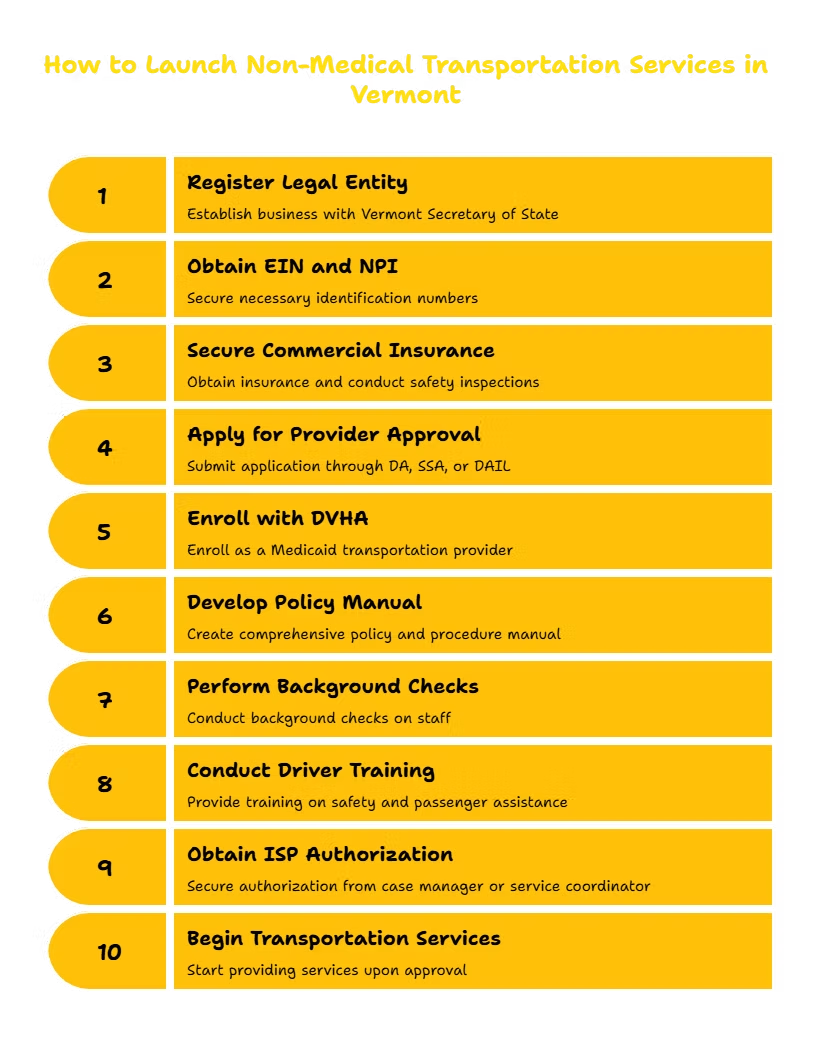
Establishing a professional NMT operation in Vermont requires meticulous adherence to both business and clinical standards. Providers must first register their legal entity with the Vermont Secretary of State, obtain a federal Employer Identification Number (EIN), and secure a Type 2 National Provider Identifier (NPI). Beyond basic business filings, the provider must obtain comprehensive commercial vehicle insurance and establish a schedule for routine safety inspections to maintain fleet integrity.
The application process requires potential providers to demonstrate operational readiness by submitting an application to a local DA, SSA, or directly to DAIL for program approval. Crucially, a prospective provider must develop a comprehensive Non-Medical Transportation Services Policy & Procedure Manual. This document must detail how the agency will manage staff background checks, driver safety training, and the day-to-day logistics of client transport.
How Do Providers Navigate the Enrollment and Compliance Process?
The transition from a business entity to a qualified Medicaid provider involves a sequenced approach to ensure all administrative requirements are met. The process typically begins with the formal registration of the business and the acquisition of the necessary federal identifiers. Once the legal structure is in place, the provider must contract with a DA/SSA or receive authorization from DAIL. This stage is critical, as it establishes the provider’s legitimacy within the local service network.
Following agency approval, the provider must complete the formal Medicaid enrollment process through the DVHA if they intend to bill the state directly. Simultaneous with this, the provider must finalize their internal infrastructure, including:
- Executing thorough background checks on all drivers and staff.
- Developing and implementing a rigorous training curriculum for all personnel.
- Ensuring all vehicle insurance and maintenance records are up-to-date and accessible for audit.
- Establishing a system for documenting trip authorization, mileage, and service delivery to comply with HIPAA and Medicaid billing standards.
What Are the Key Staffing and Training Expectations?
The quality of service is largely determined by the competence and professionalism of the transportation drivers and mobility aides. All personnel must hold a valid Vermont driver’s license and maintain a clean driving record. Because these staff members are working with vulnerable populations, they must undergo consistent training in disability awareness, defensive driving, and passenger assistance protocols—such as wheelchair securing and transfer assistance.
In addition to these core duties, agencies often designate a Transportation Coordinator to manage the complexities of route scheduling, vehicle maintenance tracking, and staff supervision. All staff, regardless of their specific role, must be fully versed in HIPAA regulations and the rights of the participants they serve. Annual driving record reviews and skills checks are standard practice to ensure that the agency maintains a high level of passenger safety and accountability.
Frequently Asked Questions
Which Medicaid Waivers Cover Non-Medical Transportation?
NMT is authorized under several programs, including the Developmental Disabilities Services Waiver (DDSW) for employment and community access, the Brain Injury Program for structured therapy travel, the Choices for Care (CFC) Waiver for adult day health, and case-by-case authorization under the Children’s High-Tech / Transition Services.
What must be included in the Policy & Procedure Manual?
The manual must detail driver training and supervision, vehicle maintenance and sanitation procedures, route planning and mileage documentation, emergency response protocols, incident reporting, passenger assistance policies, and all HIPAA and confidentiality standards.
How long does the setup process typically take?
Business setup and vehicle preparation usually require 2–3 weeks, DA/SSA contracting can take 1–2 months, Medicaid enrollment takes 4–6 weeks, and staff hiring and training require 2–3 weeks, with services launching upon ISP approval.
Key Takeaway
Success as a Non-Medical Transportation provider in Vermont relies on balancing rigorous compliance with the practical, person-centered needs of Medicaid waiver participants. By maintaining strict documentation, adhering to the safety standards set by DAIL, and ensuring seamless communication with Designated Agencies, providers can build sustainable programs that provide reliable and essential community access for those with disabilities.
Last verified: May 2024. This information is for educational purposes and does not constitute legal or professional consulting advice. Please refer to official Vermont state publications for the most current regulatory updates.