NON-MEDICAL TRANSPORTATION SERVICES PROVIDER IN UTAH
By Fatumata Kaba · 2026-03-31 · 5 min read
SUPPORTING ACCESS TO ESSENTIAL SERVICES FOR INDIVIDUALS WITH DISABILITIES THROUGH RELIABLE COMMUNITY TRANSPORTATION
Non-Medical Transportation (NMT) services in Utah serve as a vital link for individuals with disabilities or long-term care needs, facilitating access to Medicaid-covered services, employment, and essential community activities. By removing physical and logistical barriers, these services foster independence, support community integration, and help prevent institutionalization for vulnerable populations.
Operating as an allowable service under the Utah Medicaid State Plan and various Home and Community-Based Services (HCBS) waivers, NMT is strictly regulated to ensure safety and service quality. Oversight is provided by the Utah Department of Health and Human Services (DHHS), primarily through the Division of Services for People with Disabilities (DSPD) and the Division of Integrated Healthcare (DIH), ensuring that all providers meet rigorous standards of care and operational compliance.
What Are the Governing Agencies and Regulatory Roles in Utah?
Establishing an NMT agency in Utah requires a clear understanding of the hierarchy of oversight. The Utah Department of Health and Human Services (DHHS) acts as the primary regulatory body. Within this department, the Division of Services for People with Disabilities (DSPD) is responsible for approving providers, authorizing transportation services within specific HCBS waivers, and coordinating directly with case managers who manage individual participant plans.
Parallel to DSPD oversight, the Division of Integrated Healthcare (DIH) manages the administrative aspects of the Medicaid benefit. This includes the enrollment of providers into the state Medicaid system, the processing of claims, and the ongoing monitoring of reimbursement policies. Additionally, all prospective providers must interact with the Utah Department of Commerce, Division of Corporations, to ensure their business entity is legally registered and in good standing within the state.
Understanding these distinct roles is critical for compliance:
- DHHS/DSPD: Manages HCBS waiver participation, provider approval, and Individual Support Plan (ISP) alignment.
- Utah Medicaid (DIH): Governs billing, claims processing, and provider enrollment portals.
- Division of Corporations: Ensures legal entity formation and operational registration.
How Do Providers Define and Deliver Non-Medical Transportation Services?
NMT services are not merely about driving; they are about supporting the participant’s Individual Support Plan (ISP). These services are authorized to transport eligible individuals to day programs, adult day health centers, supported employment sites, and necessary medical or therapy appointments that do not require specialized ambulance transport. Providers may also assist with essential errands, such as trips to grocery stores or banks, provided these tasks are pre-authorized in the ISP.
Delivery models vary based on the specific needs of the population served. Some agencies focus on door-to-door, individual rides, while others utilize group transportation in wheelchair-accessible vans. Depending on the participant’s needs, an escort may be required to assist the individual during transit. Regardless of the model, every service interaction must be accurately tracked using logs to ensure compliance with Medicaid billing and audit requirements.
What Are the Essential Licensing and Provider Approval Steps?
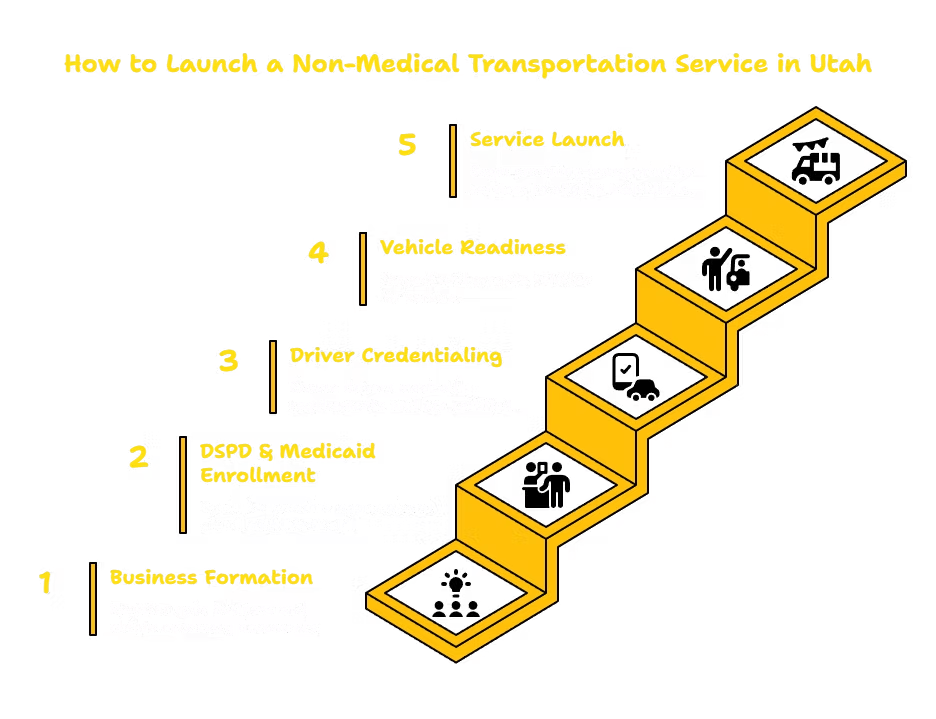
The path to becoming an approved provider is a systematic process that begins with formalizing the business entity. After registering the company with the Utah Division of Corporations, the applicant must obtain a federal Employer Identification Number (EIN) and a Type 2 National Provider Identifier (NPI). These are the foundational credentials required for any entity entering the Medicaid billing system.
Following registration, the provider must demonstrate operational readiness. This involves applying for DSPD provider approval specifically for HCBS transportation and completing the Medicaid enrollment through the Utah Provider Enrollment Portal. A significant component of this phase is the development of a comprehensive Policy & Procedure Manual, which must be submitted for review. This manual must detail how the agency maintains vehicles, conducts driver background checks, and manages day-to-day operations in a HIPAA-compliant manner.
- Register business and obtain EIN and Type 2 NPI.
- Apply for DSPD provider approval for HCBS waivers.
- Enroll in the Medicaid system via the DIH portal.
- Submit a Policy & Procedure Manual for regulatory review.
- Ensure vehicle compliance through registration and safety inspections.
What Are the Documentation and Staffing Requirements?
Maintaining high-quality service requires rigorous adherence to documentation and staffing protocols. Every agency must retain proof of legal formation, DSPD provider agreements, and Medicaid enrollment confirmations. The internal Policy & Procedure Manual must serve as a living document, covering incident response, emergency protocols, and specific procedures for ADA-accessible transport. Precise transportation logs must be kept, linking every trip back to an authorized ISP.
Staffing requirements are equally stringent to ensure the safety of the individuals being transported. All drivers must hold a valid Utah driver’s license and pass a thorough background check. It is strongly recommended—and often required by agency policy—that drivers possess CPR/First Aid certification and receive specialized training in ADA compliance, including the safe handling of wheelchairs. Coordination staff must also undergo training in client rights, HIPAA compliance, and data management to ensure that confidentiality is maintained at all times.
Which Medicaid Waivers Cover NMT Services?
NMT services are authorized under several specific HCBS waivers in Utah, each designed to support unique populations. The Community Supports Waiver (CSW) is one of the primary avenues, supporting individuals with intellectual or developmental disabilities. Other waivers include the Acquired Brain Injury (ABI) Waiver, the Physical Disabilities Waiver (PDW), and the Medically Complex Children’s Waiver (MCCW). Additionally, the New Choices Waiver (NCW) supports individuals transitioning from institutional settings into the community.
To deliver services under these waivers, the provider must be included in the participant's ISP. Coordination with case managers is a persistent requirement, as they hold the authority to authorize the transportation needed for the participant to engage in their community and access their specialized support services.
Frequently Asked Questions
How long does the provider enrollment process typically take?
The timeline varies based on agency readiness, but the full process generally spans 1 to 3 months. This includes DSPD provider enrollment, Medicaid portal registration, and the time required for vehicle and staff credentialing.
Can family members be reimbursed for transportation?
Mileage reimbursement for family members or caregivers is an allowable option under certain waiver programs. This must be clearly outlined and authorized within the participant’s Individual Support Plan (ISP) before services are delivered.
What is the most critical component of a Policy & Procedure Manual?
While all sections are vital, the sections regarding vehicle safety, incident reporting, and HIPAA-compliant documentation are scrutinized most heavily during audits. Ensuring these are robust and consistently followed is essential for long-term provider success.
Key Takeaways
Launching a Non-Medical Transportation agency in Utah requires a commitment to both administrative precision and participant safety. By focusing on the structural requirements—specifically DSPD provider approval, DIH enrollment, and the implementation of a comprehensive policy manual—providers can build a sustainable foundation. Success in this field relies on maintaining active, professional relationships with case managers and ensuring that every service delivered is fully compliant with the participant’s Individual Support Plan.
Last verified: October 2023. Disclaimer: This information is for educational purposes only and does not constitute legal or professional advice. Always consult directly with the Utah Department of Health and Human Services and your legal counsel to confirm current regulations and program requirements.