NON-MEDICAL TRANSPORTATION SERVICES PROVIDER IN SOUTH DAKOTA
By Fatumata Kaba · 2025-10-15 · 5 min read
Non-Medical Transportation (NMT) services in South Dakota are essential community supports that enable individuals with disabilities to access waiver-authorized programs, employment, and social inclusion activities. By facilitating reliable transit, these providers ensure that participants can engage in their Individual Service Plan (ISP) goals while maintaining the safety and independence necessary for community-based living.
Operating as an NMT provider requires strict adherence to state-level regulations managed by the South Dakota Department of Human Services (DHS) and the Division of Developmental Disabilities (DDD). Because these services are funded through specific Medicaid waiver programs—including the CHOICES Waiver, Family Support 360 Waiver, and Medically Fragile Waiver—providers must meet rigorous operational, safety, and documentation standards to remain eligible for reimbursement.
How Are Non-Medical Transportation Services Governed and Regulated?
The regulatory landscape for NMT in South Dakota is defined by a multi-agency framework. The primary governing entity is the South Dakota Department of Human Services (DHS), specifically the Division of Developmental Disabilities (DDD). The DDD holds the authority to authorize provider enrollment and oversees the delivery of waiver-funded transportation to ensure it aligns with federal CMS requirements for home and community-based services (HCBS).
In addition to health-related oversight, transportation providers must comply with the South Dakota Department of Public Safety (DPS). The DPS manages driver licensing and vehicle regulations, serving as the enforcement body for vehicle safety compliance, insurance mandates, and the background check requirements necessary for public transit operations. Providers must remain in good standing with both departments to maintain their status as active Medicaid waiver vendors.
Federal standards, established by the Centers for Medicare & Medicaid Services (CMS), provide the overarching guidance for these services. These standards emphasize that NMT must be a distinct, non-emergency service designed to bridge the gap between a participant's home and their authorized community-based activities, ensuring that service delivery meets federal expectations for safety and participant access.
What Are the Essential Requirements for Provider Enrollment?
Becoming a state-approved NMT provider involves a structured sequence of business and administrative steps. Initially, an entity must be properly registered with the South Dakota Secretary of State and secure both an Employer Identification Number (EIN) and a Type 2 National Provider Identifier (NPI). These identifiers are non-negotiable for Medicaid billing and administrative record-keeping.
Beyond the legal formation of the business, applicants must demonstrate operational readiness to the DHS-DDD. This includes maintaining comprehensive commercial vehicle insurance, liability policies, and workers’ compensation. Prospective providers are required to submit a robust Transportation Services Policy & Procedure Manual, which must detail how the company will handle participant safety, vehicle maintenance, and emergency response. Each driver employed by the agency must also undergo thorough background checks and possess a clean driving record to qualify for service delivery.
- Register business with the South Dakota Secretary of State.
- Obtain a Federal EIN and a Type 2 NPI.
- Apply to the DHS-DDD for waiver-specific provider enrollment.
- Maintain commercial vehicle, liability, and workers’ compensation insurance.
- Conduct initial and ongoing background checks for all drivers.
- Develop a comprehensive Transportation Services Policy & Procedure Manual.
How Do You Manage Documentation and Service Delivery Standards?
Documentation is the backbone of Medicaid reimbursement. For every trip provided, the agency must maintain precise records that align with the participant’s approved ISP. This includes logs of one-way or round-trip transit to waiver-authorized programs, employment sites, or community activities. These logs serve as proof of service and are subject to audit by the state, making accuracy in time-tracking and mileage reporting critical to financial compliance.
Internal policies should also cover the specifics of service delivery, such as the use of wheelchair-accessible vehicles for mobility-impaired passengers and the provision of escort support where designated in the participant’s plan. By establishing clear protocols for daily trip logs, HIPAA-compliant storage of participant data, and accident response, a provider minimizes liability and ensures that their services remain fully integrated with the broader Medicaid documentation cycle.
What Are the Core Staffing and Training Expectations?
The effectiveness of an NMT provider relies heavily on the quality and preparedness of its staff. Every driver must possess a valid driver’s license and maintain a record free of disqualifying infractions. Because the service population includes individuals with intellectual, developmental, or medically fragile conditions, training must extend beyond basic driving skills. Comprehensive onboarding should include disability awareness training, passenger rights education, and sensitivity to the unique needs of the populations served.
Staff must also be trained on emergency preparedness, including clear protocols for what to do in the event of a mechanical failure or a medical emergency during transit. Periodic, mandatory retraining—such as annual defensive driving courses and CPR/First Aid certification—ensures that the agency remains compliant with safety standards. Proper documentation of this training must be kept on file for all personnel, as these records are essential during state site or readiness reviews.
Frequently Asked Questions
Is Non-Medical Transportation the same as emergency medical transit?
No. NMT services are strictly for non-emergency purposes, such as transport to day programs, work sites, or community activities defined in a participant's ISP. Emergency medical transportation is a separate benefit under the Medicaid State Plan and is not governed by the NMT waiver guidelines.
Can I begin billing as soon as I register my business?
No. You must first complete the formal provider enrollment process with the DHS-DDD, which includes the submission of your safety plans, staff credentials, and policy manual. Billing can only commence once the agency has received official authorization and has been paired with a participant who has a documented need for transportation in their service plan.
What does a typical launch timeline look like for a new provider?
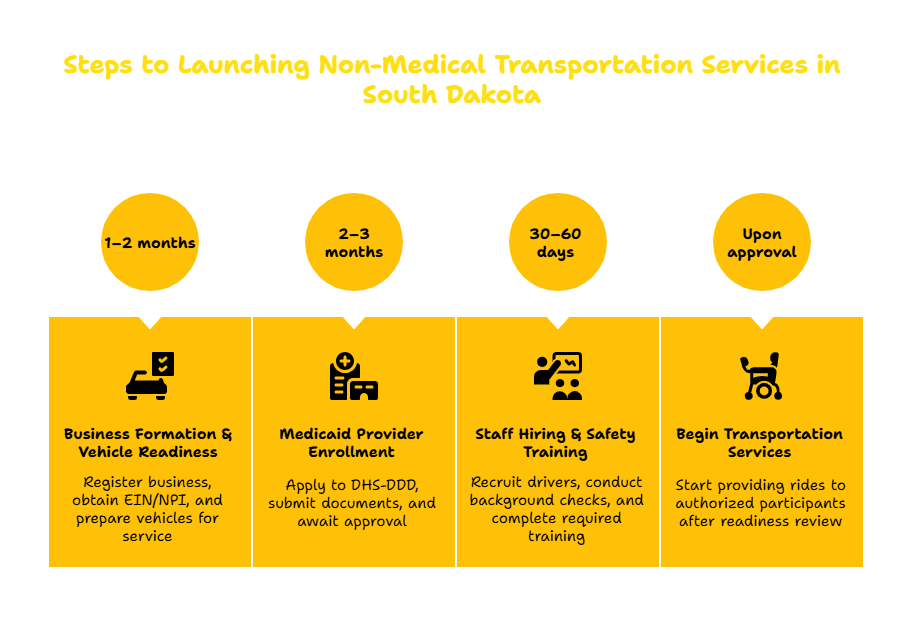
The process generally takes several months. It involves 1–2 months for business formation and vehicle readiness, 2–3 months for Medicaid provider enrollment, and 30–60 days for staff hiring and specialized training. Service initiation begins only after all approvals are secured and the first participant referrals are processed.
Key Takeaway: Success as a South Dakota Non-Medical Transportation provider requires a disciplined approach to administrative compliance, rigorous staff training, and a deep commitment to the safety of waiver participants. By maintaining accurate documentation and following the established protocols set forth by the DHS-DDD, providers can effectively support the community inclusion and independence of individuals with disabilities across the state.
Last verified: October 2023. Disclaimer: This information is for educational purposes and does not constitute legal or professional advice. Always consult directly with the South Dakota Department of Human Services (DHS) and current federal CMS guidelines for the most accurate and up-to-date requirements regarding Medicaid waiver programs.