New Hampshire DD Providers: The Enrollment Path, Step by Step
By Fatumata Kaba · 2026-08-08 · 5 min read
Entering the New Hampshire developmental disabilities services market requires a precise, sequential approach to regulatory compliance and state registration. By aligning your organizational development with the specific requirements of the Bureau of Developmental Services (BDS) and the Medicaid Management Information System (MMIS), providers can significantly reduce the administrative delays that often impede new agency launches.
Understanding the New Hampshire Service Landscape
Developmental services in New Hampshire are governed by the Department of Health and Human Services (DHHS), specifically through the Bureau of Developmental Services. The state utilizes a unique service delivery model where the oversight of care is centralized at the state level, but the coordination and referral pathways are decentralized through regional Area Agencies. Whether you intend to provide residential supports, in-home services, or community participation, the foundational "on-ramp" remains consistent for all entities.
The most successful providers are those who treat compliance as a prerequisite rather than a parallel track. Agencies that attempt to solicit business before obtaining their Medicaid ID and completing the He-M 504 screening typically face significant friction. Before starting any application, ensure your internal documentation—including staff training modules, fiscal integrity reports, and incident management policies—is fully matured and aligned with state statutes.
The Mandatory Medicaid Enrollment Process
Every provider operating within the Developmental Disabilities, In-Home Supports, or Acquired Brain Disorder waivers must be a formally enrolled New Hampshire Medicaid provider. This requirement applies regardless of whether your agency bills the state directly or operates through a sub-contracting arrangement. Medicaid enrollment acts as your primary credentialing step within the state’s health system.
Enrollment is facilitated through the state's MMIS Health Enterprise Portal. You must ensure that your business entity is formally registered with the New Hampshire Secretary of State before initiating the portal application, as the MMIS will verify your business status. Upon successful processing, the state assigns your agency a unique NH Medicaid ID, which serves as the permanent identifier for all future claims, reporting, and inter-agency communications.
Essential steps for enrollment include:
- Obtaining a Federal Employer Identification Number (EIN).
- Registering the business entity with the NH Secretary of State.
- Establishing an account on the MMIS Health Enterprise Portal.
- Verifying that all clinical and administrative staff meet state-level provider qualifications.
Mastering the BDS Screening Under He-M 504
The core of your operational legitimacy in New Hampshire is the Bureau of Developmental Services screening process, governed by the rules outlined in He-M 504, which covers provider and provider agency operations. This review is rigorous and ensures that new entrants to the system maintain the quality and safety standards required for vulnerable populations. The screening evaluates your internal governance, operational capacity, and regulatory adherence.
During the He-M 504 screening, the BDS will request evidence of your organization’s readiness. This includes proof of comprehensive staff training practices and documented service-specific competencies. Furthermore, your agency must present three professional references that can attest to your ability to manage service delivery. Financial integrity is also under scrutiny, as the state requires indicators of fiscal health to ensure that your agency can sustain operations without interruption to client care.
Your policy library should demonstrate specific compliance with:
- Liability protections and comprehensive insurance coverage.
- Strict adherence to restraint and seclusion policies as mandated by state law.
- Procedures for background checks, abuse registry screenings, and OIG exclusion list monitoring.
- Comprehensive attestations for all personnel involved in service delivery.
Meeting the Federal Settings Rule
Beyond state-specific rules, federal requirements play a major role in the approval process for community-based settings. A federal Settings Rule self-assessment must be submitted to the BDS as part of your application package. This assessment confirms that your proposed service environment supports full integration into the greater community, allows for individual choice, and protects the rights of participants.
The self-assessment requires an honest appraisal of how your physical location and service culture enable individuals to access the community. If you are launching a residential program, ensure that your facility meets the criteria for home and community-based settings, including privacy, control over schedules, and access to visitors. Failure to align with these federal standards can result in a denial of the setting, regardless of your agency's fiscal or clinical qualifications.
Building Relationships with Area Agencies
New Hampshire’s delivery system is built upon the critical bridge provided by regional Area Agencies. While the Bureau of Developmental Services manages the regulatory and compliance side of your operations, the Area Agencies act as the point of entry for the individuals and families seeking services. Establishing a professional presence within your target region is essential to the sustainability of your agency.
Once you have secured your Medicaid enrollment and passed your He-M 504 screening, you should begin the process of informing the local Area Agencies of your scope of services. These agencies manage the intake, service planning, and referral processes for the populations they serve. Developing a relationship with their regional directors and service coordinators ensures that when a need arises that matches your agency’s capabilities, your name is known and vetted as a reliable resource.
Frequently Asked Questions
What is the sequence of documentation required for the He-M 504 screening?
The screening requires a comprehensive collection of evidence, including fiscal integrity reports, background check attestations, staff training curricula, and proof of liability insurance. You must have all policies finalized and your organization fully registered with the Secretary of State before submission.
Do I need an MMIS ID even if I am not billing Medicaid directly?
Yes. In New Hampshire, all providers of services under the developmental disabilities, in-home supports, or acquired brain disorder waivers must be enrolled as Medicaid providers in the MMIS system, regardless of whether they perform the billing function themselves.
How does the Area Agency influence my agency's success?
Area Agencies act as the primary referral source. While they do not oversee the regulatory compliance process, they are responsible for coordinating care for individuals in their region. Having a strong, compliant profile allows you to effectively communicate your service offerings to these agencies, which is necessary for long-term referral volume.
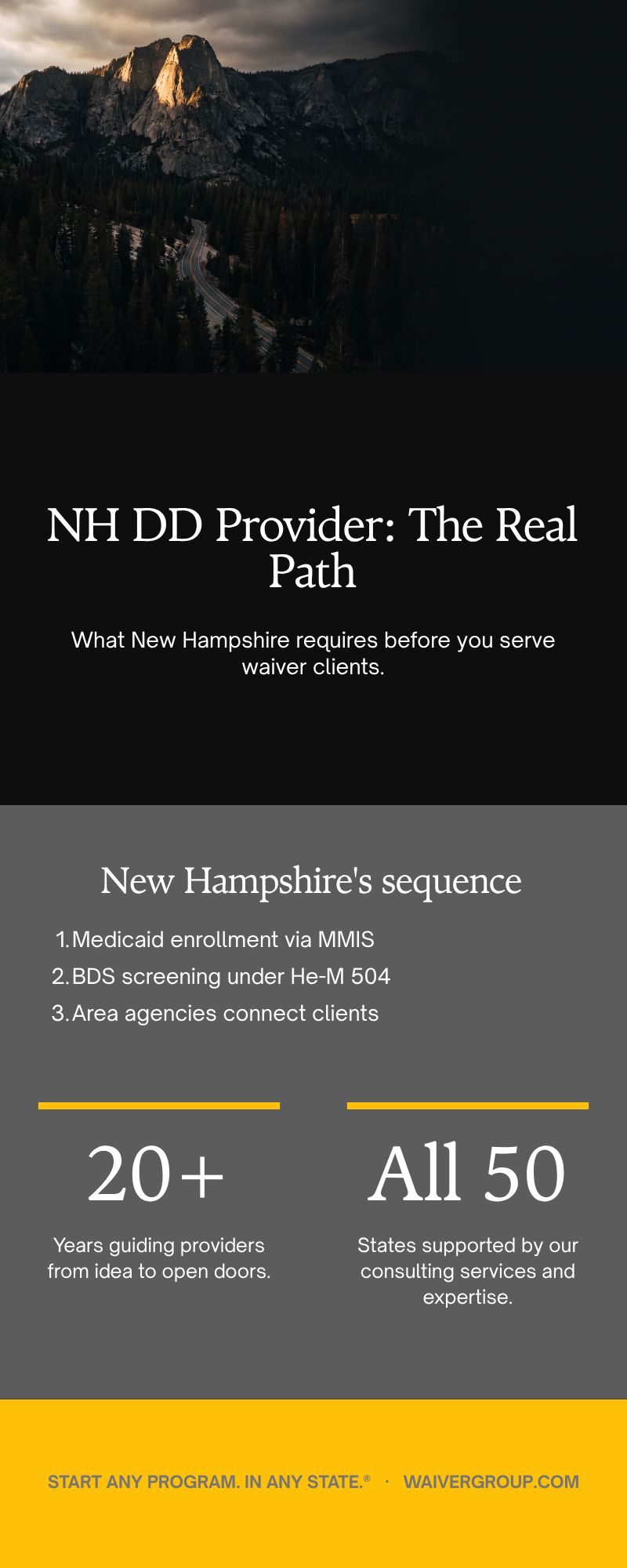
Key takeaway: Treat New Hampshire as a sequence — MMIS enrollment, Secretary of State registration, the He-M 504 screening, then area agency relationships — and build your policies, references, and financials before you apply.
Last verified August 8, 2026. General information about New Hampshire requirements, not legal or regulatory advice — confirm current rules with the New Hampshire Department of Health and Human Services, Bureau of Developmental Services.