Nevada Medicaid and PERS: How to Get Approved to Bill
By Fatumata Kaba · 2026-07-07 · 5 min read
To become a Nevada Medicaid-approved provider for Personal Emergency Response Systems (PERS), an agency must first secure active enrollment through the Nevada Division of Health Care Financing and Policy (DHCFP) and establish a compliant billing infrastructure. Because Nevada does not allow retroactive billing for PERS, providers must ensure their enrollment and service authorization protocols are finalized before any equipment is delivered or installed for a Medicaid consumer.
Understanding the Nevada PERS Regulatory Landscape
In Nevada, PERS is classified as a critical component of Home and Community-Based Services (HCBS) designed to support independent living for elderly and disabled populations. For an agency to participate, it must operate within the strict regulatory framework defined by the state’s Medicaid program. PERS is generally categorized as a supplemental service that requires the member to have an identified need for emergency access to assistance due to a chronic medical condition or high risk of falls.
Provider agencies are responsible for understanding that PERS coverage is contingent upon the member’s specific waiver requirements. Because these programs operate under federal guidelines managed at the state level, the administrative burden rests on the provider to ensure that the services being rendered remain medically necessary and aligned with the consumer’s current Plan of Care (POC). Engaging with the state’s fiscal agent portal early in the process is essential to ensure that your agency’s taxonomy codes correctly reflect your capacity to provide PERS.
Navigating the Nevada Medicaid Enrollment Process
The first and most critical step for any agency is obtaining provider status through the Nevada Division of Health Care Financing and Policy. Enrollment is the foundational gatekeeper; without an active provider ID linked to the appropriate specialty for PERS, no claims will be processed or reimbursed. Providers may choose to either add the PERS service specialty to an existing Medicaid-enrolled entity or create a separate, dedicated legal entity if the business structure requires it.
The enrollment process requires thorough documentation, including proof of licensure (if applicable), business permits, and adherence to state-mandated background check requirements for personnel. Applicants should utilize the official Nevada Medicaid Management Information System (MMIS) provider portal to submit their application. It is highly recommended that administrators double-check that the "PERS" specialty code is accurately selected during this application phase, as inaccuracies here are the leading cause of initial billing rejections.
Compliance Standards for PERS Billing
Billing accuracy is non-negotiable in the Nevada Medicaid environment. Providers must utilize the standard HCPCS codes assigned to PERS to ensure successful claims adjudication. Installation of the unit is billed using code S5160, while the ongoing monthly monitoring and maintenance service is billed using code S5161. These codes must be submitted through the electronic claims submission portal in accordance with the state’s specified billing cycle.
Beyond the technical submission, providers must ensure their internal billing department maintains a strict audit trail. Every claim must correspond to a verifiable service date and a documented, authorized Plan of Care. Because Nevada Medicaid periodically updates its billing manual, administrators should review the latest bulletins provided by the fiscal agent to ensure that modifiers or authorization requirements have not shifted. Keeping a organized, audit-ready file for every consumer is the best defense against post-payment reviews.
Documenting Medical Necessity
Medicaid will only reimburse for PERS if the documentation clearly proves the service is essential to the member’s safety and ability to reside in the community. As a provider, you must ensure that your files contain more than just a billing record; they must contain evidence of medical necessity. This documentation should be captured during the intake process and updated whenever the member's clinical status changes.
- Copies of the physician’s order or the waiver Case Manager’s authorization indicating the need for PERS.
- Proof of delivery, which includes the date the unit was installed and the signature of the member or their representative acknowledging receipt and training.
- Periodic logs showing that the unit was tested and found to be in working order during the billing period.
- Documentation regarding the member’s chronic condition that necessitates the use of an emergency signaling device.
Operational Protocols and Quality Assurance
Running a successful PERS operation requires more than just installing devices; it requires a robust quality assurance program. Providers are expected to maintain the functionality of the PERS units 24 hours a day, 7 days a week. If a device fails, the provider is responsible for prompt repair or replacement, as a non-functioning unit is not a billable service. Maintaining consistent communication with the member’s Case Manager is vital to ensuring that the equipment remains appropriate for the member's evolving needs.
Furthermore, Nevada Medicaid requires that providers conduct staff training to ensure those delivering and installing equipment understand the nuances of the PERS program. Staff should be prepared to perform an initial orientation with the member to ensure they understand how to use the equipment properly. Ensuring your team follows these standardized protocols minimizes the risk of service denials and protects your agency’s reputation with the state oversight agencies.
Frequently Asked Questions
Can I bill for PERS services before my enrollment is finalized?
No. Nevada Medicaid does not allow for retroactive billing. An agency must be fully enrolled and have an active provider ID for the PERS specialty before any services are rendered or billed. Delivering equipment before enrollment is confirmed will result in a loss of potential revenue for those dates of service.
Are there specific equipment requirements for PERS providers?
Providers must ensure the equipment meets state standards for reliability and ease of use. While the state may not mandate a specific brand, all equipment must be capable of providing 24/7 monitoring and be reliable enough to meet the medical necessity requirements documented in the member’s Plan of Care.
How often should I verify the Plan of Care for my PERS consumers?
It is recommended to verify the current authorization and Plan of Care status for each consumer at least once per quarter or whenever you receive notification of a change from the Case Manager. Ensuring that the authorization is active before submitting monthly billing for code S5161 is critical to avoiding claim denials.
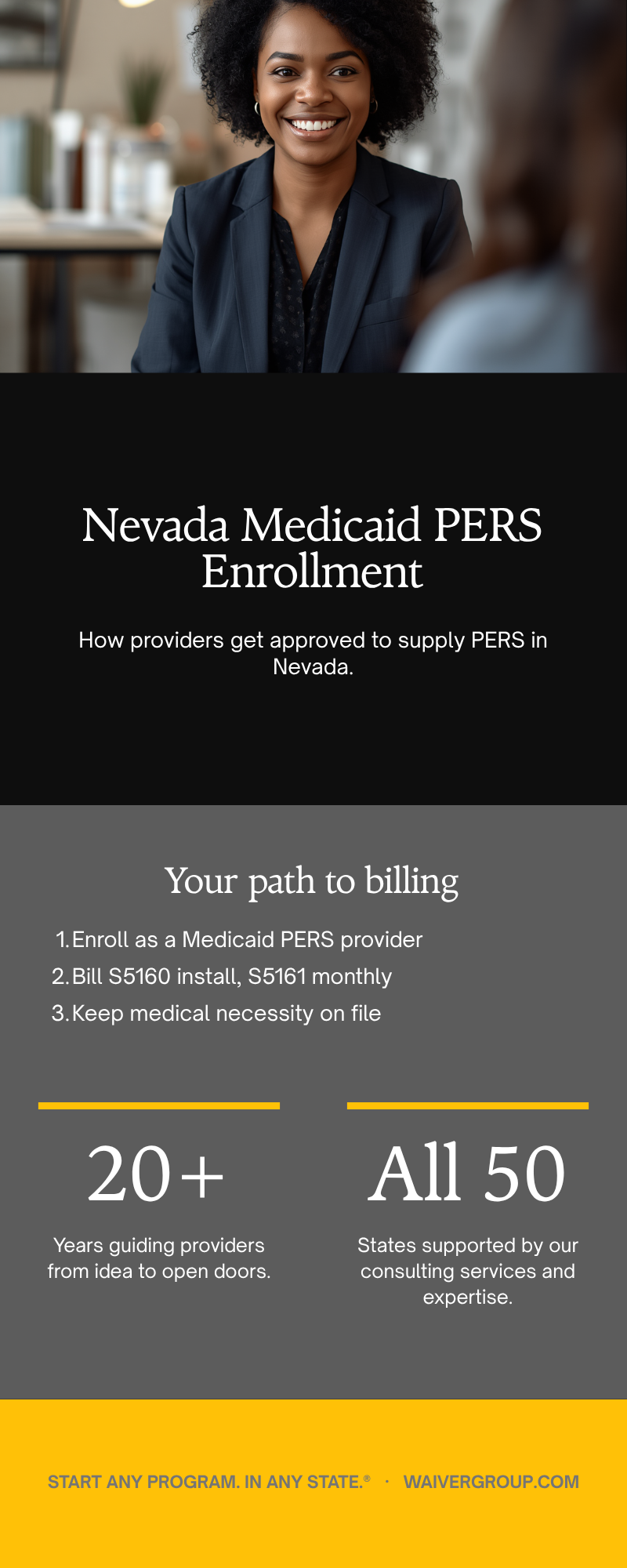
Key takeaway: Enroll with Nevada Medicaid first, bill S5160 to install and S5161 monthly, and keep medical necessity documented.
Last verified: 2024. The information provided herein is for general educational purposes only and does not constitute formal legal or regulatory advice. State Medicaid rules and waiver program requirements are subject to change. Providers are responsible for consulting the official Nevada Division of Health Care Financing and Policy (DHCFP) manuals and corresponding state regulations to ensure full compliance with current program requirements.