MEDICAL EQUIPMENT AND SUPPLY SERVICES PROVIDER IN MISSISSIPPI
By Fatumata Kaba · 2025-08-06 · 6 min read
Ensuring Access to Essential Medical Equipment and Supplies for Individuals with Disabilities or Chronic Conditions
Medical Equipment and Supply Services in Mississippi serve as a cornerstone of the state’s Home and Community-Based Services (HCBS) ecosystem, providing the durable medical equipment (DME) and essential supplies required to support health management and independent living. By facilitating access to critical items—ranging from mobility aids to specialized health supplies—these services empower individuals with disabilities or chronic conditions to remain safely in their own homes rather than in institutional settings.
Providers operating in this sector must navigate a rigorous regulatory environment governed by state and federal mandates. This includes adhering to strict clinical standards, ensuring proper equipment maintenance, and maintaining ongoing compliance with both the Mississippi Division of Medicaid (DOM) and the Mississippi Department of Health (MDH). Successfully launching and managing such a service requires a deep understanding of the intersection between healthcare delivery, medical inventory management, and Medicaid reimbursement policy.
Governing Agencies and Regulatory Framework
The provision of medical equipment and supplies in Mississippi is subject to oversight by three primary tiers of government. Each agency plays a specific role in ensuring that patients receive high-quality, safe, and appropriate equipment, while also ensuring that taxpayer funds are utilized in accordance with state and federal regulations.
The Mississippi Department of Health (MDH) functions as the primary regulatory body for licensure, ensuring that DME providers meet state health and safety standards. Concurrently, the Mississippi Division of Medicaid (DOM) serves as the funding and administrative authority for the various HCBS Waiver programs. Finally, the Centers for Medicare & Medicaid Services (CMS) provides the overarching federal framework, setting the standards for program compliance and quality assurance that all Mississippi waiver programs must satisfy.
- Mississippi Department of Health (MDH): Regulates DME providers and ensures operational compliance with state health regulations.
- Mississippi Division of Medicaid (DOM): Administers Medicaid and HCBS Waiver programs, including the financial authorization and funding for medical equipment and supplies.
- Centers for Medicare & Medicaid Services (CMS): Provides federal oversight and ensures consistent waiver compliance across state programs.
Understanding Medical Equipment and Supply Service Delivery
Medical Equipment and Supply Services are defined by the specific needs outlined in an individual’s Individual Service Plan (ISP) or Person-Centered Plan (PCP). These services are not merely transactional; they are clinical support functions designed to facilitate daily living and improve health outcomes. Providers are responsible for the entire lifecycle of the equipment, from procurement and delivery to training and ongoing maintenance.
Services often include the provision of durable medical equipment (DME) such as wheelchairs, hospital beds, and walkers, as well as the delivery of recurring disposable medical supplies like incontinence products and essential wound care items. A critical component of these services is the requirement to provide training on the safe use of the equipment, ensuring that both the recipient and their caregivers can operate the items correctly to prevent injury and maximize therapeutic benefit.
- Provision of durable medical equipment (DME) such as wheelchairs, hospital beds, and walkers.
- Delivery of disposable medical supplies like incontinence products and wound care items.
- Regular equipment maintenance and repair services to ensure continued functionality.
- Training for clients and caregivers on safe equipment use and injury prevention.
- Ongoing coordination with healthcare providers to manage prescriptions and required clinical documentation.
Licensing and Medicaid Provider Enrollment Requirements
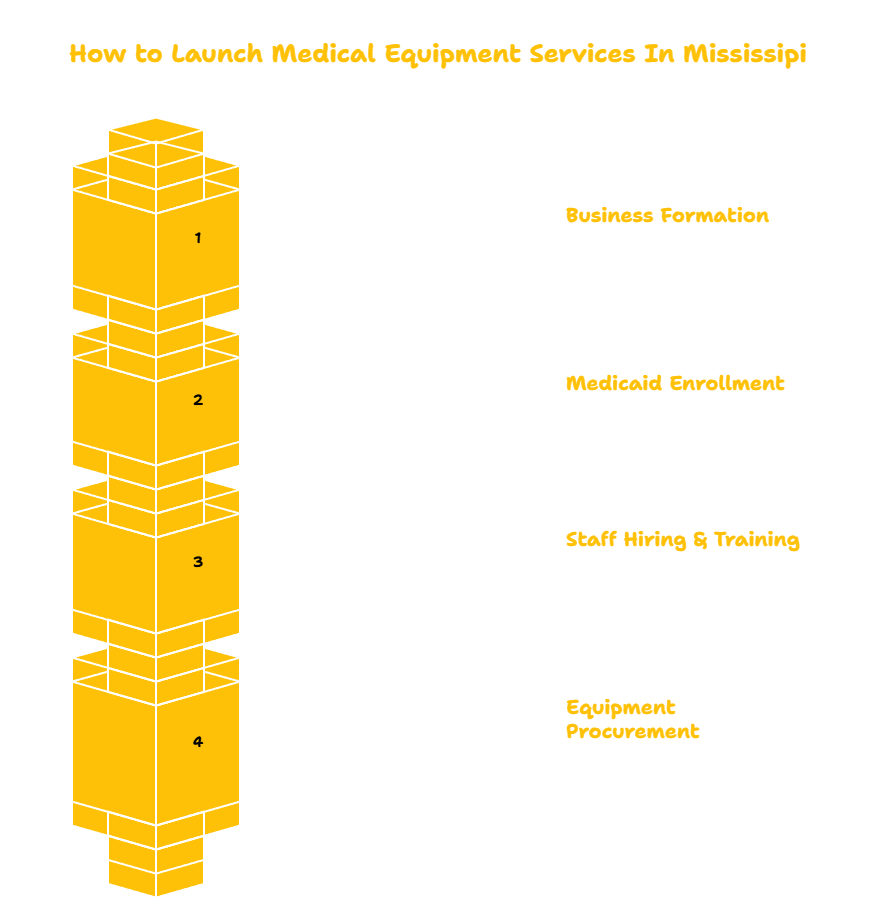
Entering the Mississippi market as a DME provider requires a disciplined approach to documentation and regulatory adherence. Before service delivery can commence, an entity must satisfy both business registration requirements and specific healthcare provider enrollment criteria. This involves a sequenced process of obtaining legal status, securing appropriate tax and provider identifiers, and passing state licensure reviews.
The enrollment journey begins with registering the business with the Mississippi Secretary of State and obtaining an Employer Identification Number (EIN) from the IRS. Once established, the provider must secure a National Provider Identifier (NPI) and complete the formal application process through the Mississippi Division of Medicaid. Furthermore, obtaining a formal DME Supplier License from the MDH is non-negotiable, as is maintaining comprehensive liability insurance and detailed staff training logs to meet state audit requirements.
- Register the business with the Mississippi Secretary of State.
- Obtain an EIN from the IRS and a Type 2 NPI.
- Obtain a DME Supplier License from the Mississippi Department of Health.
- Enroll as an official Medicaid provider with the Mississippi Division of Medicaid.
- Maintain valid professional and general liability insurance.
Required Infrastructure: Documentation and Staffing
Operational success in the DME sector relies heavily on the quality of a provider’s policy and procedure manual. This document serves as the internal blueprint for operations, detailing how the company manages product procurement, maintains inventory, handles equipment safety protocols, and ensures that all client education is properly documented. Regulatory bodies will review these materials during site visits to verify that the provider maintains a compliant, evidence-based operation.
Staffing also plays a pivotal role in maintaining service quality. The DME Program Manager must possess sufficient experience in healthcare administration or medical equipment management to oversee the operational requirements of the program. Likewise, technicians and delivery specialists must be properly vetted—requiring background checks and TB clearance—and must be adequately trained in equipment assembly, infection control, and professional client interaction.
- Policy & Procedure Manual: Must cover procurement, maintenance, safety, and delivery protocols.
- DME Program Manager: Required to have documented experience in healthcare or equipment management.
- Technician/Delivery Staff: Must complete training in assembly, maintenance, and safe handling.
- Documentation Logs: Strict maintenance of client records, prescriptions, and service history is mandatory.
Leveraging HCBS Waivers for Service Provision
Medical Equipment and Supply Services are delivered under the authority of specific Medicaid HCBS Waivers, which are designed to support individuals in remaining in their homes. Providers authorized under these programs serve diverse populations, including the elderly, individuals with physical disabilities, and those recovering from traumatic brain or spinal cord injuries. Each waiver has unique nuances regarding the scope of equipment covered, making it essential for providers to stay updated on current program manuals.
Providers approved for these waivers facilitate essential independence, providing not only the hardware but also the maintenance and user training necessary for long-term usage. By aligning service delivery with the requirements of the 1915(c) waivers, agencies play a vital role in the long-term support systems of the state, ensuring that the necessary equipment is provided in a timely and compliant manner.
Frequently Asked Questions
How long does the Medicaid provider enrollment process typically take?
The Medicaid provider enrollment process generally takes between 60 to 90 days. This timeline is contingent upon the accuracy of the application submitted and the speed at which supporting documentation, such as the DME Supplier License and background checks, are processed.
What are the primary responsibilities of a DME provider regarding equipment safety?
Providers are responsible for ensuring that all equipment is in good working order, properly assembled, and safe for the user. This includes conducting periodic maintenance, performing safety assessments upon delivery, and providing comprehensive education to the client or caregiver regarding the proper usage and handling of the equipment.
Are providers required to maintain documentation for staff training?
Yes, maintaining documentation of staff training is a critical requirement. Providers must keep records showing that all personnel have received adequate training in equipment assembly, maintenance, infection control, and client interaction to ensure that the agency meets state-mandated quality and safety standards.
Key Takeaway
Establishing a Medical Equipment and Supply Service in Mississippi requires a commitment to rigorous compliance with Mississippi Division of Medicaid and Department of Health standards. By systematically addressing business registration, licensure, staff training, and the documentation of equipment lifecycle management, providers can successfully integrate into the state's HCBS framework to support individuals in need.
Waiver Consulting Group provides comprehensive start-up assistance for agencies and entrepreneurs looking to launch and scale these essential services across Mississippi. From policy and procedure manual development and Medicaid provider enrollment to staff credentialing and client intake system setup, our resources are designed to ensure your agency operates in full compliance with state waiver requirements. Visit our client portal to explore the extensive resources available to support your operational goals.
Last verified: October 2023. This information is for educational purposes only and does not constitute legal or professional medical advice. Always consult with the Mississippi Division of Medicaid or legal counsel regarding current state regulations and provider requirements.