Medicaid Waiver vs. Assisted Living: How and When You Get Paid
By Fatumata Kaba · 2026-06-19 · 5 min read
The distinction between obtaining licensure and achieving the status of a reimbursable provider is the most critical hurdle for new healthcare agency founders. While licensure grants the legal authority to operate, the mechanism for receiving payment—whether through state-administered Medicaid waiver programs or private-pay assisted living contracts—dictates the actual timing and reliability of your agency’s revenue cycle.
For entrepreneurs evaluating the operational differences between home and community-based services (HCBS) and residential assisted living, understanding these cash flow variables is essential for solvency. The gap between your license date and your first remittance is rarely zero, and mapping this timeline is the primary predictor of an agency’s ability to survive its first twelve months of operation.
How Does Medicaid Waiver Billing Differ from Private-Pay Assisted Living?
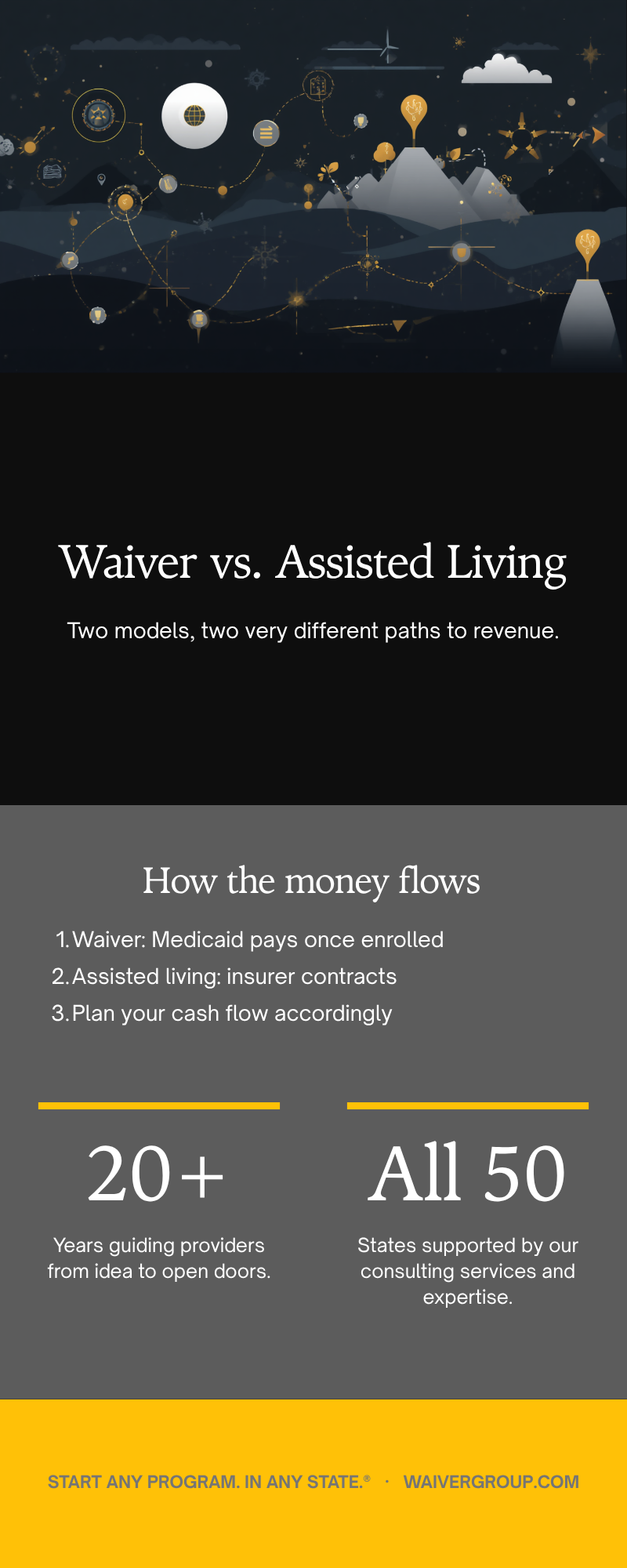
Medicaid waiver services operate under state-defined fee schedules and specific billing portals managed by the state's Department of Health or Human Services. Once an agency is licensed and enrolled as a qualified Medicaid provider, billing processes are standardized. Provided that services are rendered to an eligible participant and correctly documented according to state mandates, payment follows a set administrative cycle established by the state agency.
Conversely, assisted living revenue models are frequently fragmented and highly dependent on individual insurer negotiations. Unlike the centralized nature of Medicaid waivers, assisted living facilities must often navigate complex credentialing processes with managed care organizations (MCOs), private insurance companies, and individual long-term care insurers. This process involves proving your facility's adherence to private network standards, which can delay the start of your revenue stream significantly beyond your initial facility licensing date.
The Direct Path: Revenue Cycles in Medicaid Waiver Programs
Medicaid waiver programs offer a more predictable, albeit highly regulated, path to revenue. Because these programs are funded by the Centers for Medicare & Medicaid Services (CMS) and administered by the states, the requirements for billing are uniform for all enrolled providers within that specific waiver category. Once you have navigated the provider enrollment application and cleared the background and site verification processes, you are typically eligible to begin billing for services rendered to participants authorized under your specific waiver program.
The core of this model is the "authorized service" workflow. You do not need to negotiate a contract with a private network to treat a patient; rather, you work within the state's established HCBS fee-for-service framework. This reduces the time spent on administrative negotiations, allowing providers to focus on service delivery and compliant documentation, which are the primary triggers for claims processing.
The Multi-Layered Path: Revenue Cycles in Assisted Living
Entering the assisted living sector requires a different strategic approach to revenue. While licensing allows you to open your doors, it does not guarantee that insurers will provide the residents or the reimbursement rates you anticipate. Because assisted living relies heavily on private-pay arrangements and third-party insurer contracts, the agency must often conduct significant business development before the first resident even arrives.
Even if an assisted living facility is prepared to accept residents, delays in contract finalization can create a "dry spell." Founders must account for the following complexities when projecting their initial revenue timeline:
- Negotiating per-diem rates with individual insurance providers or MCOs.
- Meeting proprietary quality metrics required by private payer networks.
- Aligning billing systems with the diverse requirements of different insurance carriers.
- Maintaining a marketing pipeline that attracts private-pay clients to bridge gaps in insurance-funded occupancy.
Planning Your Financial Runway: Why Licensing is Not the Finish Line
New providers often make the mistake of setting their budget based on the date their license arrives. This is a hazardous assumption. Licensing is merely the state's validation that you have met the minimum health and safety standards to exist. It is not an authorization to bill or a guarantee of immediate revenue. The gap between receiving your license and receiving your first payment is the "runway" your business requires to survive.
To avoid a cash flow crisis, founders must conduct a realistic assessment of their state’s current administrative processing times. This includes the time required to link your facility to the state billing portal, obtain your NPI (National Provider Identifier), and—in the case of assisted living—complete the credentialing process with major regional payers. Building a six-month reserve is a common industry recommendation to ensure that unexpected administrative delays do not force a premature closure.
Managing Administrative Friction in the First Year
Regardless of whether you choose Medicaid waivers or assisted living, administrative friction is inevitable. For waiver agencies, the primary source of friction is the documentation process; if your clinical notes do not perfectly align with the specific procedural codes billed, the state will deny the claim. This requires a robust internal audit system to verify that every hour of service is documented according to the exact definitions set forth in the state’s provider manual.
For assisted living facilities, the friction is primarily contractual and communication-based. You will frequently find yourself managing inquiries from multiple stakeholders—including case managers, family members, and insurance adjusters. Managing these relationships is not just a customer service function; it is a revenue-protection function, as efficient communication directly correlates to how quickly authorization for services is granted and how promptly claims are settled.
Frequently Asked Questions
Is the Medicaid provider enrollment process the same in every state?
No. While Medicaid is a federal-state partnership, provider enrollment is handled at the state level. Each state manages its own Medicaid Management Information System (MMIS) and has its own specific requirements for HCBS waiver provider enrollment, training, and site compliance.
Can I begin billing for assisted living services the day I receive my license?
Generally, no. Licensure allows you to operate the facility, but you must still secure contracts with insurance companies or establish private-pay agreements before you can receive revenue for resident care. These negotiations are separate from the state licensing process.
What is the most common reason for payment delays in waiver programs?
The most frequent cause of delay is a mismatch between the documentation provided and the service definition authorized in the waiver plan. Even minor discrepancies in billing codes or service dates can trigger an automated rejection in the state's claims processing system, requiring time-consuming manual corrections.
Key Takeaway
Your license date and your first-payment date are rarely the same. Plan for the distance between them. Start Any Program. In Any State.® Not sure how the numbers line up for your model? Book a video consultation at waivergroup.com/videoappointment, call 302.888.9172, or email [email protected].
Last verified: October 2023. Disclaimer: This information is for educational purposes only and does not constitute legal or financial advice. Regulations for Medicaid and assisted living vary by state and are subject to change. Always consult with state agency officials or professional legal counsel regarding specific licensing and reimbursement requirements in your jurisdiction.