MEAL & NUTRITION SERVICES PROVIDER IN VIRGINIA
By Fatumata Kaba · 2026-04-07 · 5 min read
Meal and nutrition services in Virginia serve as a critical component of the Home and Community-Based Services (HCBS) ecosystem, providing essential dietary support to individuals with disabilities, chronic illnesses, or functional limitations. By facilitating access to nutritious, medically appropriate meals, these provider agencies empower participants to maintain their health and live independently within their own homes and communities rather than in institutional settings.
Operating these services within the Virginia Medicaid framework requires strict adherence to standards set by the Department of Medical Assistance Services (DMAS) and coordination with Community Services Boards (CSBs) and Managed Care Organizations (MCOs). Providers must balance food safety regulatory requirements with clinical documentation standards to ensure that every delivered meal or nutrition-based intervention aligns with the participant's specific Individual Support Plan (ISP).
How Does the Virginia Medicaid Framework Regulate Nutrition Services?
The provision of meal and nutrition services is governed by a multi-layered regulatory structure designed to protect vulnerable populations. DMAS serves as the primary authority, overseeing Medicaid reimbursement protocols and establishing the baseline provider standards that ensure quality and safety. Compliance is not merely an operational choice but a prerequisite for maintaining eligibility to bill for services under the state's various waiver programs.
For participants enrolled in the Community Living (CL) and Family and Individual Supports (FIS) Waivers, the authorization process is facilitated by Community Services Boards (CSBs). These local entities assess the participant's needs and integrate nutrition support directly into the ISP. Conversely, for individuals served through the Commonwealth Coordinated Care Plus (CCC Plus) Waiver, the oversight, referral, and claim management processes are handled by the member's assigned MCO. Understanding the distinction between these pathways is essential for providers to ensure they are submitting claims to the correct entities.
- DMAS: Establishes statewide Medicaid reimbursement policies and provider enrollment requirements.
- CSBs: Coordinate and authorize nutrition services for CL and FIS waiver participants through the ISP.
- MCOs: Manage authorization and claims processing specifically for CCC Plus waiver members.
What Are the Core Service Delivery Standards for Nutrition Providers?
Meal and nutrition supports encompass a variety of interventions, ranging from the physical delivery of meals to the provision of complex dietary education. Providers must be capable of delivering frozen, fresh, or shelf-stable meals that meet the specific nutritional requirements of the individual. Often, these services are bundled with broader assistance related to activities of daily living (ADLs) or instrumental activities of daily living (IADLs), such as grocery shopping or meal planning assistance.
Beyond the delivery of physical food, providers may be tasked with supporting special diets—including low-sodium, diabetic-friendly, or texture-modified meals—that are medically necessary. The service model often requires a high degree of collaboration with dietitians or nutritionists to ensure that the nutrition provided remains consistent with the participant’s evolving health profile. Success in this sector hinges on the ability to translate clinical nutritional needs into reliable, consistent home-delivered solutions.
What Steps Are Required to Establish a Medicaid-Eligible Nutrition Business?
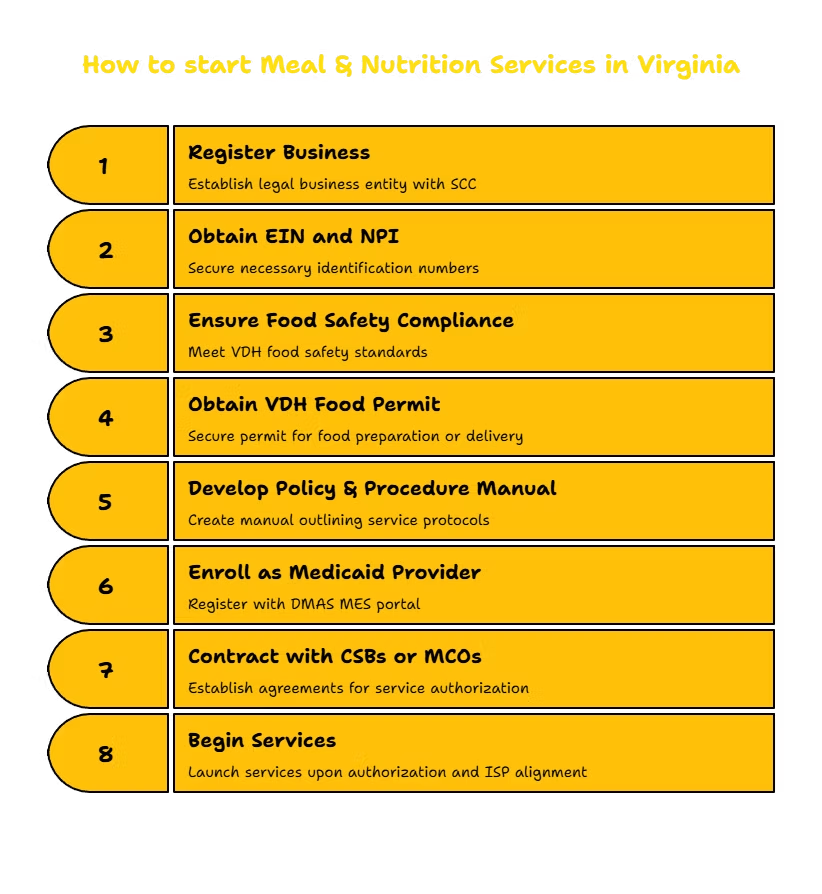
The path to becoming a recognized Medicaid provider begins with rigorous business formation and regulatory licensing. Before approaching state agencies, a founder must register their business with the Virginia State Corporation Commission (SCC) and secure an Employer Identification Number (EIN) along with a Type 2 National Provider Identifier (NPI). These are the foundational legal and administrative requirements for any health-related entity operating in the Commonwealth.
Furthermore, because the service involves food, providers must operate in strict alignment with the Virginia Department of Health (VDH) food safety regulations. If an agency intends to prepare or directly deliver meals, obtaining a VDH Food Establishment Permit is a non-negotiable step. Once the physical and legal infrastructure is in place, the agency must draft a comprehensive Policy & Procedure Manual that serves as the blueprint for daily operations, infection control, and client grievance handling.
- Register the business entity with the Virginia SCC.
- Obtain a Type 2 NPI and valid EIN for billing purposes.
- Secure a VDH Food Establishment Permit to demonstrate compliance with state food safety standards.
- Enroll as an official Medicaid provider through the DMAS Medicaid Enterprise System (MES) portal.
How Do Providers Manage Staffing and Documentation Protocols?
Staffing a nutrition service agency requires a mix of logistics-focused personnel and healthcare-aware staff. Drivers and nutrition assistants are the face of the organization, and they must undergo thorough background checks, possess a valid driver’s license, and maintain up-to-date food handler safety certifications. Their primary role is to ensure the integrity of the food during transport and to document all deliveries accurately within the client’s records.
For more specialized care, agencies may incorporate Registered Dietitians (RDs) to perform assessments and assist in the development of care plans. Regardless of the role, all staff must undergo mandatory training in HIPAA compliance, client confidentiality, universal precautions, and incident reporting. The documentation standards are stringent; agencies must maintain records that detail meal preferences, delivery times, and evidence that the services provided continue to support the goals outlined in the participant's ISP.
Frequently Asked Questions
How do providers get paid for meal services under Medicaid?
Payment is processed through the DMAS MES portal for authorized services. Providers must submit accurate claims that align with the service units approved in the member's ISP, whether the authorization comes through a CSB or an MCO.
Are there specific dietary requirements I must follow?
Yes, all meals must adhere to the nutritional standards defined in the participant's person-centered plan. This includes any medically necessary modifications, such as texture-modified diets or specific nutrient restrictions, as requested by the participant’s care team.
What is the typical timeframe for launching a provider agency?
The timeline varies based on operational readiness, but generally, business setup takes 2–4 weeks, followed by 1–2 months for Medicaid enrollment and contracting. Final preparations for staffing and documentation usually take an additional 2–3 weeks before service delivery can officially commence.
Key Takeaway
Success as a Virginia Medicaid meal and nutrition provider requires a strategic approach that bridges the gap between culinary food safety standards and stringent healthcare documentation requirements. By maintaining clear protocols for DMAS enrollment, securing necessary VDH permits, and ensuring that all services remain strictly mapped to the participant's ISP, providers can build a sustainable and compliant agency that significantly enhances the health and independence of the communities they serve.
Last verified: 2024. This article is for informational purposes and does not constitute legal or professional Medicaid billing advice. Consult the official Virginia Department of Medical Assistance Services (DMAS) website at https://www.dmas.virginia.gov for the most current regulatory guidance and policy updates.