MEAL & NUTRITION SERVICES PROVIDER IN VERMONT
By Fatumata Kaba · 2026-04-09 · 6 min read
DELIVERING NUTRITIOUS MEALS AND DIETARY SUPPORT TO PROMOTE HEALTH, WELLNESS, AND INDEPENDENCE FOR MEDICAID WAIVER PARTICIPANTS
Meal & Nutrition Services in Vermont are critical support mechanisms designed for individuals who cannot independently manage their nutritional needs due to age, disability, or chronic medical conditions. By providing essential dietary assistance, these services empower participants to remain in their own homes and communities, effectively reducing the risk of malnutrition, unnecessary hospitalizations, and premature transition into institutionalized care settings.
Administered under Vermont’s Medicaid Home and Community-Based Services (HCBS) waivers, these services are coordinated through the Department of Disabilities, Aging and Independent Living (DAIL) and delivered via local Designated Agencies (DAs) or Specialized Services Agencies (SSAs). Providers of these services play a vital role in the state's long-term care infrastructure by ensuring that every meal delivered or prepared adheres to strict nutritional guidelines and individual support requirements.
How Does the Regulatory Framework Govern Meal & Nutrition Services?
The provision of nutritional support in Vermont is subject to rigorous oversight to ensure the safety and health of vulnerable populations. The Department of Disabilities, Aging and Independent Living (DAIL) serves as the primary authority, responsible for authorizing specific services under HCBS waivers and establishing the quality standards that all providers must uphold. Compliance is monitored closely to ensure that service delivery remains consistent with the participant's established health outcomes.
Financial administration and provider enrollment fall under the jurisdiction of the Department of Vermont Health Access (DVHA). While DAIL manages the standards of care, the DVHA oversees the mechanisms for reimbursement and ensures that providers are properly enrolled within the Medicaid system. Furthermore, Designated Agencies (DAs) and Specialized Services Agencies (SSAs) act as the frontline coordinators, managing the Individual Support Plans (ISPs) that dictate the specific meal services authorized for each participant.
- DAIL: Establishes service standards and authorizes waiver-based nutrition programs.
- DVHA: Manages Medicaid provider enrollment, billing processes, and reimbursement.
- DAs/SSAs: Coordinate participant ISPs and monitor ongoing service delivery compliance.
What Components Define Approved Meal & Nutrition Services?
Meal & Nutrition Services must be customized to address the specific functional or health-related deficits identified in a participant’s ISP. These services go beyond mere delivery; they are intended to be a comprehensive support system that ensures the participant maintains adequate nutritional intake. Providers are expected to maintain professional standards that align with USDA dietary recommendations and stringent food safety protocols.
Services provided may vary based on the specific waiver program and the participant's unique medical or physical needs. Common service components include the delivery of hot, frozen, or shelf-stable meals, in-home meal preparation, assistance with grocery shopping, and individualized menu planning. In cases involving clinical needs, services may extend to basic nutrition education and, when delivered by a qualified professional, dietary assessments and tracking.
- Home-delivered meals (hot, frozen, or shelf-stable options)
- In-home meal preparation and assistance
- Dietary restriction management and menu planning
- Grocery shopping support for meal-related items
- Basic nutrition education and dietary assessment tracking
What Are the Prerequisites for Provider Approval and Licensing?
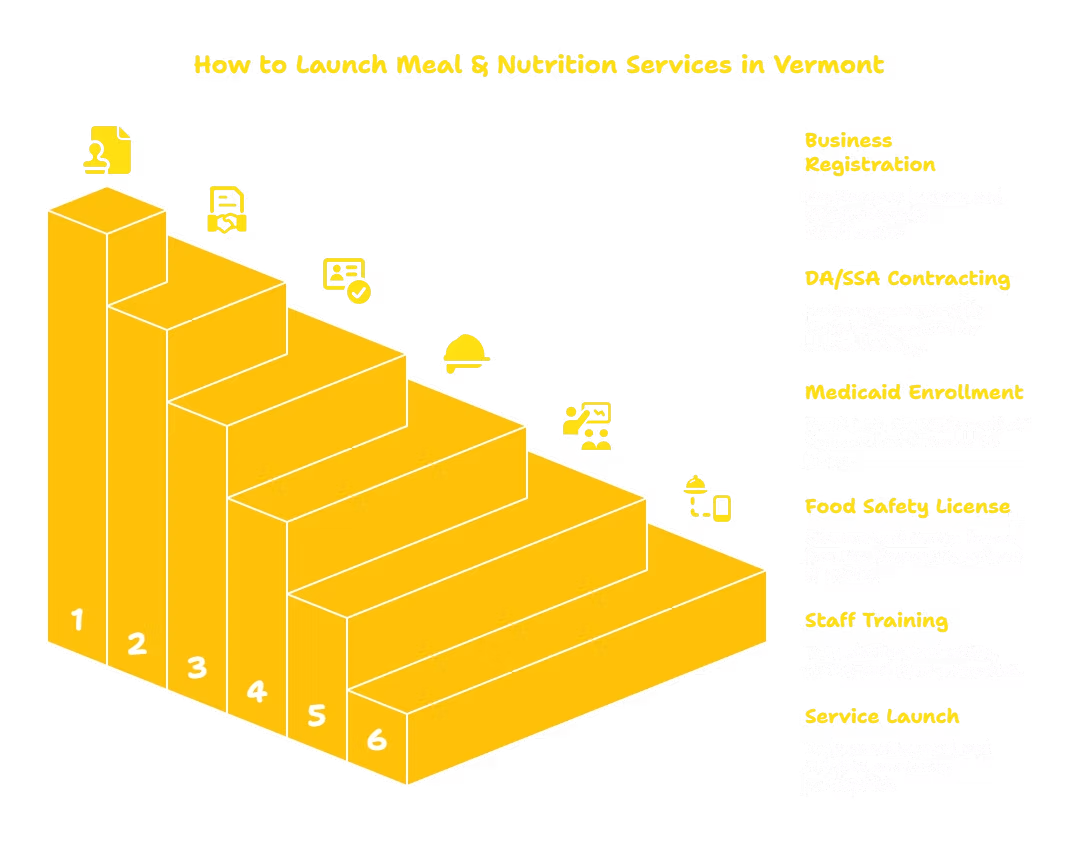
Launching a Meal & Nutrition service requires a disciplined approach to business formation and regulatory compliance. Before delivering services, an organization must formalize its legal structure by registering with the Vermont Secretary of State and obtaining a federal Employer Identification Number (EIN) and a Type 2 National Provider Identifier (NPI). These foundational steps are mandatory for any entity seeking to engage with the state’s Medicaid infrastructure.
Operational compliance is equally vital. If the business intends to prepare meals commercially, it must secure a food service license from the Vermont Department of Health. Additionally, providers must develop a comprehensive Policy & Procedure Manual. This document serves as the roadmap for operations, covering everything from food handling and sanitation to HIPAA-compliant data management and internal grievance procedures. Maintaining professional liability insurance is a non-negotiable requirement to protect both the provider and the program participants.
What Is the Sequence for Medicaid Provider Enrollment?
The enrollment process is structured to ensure that only qualified entities are authorized to bill Medicaid for services. Initially, the provider must obtain all necessary business registrations and food service licenses, if applicable. Following this, the provider must engage with a DA or SSA, as these agencies often serve as the gatekeepers for authorizing and contracting specific service providers within their service regions.
Once a contract or authorization is in place with a DA/SSA, the provider must complete the enrollment process with the DVHA to facilitate Medicaid billing. A significant portion of this stage involves submitting a robust staffing plan, proof of food safety certifications, and the finalized Policy & Procedure Manual. Once the state verifies that the provider meets all criteria, services may commence according to the schedules outlined in individual participant ISPs.
What Documentation Is Required for Ongoing Compliance?
Documentation is the backbone of any audit-ready Medicaid program. Providers must maintain meticulous records that verify service delivery and compliance with safety standards. This includes maintaining up-to-date food service licenses and inspection reports, as well as documented training logs for all staff members. The Policy & Procedure Manual must be a living document that is reviewed and updated as necessary to reflect changing state regulations or best practices.
Administrative records must also be organized to provide evidence of service delivery. This includes detailed tracking logs for meal deliveries, dietary compliance notes, and incident reporting forms. Because providers deal with sensitive medical information, all documentation must strictly adhere to HIPAA privacy rules. Each participant’s file should contain the authorized ISP, documentation of their specific dietary needs, and proof that the services rendered match the authorized plan of care.
- Records of food safety certifications for all kitchen staff
- Detailed delivery logs and meal tracking sheets
- Incident reports and emergency response documentation
- HIPAA-compliant client records and grievance logs
- Menu documentation verified against USDA or physician requirements
Frequently Asked Questions
How are staff qualifications verified for meal service providers?
All staff involved in meal preparation and delivery must undergo background checks and hold relevant certifications, such as ServSafe for food handlers. Providers are responsible for ensuring that all personnel are trained in HIPAA confidentiality, infection control, and emergency response procedures before they begin interacting with participants.
Which Medicaid waivers typically cover these nutritional services?
Meal & Nutrition Services are commonly authorized under the Choices for Care (CFC) waiver for adults with functional limitations. Depending on the specific circumstances, they may also be available through the Developmental Disabilities Services Waiver (DDSW), the Brain Injury Program, or the Pediatric High-Tech Waiver, provided the service is included in the participant's approved ISP.
What is the typical timeline to launch a new meal services business?
The launch process generally spans several months. Business registration and initial food safety compliance take approximately 2–3 weeks. Securing DA/SSA contracts and completing the Medicaid enrollment process typically takes 1–2 months. Finally, facility licensing and comprehensive staff training require an additional 4–6 weeks prior to the service launch date.
Key Takeaway
Success as a Medicaid-funded Meal & Nutrition provider in Vermont depends on a rigorous commitment to documentation, strict adherence to state food safety regulations, and seamless coordination with Designated Agencies and the Department of Disabilities, Aging and Independent Living. By building a robust operational framework centered on participant health and HIPAA compliance, providers can ensure long-term stability and success in supporting Vermont’s most vulnerable populations.
Last verified: 2024. This content is for informational purposes only and does not constitute legal or professional advice. Always consult with the Vermont Department of Disabilities, Aging and Independent Living or relevant state authorities for the most current regulatory guidance and requirements.