MEAL & NUTRITION SERVICES PROVIDER IN SOUTH DAKOTA
By Fatumata Kaba · 2025-10-15 · 5 min read
PROMOTING HEALTH, DIGNITY, AND INDEPENDENCE THROUGH NUTRITIONAL SUPPORT FOR INDIVIDUALS WITH DISABILITIES AND AGING POPULATIONS
Meal and Nutrition Services in South Dakota are essential community-based supports designed to ensure that eligible individuals receive safe, nutrient-dense meals tailored to their unique dietary requirements, thereby facilitating their ability to reside independently at home. These services are authorized under various frameworks, including the CHOICES Waiver, Family Support 360 (FS360) Waiver, Medically Fragile Waiver, and specific State-funded Nutrition Programs for Older Adults, providing options ranging from home-delivered meal programs to congregate dining settings.
What Are the Governing Agencies and Regulatory Frameworks?
The administration of nutrition services in South Dakota is a collaborative effort between state and federal entities, each playing a distinct role in oversight and quality assurance. The South Dakota Department of Human Services (DHS), specifically the Division of Developmental Disabilities (DDD), serves as the primary authority for authorizing waiver-funded meals for participants enrolled in the CHOICES and FS360 programs.
Complementing this, the South Dakota Department of Social Services (DSS) through the Division of Adult Services and Aging manages state-funded nutritional initiatives for the elderly population. At the federal level, the Centers for Medicare & Medicaid Services (CMS) maintains rigorous oversight, setting the foundational standards for how Medicaid waiver-based nutrition and meal delivery services must be implemented to ensure participant health and safety.
How Do Meal and Nutrition Services Support Participant Independence?
These services are engineered to address the critical nexus between adequate nutrition and the ability to maintain health outside of institutional settings. By providing consistent access to food, providers prevent health complications associated with malnutrition and dehydration, which are particularly prevalent among individuals with physical disabilities or aging-related cognitive and functional limitations.
Comprehensive service models typically encompass a variety of delivery methods and clinical supports to meet diverse participant needs:
- Home-Delivered Meals: Providing hot or frozen options on a pre-determined schedule.
- Congregate Meals: Served in licensed adult day or community centers to encourage social engagement.
- Specialized Diets: Preparation of medically necessary meals, including diabetic, renal, pureed, or allergen-free options.
- Dietary Consultation: Access to licensed dietitians for individualized meal planning and nutrition education.
- Operational Support: Maintenance of meal logs, delivery documentation, and robust care coordination.
What Are the Licensing and Provider Approval Prerequisites?
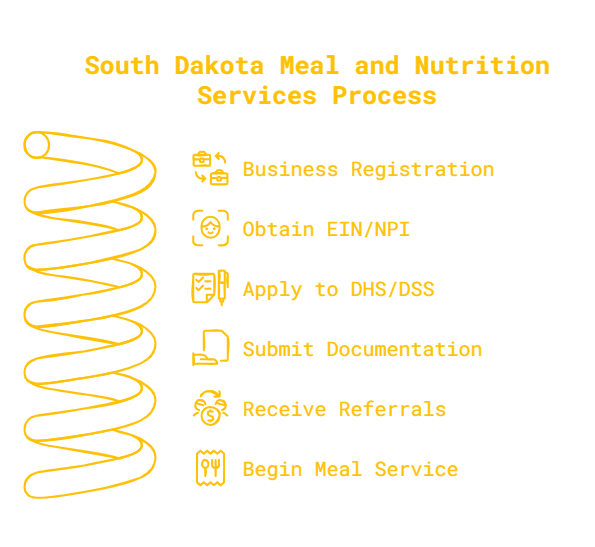
Establishing a compliant meal and nutrition agency requires strict adherence to business registration and food safety mandates. Prospective providers must first formalize their business structure with the South Dakota Secretary of State and secure a federal Employer Identification Number (EIN) and a Type 2 National Provider Identifier (NPI). Beyond business registration, providers must ensure their physical kitchen facilities or meal distribution centers meet all local and state food safety requirements.
The regulatory path requires a high degree of administrative readiness. Providers must develop a comprehensive Policy & Procedure Manual that details every facet of their operation, from food preparation and temperature control to emergency contingency plans. Furthermore, if the provider is engaged in the physical preparation of meals, they must secure and maintain an active license from the South Dakota Department of Health, ensuring that the facility undergoes regular inspections to verify compliance with public health standards.
What Is the Required Documentation for Enrollment?
To successfully enroll as a Medicaid-funded nutrition provider, the applicant must compile a transparent and thorough documentation packet. This evidentiary file serves as the basis for the state’s assessment of the provider’s readiness to deliver quality services to a vulnerable population. Key documents include proof of business standing, such as Articles of Incorporation, alongside EIN and NPI verification.
Central to the application is the Policy & Procedure Manual, which must serve as a functional guide for staff. It is essential that this manual addresses the following critical areas:
- Nutritional Standards: Protocols for meeting specific dietary requirements and medical diet accommodations.
- Safety Protocols: Standard operating procedures for temperature monitoring and food safety logs.
- Verification Systems: Mechanisms for documenting each meal delivered to verify service delivery for billing purposes.
- Privacy and Compliance: Utilization of HIPAA-compliant logs for managing participant information.
- Continuous Quality Improvement: Feedback forms to assess participant satisfaction and service quality.
What Are the Staffing and Training Expectations?
Staffing requirements are designed to ensure that every individual involved in the meal process—from the kitchen to the doorstep—is capable of maintaining high standards of food safety and participant care. For personnel involved in meal preparation or delivery, foundational requirements include valid food handler certification, comprehensive background checks, and ideally, current CPR and First Aid training.
When the scope of service includes nutritional counseling, agencies must engage a Licensed Dietitian to oversee meal planning. All employees must participate in an intensive orientation that covers critical operational standards, including HIPAA and participant privacy, emergency protocols for handling missed deliveries, and waiver-specific billing procedures to ensure fiscal integrity.
Frequently Asked Questions
What is the typical timeline for launching a meal and nutrition service provider?
The timeline generally spans several months, beginning with a 1–2 month phase for business registration and food safety planning, followed by another 1–2 months for provider enrollment and policy manual development. The final phase involves 30–45 days for staff hiring and training, after which service delivery may commence upon formal authorization or referral.
How are meals categorized under the different Medicaid waiver programs?
Services are distinct by program: the CHOICES Waiver provides home-delivered or day-program meals; the Family Support 360 Waiver supports meals for individuals living with family; the Medically Fragile Waiver focuses on physician-prescribed nutrition; and the State Aging Services program provides nutrition for seniors through the DSS.
What role does the South Dakota Department of Health play for providers?
The Department of Health oversees the food service licensing process. If your agency is preparing meals, you must comply with their specific food service rules to ensure your kitchen facilities meet the safety standards required for the provision of food to the public and program participants.
Key Takeaway
Launching a Medicaid-funded nutrition service in South Dakota requires a rigorous focus on regulatory compliance, detailed operational documentation, and strict adherence to food safety standards. By aligning business operations with the specific requirements set forth by the South Dakota DHS, DSS, and CMS, providers can ensure the delivery of high-quality, life-sustaining nutrition services that support the independence and well-being of the state’s most vulnerable residents.
Last verified: October 2023. Disclaimer: This article is for informational purposes only and does not constitute legal or professional consulting advice. Requirements for Medicaid waiver programs are subject to change. Always verify current state regulations and policy manuals with the South Dakota Department of Human Services or the South Dakota Department of Social Services before starting a business operation.