MEAL AND NUTRITION SERVICES PROVIDER IN NORTH CAROLINA
By Fatumata Kaba · 2025-09-12 · 5 min read
Becoming a Meal and Nutrition Services provider in North Carolina requires navigating a specialized regulatory framework designed to ensure that vulnerable populations—including those with disabilities, chronic health conditions, and age-related needs—receive safe, clinically appropriate nutritional support. By enrolling as a Medicaid Home and Community-Based Services (HCBS) provider, your agency plays a critical role in chronic condition management, preventing institutionalization, and improving overall health outcomes for waiver participants across the state.
To successfully enter this market, prospective providers must align their business operations with the stringent standards set by the North Carolina Department of Health and Human Services (NCDHHS) and the North Carolina Division of Health Benefits (NC Medicaid). This guide outlines the essential steps for establishing a compliant, high-quality nutrition services program in accordance with federal CMS standards and North Carolina’s specific waiver requirements.
How Do You Establish Governance and Regulatory Compliance for Your Agency?
The regulatory architecture for North Carolina meal and nutrition services is anchored by the NCDHHS, which administers the funding, and the NC Medicaid division, which oversees provider participation and reimbursement. Agencies must demonstrate that they operate in full compliance with the standards established by the Centers for Medicare & Medicaid Services (CMS). This federal oversight ensures that all service delivery, from initial nutritional assessment to final meal delivery, meets strict person-centered care and safety standards.
Beyond the NCDHHS and NC Medicaid, providers serving specific populations must also satisfy the oversight requirements of the North Carolina Division of Mental Health, Developmental Disabilities, and Substance Abuse Services (DMH/DD/SAS). This ensures that programs tailored to individuals with developmental disabilities or behavioral health needs maintain clinical integrity. Achieving compliance requires not only formal business registration with the North Carolina Secretary of State but also a deep integration into the NCTracks provider system, which serves as the central hub for enrollment, service authorization, and claims processing.
What Specific Services Can a Medicaid-Approved Provider Deliver?
Medicaid-funded nutrition programs are designed to be comprehensive, moving beyond simple meal delivery to offer holistic dietary support. Approved providers are expected to act as a bridge between clinical health goals and daily living requirements. This requires a structured approach to menu planning, food safety, and nutritional education, ensuring that every meal provided directly supports the participant’s medical and wellness plan.
- Meal Preparation: Cooking and preparing balanced meals that align with physician-ordered dietary restrictions.
- Meal Delivery: Providing pre-cooked, nutritionally balanced meals directly to the participant's home.
- Dietary Assessment: Evaluating individual nutritional needs based on existing medical conditions or personal dietary goals.
- Nutritional Counseling: Offering professional guidance on healthy eating, portion control, and long-term meal planning.
- Special Diet Management: Preparing customized meals tailored for specific conditions like diabetes, hypertension, or food allergies.
- Food Safety Education: Teaching participants and caregivers safe food handling and storage practices.
- Shopping Assistance: Helping individuals navigate grocery selection and budget-conscious meal planning.
- Culinary Skill Training: Providing basic instruction to help participants achieve greater independence in the kitchen.
- Community Meal Programs: Organizing group dining events to foster social interaction and reduce isolation.
- Documentation: Maintaining rigorous records of meal plans, assessments, and education delivered to ensure audit readiness.
What Are the Prerequisites for Provider Enrollment and Licensing?
The enrollment process begins with fundamental business formation steps. Before applying for Medicaid participation, an agency must be legally established with the North Carolina Secretary of State and possess a valid EIN from the IRS. Furthermore, the agency must secure a Type 2 NPI (National Provider Identifier), which is essential for organizational billing in the healthcare sector. These foundational documents serve as the basis for all subsequent applications.
Once the business is legally established, the agency must demonstrate financial and operational responsibility through comprehensive insurance coverage, including general and professional liability policies. A critical component of this phase is the development of a robust Policy & Procedure Manual. This document must cover all aspects of the agency’s operations, including dietary safety protocols, client confidentiality under HIPAA, participant rights, grievance procedures, and the specific standards for staff training and background screenings.
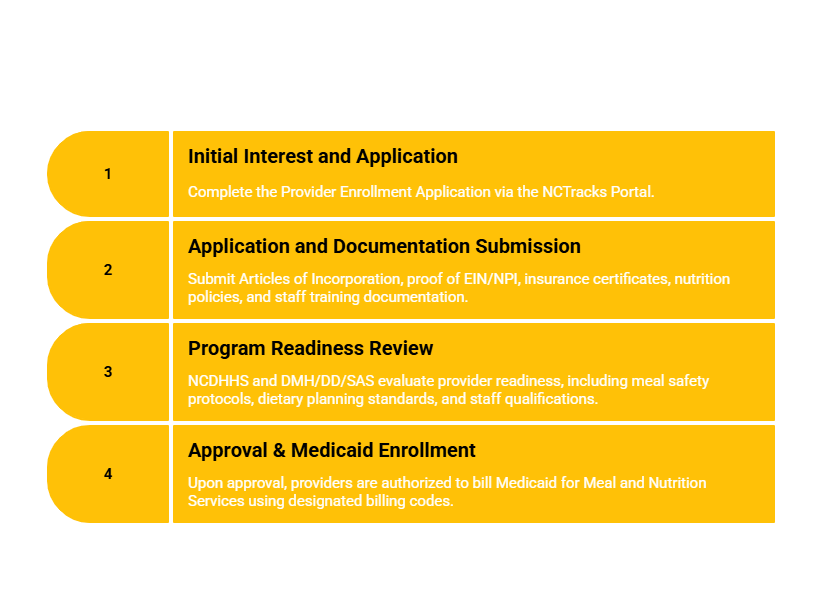
How Do You Navigate the North Carolina Medicaid Enrollment Process?
The pathway to becoming an active provider involves a multi-stage submission process through the NCTracks Provider Portal. Initially, agencies must submit their enrollment application, accompanied by all required documentation such as Articles of Incorporation, proof of NPI/EIN, and comprehensive policy manuals. This submission initiates a "Program Readiness Review" by NCDHHS and DMH/DD/SAS officials, who evaluate whether the agency has the infrastructure to safely deliver services.
The timeline for this transition is significant, generally requiring between 60 to 90 days for Medicaid enrollment and readiness verification alone. During this window, agencies must be prepared for potential follow-up questions from regulators regarding their food hygiene protocols or staff qualification records. Once the state issues a formal approval notice, the agency is authorized to begin billing for services rendered to participants enrolled in programs such as the Innovations Waiver, CAP/DA, CAP/C, or the TBI Waiver.
What Are the Essential Staffing and Competency Requirements?
The quality of a nutrition program is heavily dependent on the professional qualifications of its staff. The agency must appoint a Nutrition Program Director, typically a Registered Dietitian (RD) with a degree in nutrition or dietetics and experience in program management. This individual is responsible for overseeing the clinical accuracy of the meal plans and ensuring that all dietary interventions are appropriate for the specific needs of the participants.
Beyond the director, the agency must hire qualified dietitians or nutritionists, as well as support staff for meal preparation and delivery. All personnel, regardless of their role, are required to undergo rigorous training before providing direct service. This includes HIPAA compliance, food safety and hygiene, emergency response, and record-keeping training. Annual competency evaluations and ongoing professional development are mandatory to maintain the agency’s status as an approved Medicaid provider.
Frequently Asked Questions
What waivers currently include Meal and Nutrition Services in North Carolina?
These services are authorized under the Innovations Waiver, the Community Alternatives Program for Disabled Adults (CAP/DA), the Community Alternatives Program for Children (CAP/C), the Traumatic Brain Injury (TBI) Waiver, and broader HCBS waiver initiatives.
What must be included in the agency’s Policy & Procedure Manual?
The manual must detail meal planning and delivery protocols, dietary assessment guidelines, staff credentialing and training records, HIPAA compliance, participant rights, grievance handling, food hygiene and safety standards, and quality assurance processes.
How long should a new agency plan for the entire start-up process?
A realistic timeline spans roughly 6 to 9 months. This includes 1–2 months for business formation, 2–3 months for staff hiring and program development, 60–90 days for Medicaid enrollment and readiness reviews, and 30–45 days for final billing setup and service launch.
Key Takeaway: Successfully launching a Meal and Nutrition Services agency in North Carolina depends on a disciplined, document-heavy approach to compliance. By ensuring that your staffing credentials, food safety protocols, and Medicaid billing systems are fully aligned with NCDHHS and CMS requirements from the outset, your agency can build a sustainable model that provides essential support to the state’s most vulnerable residents.
Last verified: [Insert Date]. This article is for informational purposes only and does not constitute legal or professional medical advice. Always refer to the official NCDHHS, NCTracks, and CMS provider manuals for the most current regulatory requirements and updates.