MEAL AND NUTRITION SERVICES PROVIDER IN NEW YORK
By Fatumata Kaba · 2025-09-03 · 6 min read
Promoting Health and Well-Being Through Personalized Meal Planning and Nutrition Support
Meal and Nutrition Services in New York are specialized supports designed to assist individuals with disabilities, chronic conditions, or age-related challenges by providing access to high-quality meals, professional dietary planning, and nutritional education. These services are authorized under various New York Medicaid Home and Community-Based Services (HCBS) waiver programs to help participants effectively manage their health, prevent complications from chronic illnesses, and maintain their independence within their own homes and communities.
What Are the Governing Agencies and Regulatory Frameworks?
The delivery of Meal and Nutrition Services in New York is governed by a multi-tiered regulatory structure that ensures program integrity and participant safety. The New York State Department of Health (NYSDOH) serves as the primary authority, administering Medicaid waiver funding and overseeing the essential provider enrollment, service authorization, and reimbursement processes. Because these services are funded through Medicaid, they must also adhere to federal standards set by the Centers for Medicare & Medicaid Services (CMS), which requires that all services meet rigorous quality, safety, and person-centered care benchmarks.
Beyond state and federal oversight, specific populations are served through specialized offices. The Office for People With Developmental Disabilities (OPWDD) provides dedicated oversight for nutrition services tailored to individuals with developmental disabilities. Similarly, the New York State Office of Mental Health (OMH) ensures compliance for nutrition programs specifically designed for individuals managing complex mental and behavioral health needs. Coordination among these agencies is essential to ensure that services remain compliant across all waiver populations.
How Do Providers Deliver Meal and Nutrition Services?
Providers authorized to offer these services perform a wide array of functions that go beyond simple food delivery. A core component is the development of individualized dietary plans that address the unique clinical requirements of the participant. Whether managing diabetes, hypertension, or other chronic conditions, the service provider acts as a critical link between medical necessity and daily nutrition.
Service delivery typically encompasses the following operational tasks:
- Meal Preparation: Cooking and preparing balanced meals that align with specific dietary restrictions and preferences.
- Meal Delivery: Providing pre-cooked, nutritionally balanced meals directly to the participant's home.
- Dietary Assessment: Evaluating and monitoring nutritional needs based on ongoing medical conditions or evolving dietary goals.
- Nutritional Counseling: Offering professional guidance on healthy eating habits and sustainable meal planning.
- Special Diet Management: Preparing and portioning meals tailored for clinical conditions like renal disease or heart health.
- Food Safety and Culinary Skills: Teaching safe food handling, storage practices, and basic cooking skills to promote long-term participant independence.
What Are the Licensing and Provider Approval Requirements?
Becoming an approved Medicaid provider is a deliberate, multi-step process that requires significant preparation before a business can begin billing for services. Prospective providers must first establish their business as a legal entity registered with the New York Department of State and obtain an Employer Identification Number (EIN) from the IRS. Furthermore, a Type 2 National Provider Identifier (NPI) is required to facilitate the electronic billing process through the eMedNY system.
Operational readiness is also a major requirement for approval. Before applying, agencies must secure comprehensive general and professional liability insurance to protect against operational risks. The applicant must demonstrate that they have developed robust internal policies covering meal planning, dietary safety, and client education. Furthermore, the agency must confirm that all staff members have undergone the necessary background checks and health screenings mandated by state regulations.
How Does the New York Provider Enrollment Process Work?
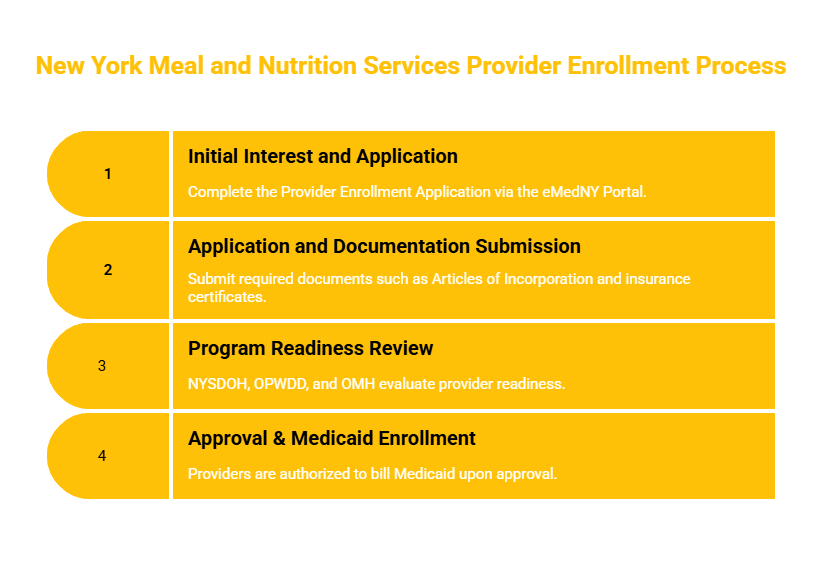
The enrollment process is facilitated primarily through the New York Medicaid Provider Enrollment Portal (eMedNY). The journey begins with the completion of the formal Provider Enrollment Application specific to HCBS waiver services. During this phase, the applicant must compile and submit a comprehensive document package, including the business’s Articles of Incorporation, proof of federal identification (EIN/NPI), insurance certificates, and proof of a developed policy manual.
Once the application is submitted, the relevant agencies—including the NYSDOH, OPWDD, or OMH, depending on the scope of the program—will conduct a Program Readiness Review. This evaluation looks beyond paperwork to assess whether the provider has the actual capacity to deliver safe, compliant services. This includes a review of food handling protocols, the quality of dietary planning standards, and the qualifications of the proposed staff. Only after the successful completion of this review will a provider be authorized to bill Medicaid using the designated service codes.
What Are the Staffing and Documentation Standards?
Maintaining high standards of care requires a qualified team with specific credentials. The Nutrition Program Director must typically hold a Registered Dietitian (RD) license and possess a Bachelor’s or Master’s degree in Nutrition or Dietetics, along with demonstrated experience in program management. Similarly, dietitians and nutritionists working under the director must hold state licensure. Support staff, such as those involved in meal preparation and delivery, should have documented experience in food service and hold appropriate food handler certifications.
Documentation is the backbone of compliance. Providers are required to maintain detailed records that support every service provided and billed. Essential documentation includes:
- Comprehensive Policy & Procedure Manual: Covering meal delivery, nutrition assessment guidelines, and safety protocols.
- Personnel Records: Including credentialing verification, background checks, and logs of ongoing training.
- Billing and Service Logs: Maintaining accurate records of meal plans, dietary interventions, and progress notes.
- Compliance Records: HIPAA compliance documentation, participant rights acknowledgement, and grievance handling logs.
- Quality Assurance: Regular reports on food hygiene, temperature logs for delivery, and internal audit results.
Frequently Asked Questions
Which Medicaid Waiver programs cover Meal and Nutrition Services?
These services are available under several New York Medicaid Waivers, including the OPWDD Comprehensive Waiver, the Home and Community-Based Services (HCBS) Waiver, the Nursing Home Transition and Diversion (NHTD) Waiver, the Traumatic Brain Injury (TBI) Waiver, and the Children’s Waiver.
How long does the process take from business formation to service launch?
The timeline varies based on organizational readiness, but the full process generally spans six to nine months. This includes 1–2 months for business formation, 2–3 months for staffing and program development, 60–90 days for the enrollment and readiness review, and 30–45 days for final billing setup.
What are the primary responsibilities of the Nutrition Program Director?
The Director is responsible for overseeing the clinical and operational integrity of the program. Their duties include ensuring that all meal plans are nutritionally adequate, supervising staff to maintain compliance with dietary standards, and managing the documentation required for Medicaid audits and quality assurance reviews.
Waiver Consulting Group’s Start-Up Assistance Service — New York Meal and Nutrition Services Provider
WCG supports agencies in launching Medicaid-compliant Meal and Nutrition Services in New York. The scope of work includes assistance with business registration, Medicaid enrollment, and licensing, as well as the development of policy manuals for dietary planning and meal safety. WCG also provides templates for staff credentialing and training, support for Medicaid billing setup, and guidance on establishing quality assurance systems for compliance monitoring.
Key Takeaway: Successful operation of a Meal and Nutrition Services provider in New York requires a disciplined approach to both clinical dietary standards and administrative Medicaid compliance. By integrating robust food safety protocols with professional nutritional oversight and meticulous record-keeping, providers can effectively support the health and autonomy of the waiver population while maintaining regulatory standing with NYSDOH, OPWDD, and OMH.
Last verified: May 2024. The information provided in this article is for educational purposes and does not constitute legal or professional advice. Requirements for Medicaid provider enrollment are subject to change by the New York State Department of Health and the Centers for Medicare & Medicaid Services. Always consult the official eMedNY portal and relevant state agency guidelines before initiating your application.