MEAL AND NUTRITION SERVICES PROVIDER IN NEW MEXICO
By Fatumata Kaba · 2025-09-05 · 6 min read
Meal and Nutrition Services in New Mexico are critical components of the state’s Home and Community-Based Services (HCBS) ecosystem, designed to provide essential dietary support to individuals with disabilities, chronic health conditions, or age-related limitations. By offering specialized meal preparation, planning, and delivery, these services ensure that participants maintain their health, independence, and nutritional well-being within their own homes and communities.
For healthcare entrepreneurs and agency administrators, establishing a provider entity requires navigating a rigorous regulatory framework overseen by the New Mexico Human Services Department (HSD) and the Developmental Disabilities Supports Division (DDSD). This article outlines the essential steps, operational requirements, and compliance standards necessary to become an authorized provider under New Mexico’s Medicaid waiver programs.
Understanding the Governing Framework for Nutrition Services
The delivery of Medicaid-funded meal services is governed by a multi-tiered regulatory structure that ensures federal accountability and state-level quality control. The Centers for Medicare & Medicaid Services (CMS) sets the overarching federal standards, ensuring that all Medicaid-funded services adhere to person-centered planning principles and participant safety protocols. These federal guidelines ensure that nutritional support is not just a food service, but a medically necessary intervention.
At the state level, the New Mexico Human Services Department (HSD) serves as the primary authority, managing the financial administration of the waiver, overseeing provider enrollment, and establishing the parameters for reimbursement. Complementing this, the Developmental Disabilities Supports Division (DDSD) focuses on the quality of service delivery. DDSD ensures that providers remain in compliance with clinical standards and that the specific nutritional needs of participants—as outlined in their Individualized Service Plan (ISP)—are met with precision and professionalism.
What Are the Core Components of Meal and Nutrition Services?
Providers authorized under New Mexico Medicaid waivers are expected to offer more than simple food delivery. The scope of service is intended to support the holistic health of the participant. This includes the development of customized meal plans that account for specific medical needs, such as diabetes management, hypertension control, or the necessity for texture-modified diets like pureed or soft foods.
Approved providers generally manage several key functional areas to ensure comprehensive care:
- Meal Preparation: Cooking and delivering nutritionally balanced meals that accommodate specific dietary restrictions and personal preferences.
- Nutritional Counseling: Providing professional guidance to help participants understand how to maintain a balanced diet that supports their chronic conditions.
- Home-Delivered Meals: Ensuring reliable delivery of meals for individuals with limited mobility or those unable to safely prepare food in their own homes.
- Congregate Meal Settings: Facilitating group meal programs to encourage social engagement and community interaction for those who benefit from structured, communal dining.
- Dietary Monitoring: Systematically tracking food intake and assessing nutritional adequacy to prevent malnourishment or dietary complications.
Licensing and Establishing Organizational Readiness
Before an agency can accept its first participant, it must establish a formal business entity and satisfy all prerequisite requirements for licensure. This begins with registering the business with the New Mexico Secretary of State and obtaining the necessary federal tax identification (EIN) and a Type 2 National Provider Identifier (NPI). These are the foundational credentials required for any entity seeking to bill Medicaid.
Operational compliance is just as critical as legal registration. A provider must secure a food establishment license from the New Mexico Environment Department (NMED), which validates the facility's adherence to sanitation and public health codes. Furthermore, agencies must secure comprehensive general and professional liability insurance. These measures protect both the agency and the participants, ensuring that every meal prepared and delivered meets the highest standards of food safety and hygiene.
Navigating the New Mexico Provider Enrollment Process
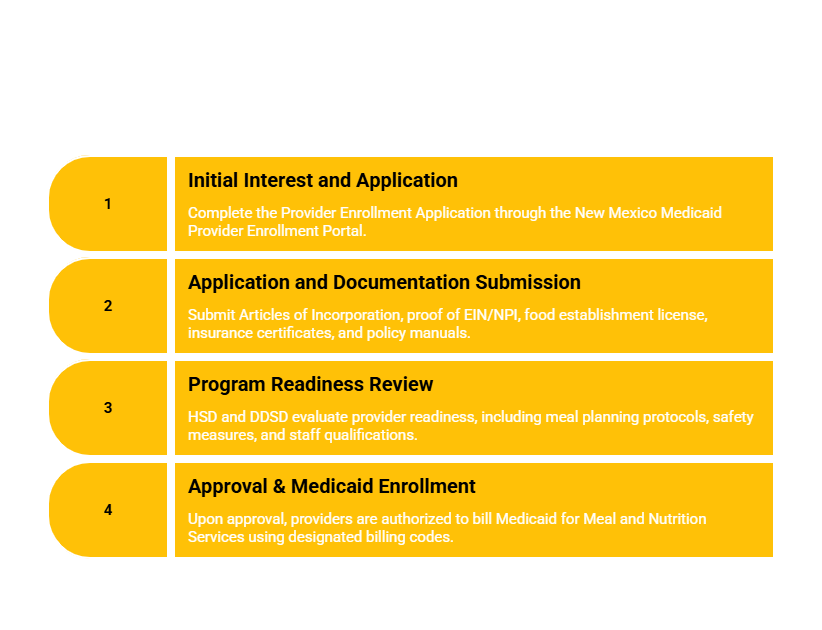
The enrollment process is a sequential journey that demands meticulous attention to detail. Initially, interested parties must register via the New Mexico Medicaid Provider Enrollment Portal. This is where the agency formally signals its intent to provide services under specific HCBS waiver programs. During the application phase, the applicant must upload all supporting documentation, including Articles of Incorporation, proof of valid insurance, and evidence of the required food establishment licenses.
Following the submission, HSD and DDSD conduct a Program Readiness Review. This evaluation is not merely administrative; regulators will assess the agency’s internal protocols, including their disaster recovery plans for meal delivery, nutritional monitoring procedures, and the competency of their proposed staff. Once the agency demonstrates that it possesses the systems required to maintain high-quality care, it receives formal authorization to begin billing Medicaid using the state-designated service codes.
Staffing, Training, and Compliance Protocols
The human element of nutrition services is subject to strict credentialing requirements to ensure that participants receive expert care. The program director must possess at least a bachelor’s degree in nutrition, dietetics, or a related food service management field. Similarly, any staff involved in specialized dietary counseling must be registered or licensed dietitians. All staff members, including delivery personnel and food handlers, must undergo rigorous background screenings and health assessments before interacting with participants.
Beyond initial hiring, the agency is responsible for an ongoing cycle of professional development. All staff must participate in mandatory training programs, including:
- Comprehensive food safety and hygiene certification (e.g., ServSafe).
- HIPAA compliance and privacy training to protect participant health information.
- Education on participant rights and grievance procedures.
- Specific training in the documentation standards required for Medicaid billing and clinical charting.
- Annual competency evaluations to ensure that safety and dietary protocols are being followed consistently.
Frequently Asked Questions
Which Medicaid waivers in New Mexico cover these services?
Meal and Nutrition Services are integrated into several key programs, including the Developmental Disabilities (DD) Waiver, the Mi Via Waiver, the Medically Fragile Waiver, and the Supports Waiver. Each of these programs provides specific service definitions under the broader HCBS umbrella.
How long does the provider enrollment process typically take?
The timeline varies based on organizational readiness, but the entire process generally takes between 6 to 8 months. This includes 1–2 months for business formation, 2–3 months for program development, and 60–90 days for the formal HSD and DDSD enrollment review.
What must be included in a policy and procedure manual?
A comprehensive manual must outline food storage and preparation protocols, staff background check procedures, HIPAA compliance strategies, emergency delivery contingency plans, and detailed processes for recording and monitoring a participant’s nutritional progress in accordance with their Individualized Service Plan (ISP).
WAIVER CONSULTING GROUP’S START-UP ASSISTANCE SERVICE — NEW MEXICO MEAL AND NUTRITION SERVICES PROVIDER
WCG supports agencies in launching Medicaid-compliant Meal and Nutrition Services in New Mexico, offering:
- Business registration, Medicaid enrollment, and food service licensing assistance.
- Policy manual development for meal preparation, dietary planning, and safety management.
- Staff credentialing, training program templates, and compliance documentation.
- Medicaid billing setup and audit-prepared financial management.
- Branding, website development, and community outreach strategies.
- Quality assurance systems for meal safety and dietary compliance.
- Collaboration with healthcare providers and nutrition experts.
Key Takeaway: Establishing a Meal and Nutrition Services agency in New Mexico is a significant professional undertaking that requires strict adherence to both state health department food safety regulations and Medicaid's stringent HCBS documentation and oversight standards. Success depends on thorough upfront program development and a commitment to maintaining ongoing quality assurance metrics.
Last verified: October 2023. Disclaimer: This content is for informational purposes only and does not constitute legal or financial advice. Regulations governing New Mexico Medicaid waivers are subject to change. Always consult directly with the New Mexico Human Services Department (HSD) or official state guidance for the most current requirements.