MEAL AND NUTRITION SERVICES PROVIDER IN LOUISIANA
By Fatumata Kaba · 2025-08-12 · 6 min read
SUPPORTING HEALTH, WELLNESS, AND INDEPENDENCE THROUGH MEDICALLY TAILORED MEALS AND DIETARY EDUCATION
Meal and Nutrition Services in Louisiana provide eligible Medicaid waiver participants with essential access to nutritionally balanced meals, specialized dietary supports, and expert-led education. These services are strategically designed to help individuals maintain their health, manage chronic conditions, and remain safely in their homes or community settings, thereby reducing the systemic risk of costly hospitalization or institutional care.
As the landscape of Home and Community-Based Services (HCBS) continues to evolve, the integration of nutrition as a clinical intervention is becoming a cornerstone of participant well-being. Providers operating in this space must navigate a complex regulatory environment managed by the Louisiana Department of Health (LDH), ensuring that every meal served or consultation provided adheres to state and federal quality standards.
Who are the Governing Agencies Overseeing Meal and Nutrition Services in Louisiana?
The regulatory framework for HCBS nutrition services involves a multi-tiered oversight structure. At the state level, the Louisiana Department of Health (LDH) serves as the primary governing authority. Specifically, the Office of Aging and Adult Services (OAAS) and the Office for Citizens with Developmental Disabilities (OCDD) define the eligibility requirements, service coverage criteria, and clinical expectations for all nutrition-related supports provided through the waiver programs.
Operational oversight is further segmented among several entities. The Medicaid Management Information System (MMIS), administered in conjunction with Molina Medicaid Solutions, serves as the operational backbone for provider enrollment, claims submission, and reimbursement. Simultaneously, for participants enrolled in Managed Care Organizations (MCOs) under the Bayou Health program, those entities play a critical role in authorizing specific meal and nutritional support services directly within the participant’s individualized Plan of Care (POC). At the federal level, the Centers for Medicare & Medicaid Services (CMS) provides the overarching mandate to ensure that all state-run HCBS waiver services meet rigorous safety and quality requirements.
How Do Providers Obtain Necessary Licensing and Approval?
Entering the Louisiana Medicaid provider market requires a disciplined approach to administrative and operational readiness. Before a provider can be authorized to bill for services, they must establish a formal business entity with the Louisiana Secretary of State and secure essential federal identifiers, including an IRS EIN and a Type 2 National Provider Identifier (NPI). This foundational step is critical for all subsequent enrollment activities.
Beyond standard business registration, providers must meet specific food service operation requirements. This includes obtaining formal certification through the Louisiana Department of Health – Sanitarian Services to ensure the facility meets state health and safety standards. Providers must also maintain comprehensive general liability and specialized food handling insurance. Because these services are clinically driven, the provider must also maintain a robust Policy & Procedure Manual and implement HIPAA-compliant data tracking systems to document participant services and nutritional outcomes accurately.
- Register the business entity with the Louisiana Secretary of State.
- Obtain a Type 2 NPI and an IRS-issued EIN.
- Secure food service operation certification via the LDH Sanitarian Services.
- Employ or contract with a Licensed Dietitian/Nutritionist (LDN) or Registered Dietitian Nutritionist (RDN).
- Develop a comprehensive Policy & Procedure Manual for internal and external audit readiness.
What Does the Louisiana Medicaid Provider Enrollment Process Entail?
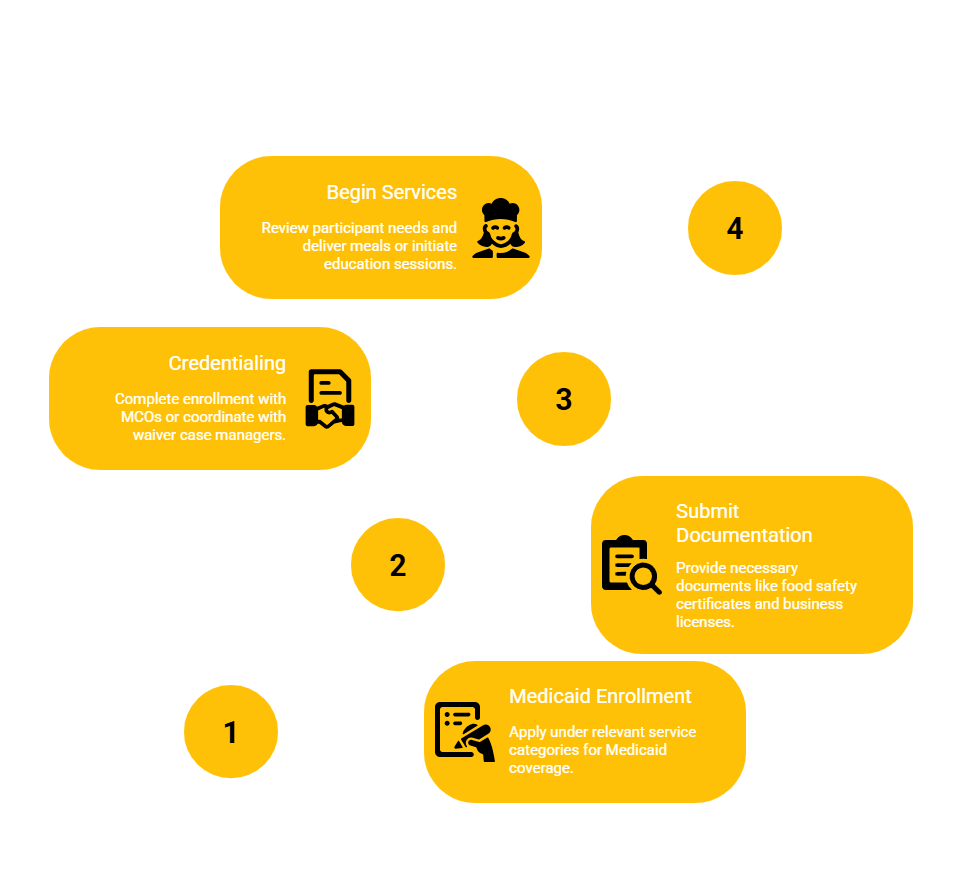
The transition from a business entity to an active Medicaid provider occurs through a structured four-step enrollment process. First, the applicant must submit a request for enrollment through the Louisiana Medicaid Provider Enrollment Portal under the appropriate service categories, such as Home-Delivered Meals, Nutrition Counseling, or Specialized Medical Supports. This stage requires high attention to detail, as any omission can lead to delays in credentialing.
Once the initial application is submitted, the provider must supply comprehensive supporting documentation. This includes food safety certificates, business licenses, proof of insurance, sample menus, and detailed staff credentials. Once the state application is reviewed, the provider must undergo credentialing with the relevant MCOs or waiver administrative teams. Only after receiving official notification of enrollment and authorization in the participant's Plan of Care can the provider begin delivering services and submitting claims based on the approved units of service.
What Are the Mandatory Staffing and Training Requirements?
The clinical and operational integrity of a Meal and Nutrition Service provider relies heavily on the qualifications of its staff. The presence of a Registered Dietitian Nutritionist (RDN) or a Licensed Dietitian (LDN) is mandatory. This individual is responsible for conducting nutritional assessments, developing specialized menu plans, providing participant education, and maintaining accurate, audit-ready clinical documentation.
Operational staff, such as the Food Service Manager or Kitchen Coordinator, must hold current certifications in food safety and possess demonstrable experience in mass meal preparation, cold-chain storage, and delivery logistics. Delivery staff and nutrition aides must also undergo rigorous training. All personnel, regardless of their role, are required to complete training on HIPAA compliance, participant rights, food safety, infection control, and emergency response. Ongoing professional development is a standard expectation to ensure that staff remain informed of evolving nutrition science and safety protocols.
Which Medicaid HCBS Waivers Cover These Services?
Meal and Nutrition Services are integrated into several key Louisiana HCBS waivers, each designed to meet specific population needs. These include the Community Choices Waiver (CCW), the Residential Options Waiver (ROW), the New Opportunities Waiver (NOW), and the Supports Waiver. Additionally, the Children’s Choice Waiver provides specific coverage for nutrition counseling and caregiver training.
These services are versatile in their delivery settings. While the participant’s home is the most common environment for meal delivery, services may also be rendered at adult day health centers or other community sites as specified in the participant’s Plan of Care. Furthermore, the use of virtual education or tele-nutrition sessions is becoming an increasingly common and approved method for delivering nutritional guidance, provided it has been authorized in advance by the appropriate waiver authority.
Frequently Asked Questions
How long does the launch process take for a new nutrition provider?
The timeline typically spans several months. Business formation and initial licensing usually take 1 to 2 months. Food service certification and the Medicaid enrollment process generally require 60 to 90 days. Staff recruitment and menu development take approximately 30 to 45 days, with program launch occurring on a rolling basis once authorizations are secured.
What must be included in the provider’s policy and procedure manual?
A comprehensive manual must include intake and nutrition risk screening tools, sample menus with clear dietary labeling, delivery schedules, confirmation forms, participant dietary goal tracking, and HIPAA-compliant nutrition consultation forms. It must also outline emergency meal delivery protocols, staff credentials, and billing logs.
Are providers required to work with Managed Care Organizations (MCOs)?
Yes, for participants enrolled in Bayou Health or other managed care programs, the MCOs are responsible for authorizing the specific nutrition services within the participant’s Plan of Care. Providers must coordinate with these organizations to ensure that services provided are authorized and eligible for reimbursement.
Key Takeaway: Successful participation as a Louisiana Medicaid Meal and Nutrition provider requires a balanced focus on stringent regulatory compliance, documented clinical oversight by licensed nutritionists, and robust logistical systems for food safety and delivery. By adhering to the guidelines set forth by the Louisiana Department of Health and maintaining audit-ready documentation, providers can effectively support the independence and health outcomes of waiver participants.
Last verified: 2024. The information provided is for educational purposes only and does not constitute legal or professional advice. Always consult the official Louisiana Medicaid Provider Manual and relevant state statutes for the most current regulations.