MEAL AND NUTRITION SERVICES PROVIDER IN IOWA
By Fatumata Kaba · 2025-07-22 · 5 min read
ENSURING ACCESS TO HEALTHY, BALANCED MEALS TO SUPPORT WELL-BEING AND COMMUNITY LIVING
Meal and Nutrition Services in Iowa provide essential dietary support for individuals who are unable to prepare or obtain adequate food independently due to disability, chronic illness, or age-related challenges. These services are authorized under Iowa’s Home and Community-Based Services (HCBS) waiver programs and are strategically designed to promote health, stability, and the ability of participants to remain in their homes rather than transitioning to institutional care.
What Are the Governing Bodies Overseeing Meal and Nutrition Services in Iowa?
The delivery of nutritional services in Iowa is regulated through a collaborative framework involving state and federal oversight agencies. The primary regulatory body is the Iowa Department of Health and Human Services (HHS), specifically through the Iowa Medicaid Enterprise (IME). This entity is responsible for establishing provider enrollment standards, defining service requirements, and managing reimbursement policies for all HCBS waiver programs.
Day-to-day operations and service delivery are closely monitored by Managed Care Organizations (MCOs). These organizations are tasked with reviewing meal plan authorizations to ensure they align with the participant’s Individualized Service Plan (ISP) goals, processing claims for payment, and conducting quality assurance reviews. Furthermore, the Centers for Medicare & Medicaid Services (CMS) provides the overarching federal framework, ensuring that all state-level meal and nutrition programs remain in strict compliance with federal Medicaid regulations and quality of care standards.
How Do Providers Effectively Deliver Meal and Nutrition Services?
Meal and Nutrition Services encompass a variety of support models tailored to the functional limitations and dietary requirements of the participant. Providers must ensure that the nutrition provided is not merely sustenance but is medically appropriate, safe, and aligned with the participant's specific healthcare needs as outlined in their ISP.
Approved providers generally deliver services through the following modalities:
- Home-delivered meals for individuals unable to shop or cook independently.
- On-site congregate meals in approved community-based settings.
- Diet-specific meals, such as low sodium or diabetic-friendly options, based on physician or dietitian recommendation.
- Nutrition education and structured meal planning assistance.
- Meal preparation support within the home or community setting, when authorized.
- Monitoring and support regarding safe food handling, portion control, and dietary compliance.
What Are the Essential Licensing and Provider Approval Prerequisites?
Launching a Medicaid-approved meal service in Iowa requires a rigorous adherence to administrative and safety prerequisites. Before a provider can begin billing Medicaid, they must establish a formal business structure and obtain all necessary state and federal identifiers. This includes registering the business with the Iowa Secretary of State and obtaining both an Employer Identification Number (EIN) from the IRS and a Type 2 National Provider Identifier (NPI).
Beyond administrative setup, physical and operational compliance is mandatory. Providers must maintain adequate general liability and commercial kitchen insurance. Additionally, all facilities must comply with local health department regulations regarding food safety, temperature control, and sanitation. The provider must develop comprehensive internal policies that govern every aspect of the food lifecycle—from procurement and storage to the final delivery to the participant’s door—ensuring that all staff members are trained and vetted through required background checks.
What Is the Step-by-Step Provider Enrollment Process?
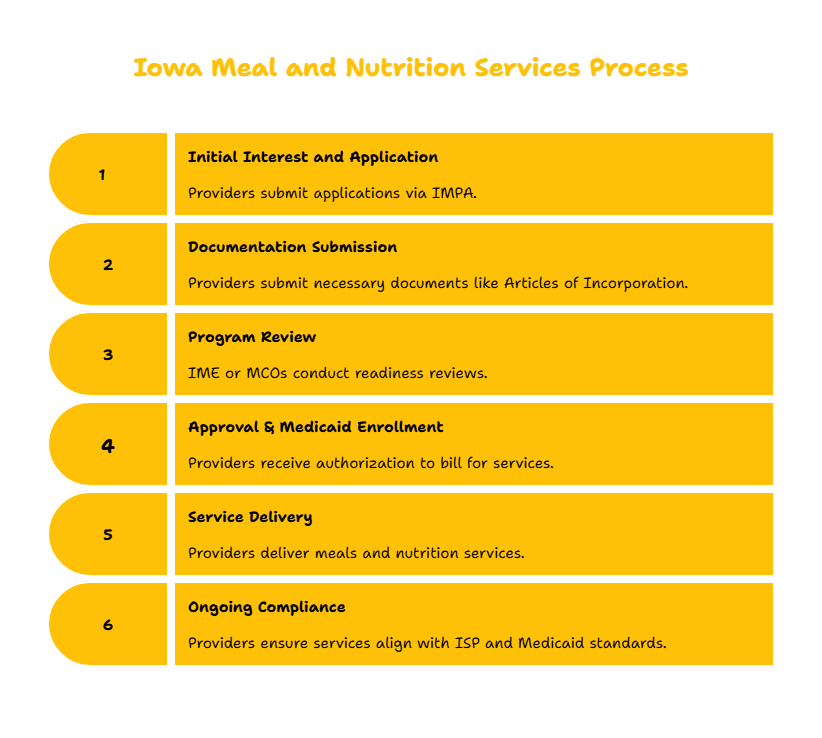
The enrollment journey begins with the submission of a provider application via the Iowa Medicaid Provider Portal (IMPA). This process requires the provider to demonstrate their readiness to deliver services under the applicable HCBS waivers. During this phase, providers must coordinate with the MCOs that cover their target service area, as these entities will ultimately provide the service authorizations at the participant level.
Following the submission of the application, the applicant must provide extensive documentation to prove operational capacity. This includes, but is not limited to, Articles of Incorporation, proof of insurance, a comprehensive Policy & Procedure manual, and detailed menus. Once the application is submitted, the IME or the MCOs may perform a readiness review. This review evaluates the provider’s ability to meet health standards and their capacity to maintain accurate delivery tracking logs. Upon successful completion of these reviews, the provider is authorized to begin billing for home-delivered or congregate meals using the designated Medicaid service codes.
How Does a Provider Manage Staffing and Documentation Requirements?
Successful program management requires a clear hierarchy of roles, including a Program Manager or Supervisor who oversees food service operations and ensures adherence to nutrition standards. All food service staff and delivery drivers must hold valid food handler permits and receive specialized training in sanitation, infection control, and emergency response. In cases where the service scope includes therapeutic meal planning, the involvement of a registered dietitian or nutritionist is highly encouraged to ensure dietary adequacy.
Documentation is the backbone of compliance. Providers must maintain robust records, including:
- Detailed intake and dietary assessment records for each participant.
- Records demonstrating consistent food temperature monitoring and sanitation protocols.
- Menus developed in accordance with USDA guidelines or physician-directed plans.
- Staff training logs, including HIPAA compliance, abuse prevention, and background check records.
- Billing logs that correlate directly with verified meal delivery dates.
Frequently Asked Questions
Which Medicaid waiver programs cover Meal and Nutrition Services in Iowa?
These services are primarily authorized under the Intellectual Disability (ID) Waiver, the Brain Injury (BI) Waiver, the Health and Disability (HD) Waiver, and the Elderly Waiver. Each waiver has specific criteria, and providers should verify coverage based on the specific participant's enrolled program.
What is the typical timeline for starting a meal service program?
The process generally takes 6 to 9 months. This includes 1–2 months for business formation and kitchen compliance, 1–2 months for staff hiring and credentialing, 60–90 days for Medicaid enrollment and MCO readiness reviews, and 30–45 days for final billing system setup and service launch.
Where can providers find resources for contacting Iowa Medicaid?
Providers should utilize the Iowa Medicaid Enterprise (IME) website at https://ime.iowa.gov/providers and the Iowa Department of Health and Human Services (HHS) website at https://hhs.iowa.gov. Additionally, managing claims and authorizations requires direct coordination with MCOs like Amerigroup Iowa and Iowa Total Care.
Key Takeaway
Providing Meal and Nutrition Services in Iowa is a highly regulated undertaking that requires balancing strict food safety and sanitation standards with complex Medicaid billing and authorization procedures. Success relies on meticulous documentation, proactive engagement with Managed Care Organizations, and a commitment to maintaining a compliant, high-quality program that meets the nutritional requirements of vulnerable Iowans.
Waiver Consulting Group (WCG) supports senior services programs, community kitchens, and waiver support agencies in launching Medicaid-compliant Meal and Nutrition Services across Iowa. Our scope of work includes business registration, food safety setup, Medicaid enrollment, policy development, staff credentialing, and ongoing support for MCO coordination and quality assurance.
Last verified: October 2023. Disclaimer: The information provided in this article is for educational purposes only and does not constitute legal or professional advice. Requirements for Medicaid waiver programs are subject to change. Always consult the official Iowa Department of Health and Human Services (HHS) guidelines and current state regulations before initiating your provider application process.