MEAL AND NUTRITION SERVICES PROVIDER IN INDIANA
By Watchen Roberts · 2025-08-13 · 11 min read
How to Become a Meal and Nutrition Services Provider in Indiana
Establishing a Meal and Nutrition Services provider agency in Indiana requires a comprehensive understanding of state and federal regulations, specific operational requirements, and a commitment to participant-centered care. This guide outlines the essential steps for providers looking to offer home-delivered or congregate meal services, along with nutrition education, under Indiana Medicaid Home and Community-Based Services (HCBS) waiver programs and state-funded aging initiatives.
Successful navigation of this process involves securing necessary business and food service licenses, completing rigorous Medicaid provider enrollment, ensuring staff are adequately trained and credentialed, and developing robust operational policies and procedures. By adhering to these guidelines, providers can play a vital role in promoting health, independence, and wellness for vulnerable populations across Indiana.
Understanding the Governing Agencies and Their Roles
Several key state and federal agencies oversee the provision of Meal and Nutrition Services in Indiana, each with distinct responsibilities to ensure quality, compliance, and participant safety. Understanding their roles is fundamental for any prospective provider.
The Indiana Family and Social Services Administration (FSSA) — Division of Aging is a primary governing body. This division is responsible for overseeing both state and federally funded nutrition programs, establishing crucial meal standards, and diligently monitoring provider compliance for services targeting older adults and individuals with disabilities. Their purview ensures that services meet the nutritional and functional needs of the intended population.
Complementing the Division of Aging is the Indiana Office of Medicaid Policy and Planning (OMPP). The OMPP plays a critical role in administering the Medicaid waiver funding that supports Meal and Nutrition Services. They manage the intricacies of provider enrollment and are responsible for the reimbursement processes that ensure providers are compensated for their services. Working closely with the OMPP is essential for financial and operational viability.
At the federal level, the Centers for Medicare & Medicaid Services (CMS) provides overarching federal oversight. CMS ensures that all Medicaid-funded Meal and Nutrition Services, including those in Indiana, adhere to the rigorous standards of Home and Community-Based Services (HCBS). This includes a strong emphasis on participant-centered care, high-quality service delivery, and the promotion of individual choice and autonomy.
Overview of Indiana Meal and Nutrition Services
Meal and Nutrition Services are designed to provide essential, nutritious, and balanced meals, alongside valuable nutrition education, to individuals who face challenges in preparing meals independently. These challenges can stem from health issues, disabilities, or the natural process of aging, making these services critical for maintaining health and supporting independent living.
Approved providers in Indiana have the flexibility to offer a range of services tailored to participant needs:
- Home-delivered meals: This service provides fresh, frozen, or shelf-stable meals that are conveniently delivered directly to the participant's residence, offering a vital lifeline for those who cannot leave their homes.
- Congregate meals: These meals are served in a communal setting, such as senior centers, community centers, or adult day programs, fostering social interaction and providing a nutritious meal in a supportive environment.
- Special diet meals: Recognizing that many participants have specific medical dietary requirements, providers can offer meals that are customized to meet these needs, such as diabetic, renal, or cardiac diets, in accordance with medical recommendations.
- Nutrition education: Beyond meal provision, services can include counseling and educational classes designed to empower participants with knowledge about healthy eating habits, effective chronic disease management through diet, and crucial food safety practices.
Crucially, all services delivered must be in strict alignment with the participant’s Individualized Service Plan (ISP) or Waiver Service Plan, ensuring that the support provided is personalized and directly addresses their unique needs and goals.
Licensing and Provider Approval Requirements in Indiana
Becoming an approved Meal and Nutrition Services provider in Indiana involves meeting a series of stringent prerequisites that ensure operational readiness, financial stability, and adherence to health and safety standards. These requirements are in place to protect participants and guarantee the quality of services rendered.
Prospective providers must first establish their business formally. This includes registering the business entity with the Indiana Secretary of State, which provides legal recognition. Subsequently, obtaining an Employer Identification Number (EIN) from the IRS is necessary for tax purposes, along with a National Provider Identifier (NPI) Type 2. These identifiers are critical for all healthcare and service providers interacting with government programs.
The next critical step is to enroll as a Medicaid Waiver provider. This is accomplished through the Indiana Medicaid Provider Enrollment Portal. This enrollment process verifies that the provider meets all state and federal requirements to deliver services reimbursed by Medicaid. Alongside this, obtaining the necessary food service permits is paramount. This typically involves securing food establishment permits through local health departments, ensuring compliance with local health ordinances.
Providers must also demonstrate financial responsibility and a commitment to safety by maintaining adequate insurance coverage, specifically general liability and product liability insurance. Adherence to the Indiana State Department of Health (ISDH) food safety standards is non-negotiable. This involves developing comprehensive policies and procedures that cover all aspects of operation, including meal preparation, delivery logistics, participant safety protocols, strict food handling practices, and meticulous documentation. Furthermore, all staff involved in food preparation must hold certifications such as ServSafe or an equivalent food safety training to ensure the highest standards of hygiene and safe food handling.
Navigating the Indiana Provider Enrollment Process
The journey to becoming an officially recognized Meal and Nutrition Services provider within Indiana's Medicaid system is a structured process designed to ensure that only qualified and compliant entities can offer these vital services. This pathway begins with initial interest and culminates in full Medicaid enrollment.
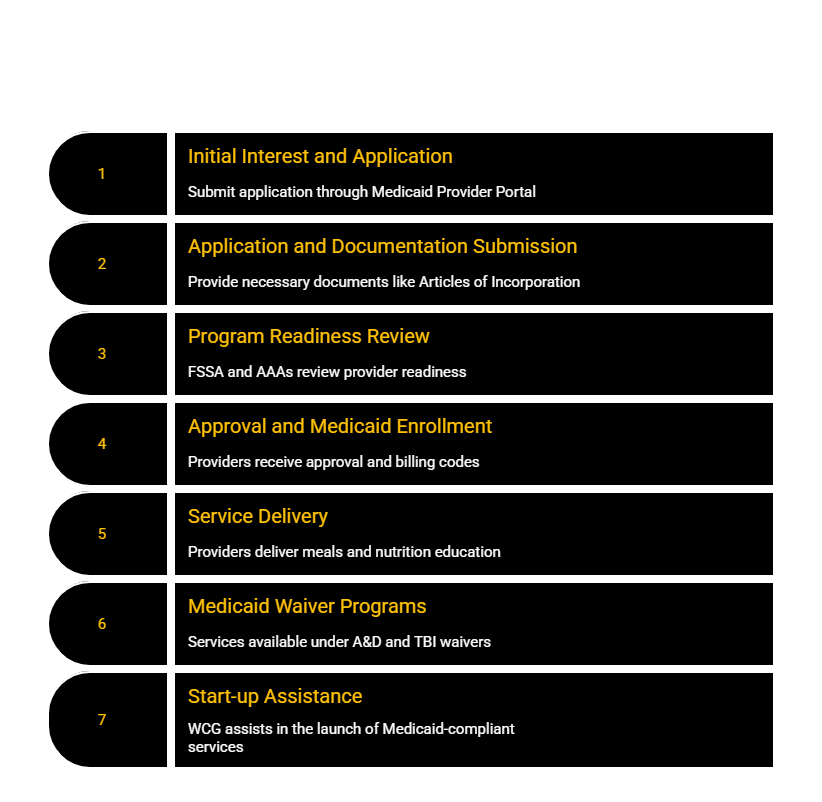
The first step for an interested entity is to formally submit a Provider Enrollment Application. This is done electronically through the Indiana Medicaid Provider Portal. Applicants will specifically seek enrollment for Meal and Nutrition Services under the HCBS waiver programs. This initial submission signals the provider's intent and begins the official vetting process.
Following the initial application, a comprehensive package of documentation must be submitted. This typically includes the business's Articles of Incorporation or equivalent business registration, verification of the EIN and NPI, all relevant food safety certifications and permits, current certificates of liability insurance, detailed operational policies and procedures, and documentation of staff qualifications and credentialing. The thoroughness of this submission is critical for a smooth review.
A critical phase involves a Program Readiness Review. Both the FSSA and local Area Agencies on Aging (AAAs) may conduct these reviews. This evaluation assesses the provider's operational capacity, including the physical state of kitchen operations, the compliance of proposed menus with established dietary guidelines, and the robustness of meal delivery procedures. This review ensures that the provider is operationally prepared to deliver services safely and effectively.
Upon successful completion of the review and approval of all submitted documentation, the provider is officially granted Medicaid enrollment. At this stage, providers are assigned specific billing codes that correspond to the services they are authorized to deliver, such as meal delivery, congregate meal services, and nutrition education activities. This final step enables the provider to commence billing and service delivery within the Medicaid framework.
Essential Documentation for Providers
Maintaining accurate and comprehensive documentation is a cornerstone of operating a compliant and efficient Meal and Nutrition Services provider in Indiana. This documentation serves multiple purposes, including regulatory compliance, operational oversight, and audit readiness.
Key foundational documents include the business's legal registration, such as Articles of Incorporation or equivalent proof of business registration from the Indiana Secretary of State. Essential identification numbers, including the IRS EIN confirmation and NPI confirmation, must also be readily available. Proof of adherence to health and safety regulations is demonstrated through food service permits and recent kitchen inspection reports, along with current certificates of general liability and product liability insurance.
A critical component is the Meal and Nutrition Services Policy & Procedure Manual. This comprehensive manual should detail:
- Participant intake, eligibility verification, and service scheduling procedures: Outlining how new participants are onboarded and services are coordinated.
- Meal preparation, portion control, diet-specific menu development, and food safety standards: Covering the entire lifecycle of meal creation to ensure quality and safety.
- Delivery route planning and meal temperature control protocols: Ensuring meals reach participants safely and at the correct temperature.
- Emergency preparedness, backup meal plans, and disaster response strategies: Addressing potential disruptions to service.
- Participant rights, HIPAA compliance, and grievance procedures: Upholding participant autonomy and privacy.
- Staff credentialing, background checks, food handler certifications, and training logs: Documenting staff qualifications and ongoing training.
- Medicaid billing, service tracking, and audit readiness documentation: Ensuring financial accountability and preparedness for regulatory reviews.
Ensuring all these documents are current, well-organized, and accessible is vital for smooth operations and successful regulatory oversight.
Staffing Requirements and Training
The effectiveness and quality of Meal and Nutrition Services are directly tied to the competency and training of the staff involved. Indiana mandates specific roles, qualifications, and ongoing training to ensure services are delivered safely, effectively, and with a participant-centered approach.
A key leadership role is the Program Director / Nutrition Services Manager. This individual typically requires a Bachelor’s degree in nutrition, dietetics, public health, or a closely related field, coupled with experience managing food service programs. A thorough background clearance is also a standard requirement for this position.
If the provider offers medical nutrition therapy or specialized dietary counseling, the involvement of a Registered Dietitian (RD) is often necessary. This professional must hold an active Indiana dietitian license and undergo a background clearance. For those preparing and delivering meals, Food Preparation and Delivery Staff are required to hold a Food Handler Certification, such as ServSafe, and must also pass background screenings. They need training in safe food preparation techniques, infection control, and best practices for interacting with participants.
Beyond role-specific requirements, all staff members must complete a core set of mandatory training modules. These include comprehensive food safety and sanitation training, HIPAA compliance and participant confidentiality training to protect sensitive information, elder abuse prevention and mandatory reporting training to safeguard vulnerable individuals, and emergency procedures and infection control training. Continuous professional development is also emphasized, with annual continuing education and competency evaluations being standard practice to keep staff skills current and performance high.
Indiana Medicaid Waiver Programs Offering Meal and Nutrition Services
Meal and Nutrition Services are a critical component of Indiana's commitment to supporting individuals in living independently within their communities. These services are specifically integrated into several key Medicaid waiver programs designed to provide comprehensive care for eligible participants.
Two primary Indiana Medicaid waiver programs authorize Meal and Nutrition Services: the Aged and Disabled Waiver (A&D) and the Traumatic Brain Injury Waiver (TBI). These waivers provide funding for a range of supports, with nutrition services playing a crucial role in maintaining health and preventing institutionalization for individuals with diverse needs.
Within the scope of these waivers, approved providers are authorized to deliver several types of nutrition-related support. These include home-delivered meals, which can be provided on a daily basis or multiple times per week, offering consistent nutritional support to homebound individuals. Congregate meals are also a vital service, offered at certified group dining sites that foster social engagement alongside nutritional benefits. For participants with specific health conditions, specialized diet meals can be provided, strictly adhering to their prescribed medical plans. Additionally, providers can offer nutrition education classes or individual counseling sessions, empowering participants with the knowledge and skills to manage their health through informed dietary choices.
Frequently Asked Questions for Meal and Nutrition Providers in Indiana
What are the primary differences between home-delivered meals and congregate meals in Indiana?
Home-delivered meals are prepared and then transported directly to a participant's residence, offering convenience and essential support for individuals who are homebound or have limited mobility. Congregate meals, on the other hand, are served in a communal setting, such as a senior center or community facility, providing a social dining experience in addition to a nutritious meal.
How are special diet meals handled for participants with medical conditions?
Special diet meals must be prepared in strict accordance with a participant's medical dietary needs, as prescribed by a physician or a Registered Dietitian. Providers must have clear protocols for menu development, preparation, and portion control to ensure these specialized meals meet specific nutritional requirements for conditions like diabetes, kidney disease, or heart conditions.
What is the typical timeline for a provider to become fully enrolled and operational?
The timeline for launching Meal and Nutrition Services can vary, but generally involves several phases. Business formation and food safety compliance typically take 1–2 months. Staff hiring, credentialing, and program development may take an additional 2–3 months. The Indiana Medicaid enrollment and service authorization process can take 60–90 days, followed by 30–45 days for Medicaid billing setup and service launch. Overall, providers should anticipate a process that can span several months.
Key Takeaway
Becoming a Meal and Nutrition Services provider in Indiana under Medicaid waiver programs requires a dedicated approach to meeting regulatory, operational, and service delivery standards. By meticulously addressing business registration, food safety compliance, Medicaid enrollment, staff training, and documentation requirements, providers can establish a sustainable and impactful service that significantly enhances the health and independence of participants across the state.
WCG assists nutrition service agencies, home-delivered meal providers, and community-based organizations in launching Medicaid-compliant Meal and Nutrition Services across Indiana. Our support encompasses business registration, food service licensing, and Medicaid enrollment assistance; development of essential Policy & Procedure Manuals; creation of staff credentialing templates, meal tracking systems, and dietary compliance forms; Medicaid billing system setup and audit-ready claims management; assistance with website, domain, and professional branding; guidance on menu development, special diet compliance, and emergency meal planning; implementation of quality assurance systems for inspections, satisfaction surveys, and service monitoring; and partnership development with key organizations such as Area Agencies on Aging, hospitals, and community service organizations.
Our Client Portal offers a wealth of resources that you can explore related to various programs and state requirements.