MEAL AND NUTRITION SERVICES PROVIDER IN GEORGIA
By Fatumata Kaba · 2025-07-14 · 6 min read
SUPPORTING HEALTH, WELLNESS, AND INDEPENDENT LIVING THROUGH NUTRITIONAL MEAL DELIVERY AND COUNSELING
Meal and Nutrition Services in Georgia are essential Home and Community-Based Services (HCBS) designed to support individuals with disabilities, chronic health conditions, and aging-related needs by providing reliable access to healthy food. These services are authorized under Georgia’s Medicaid waiver programs to promote better health outcomes, support independent living, and prevent hospitalizations caused by malnutrition or food insecurity.
Providers in this sector play a critical role in the healthcare continuum, ensuring that participants who are unable to shop for, prepare, or safely handle meals have access to nutritionally balanced, medically appropriate food. By integrating these services into a participant's individualized service plan, Georgia’s Medicaid program effectively bridges the gap between clinical care and daily living requirements.
What Are the Governing Agencies for Georgia Medicaid Nutrition Services?
The administration of Meal and Nutrition Services in Georgia involves a structured hierarchy of oversight, ranging from state-level operational control to federal regulatory guidance. Understanding this framework is vital for any provider seeking to maintain compliance and successfully navigate the Medicaid landscape.
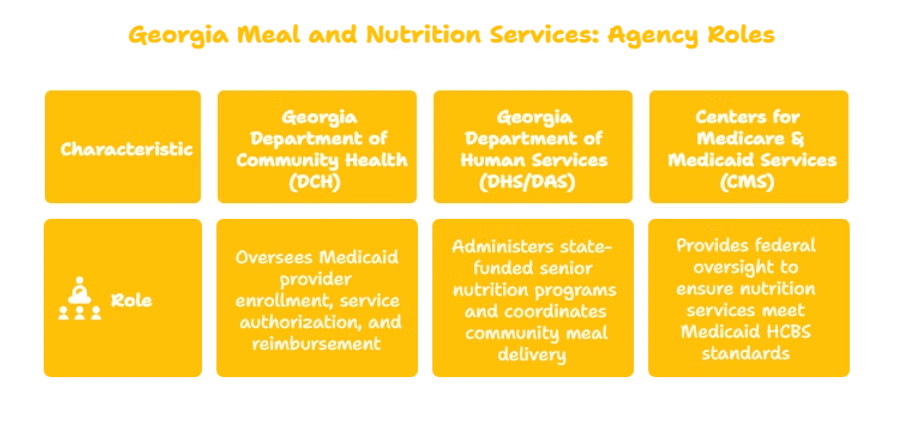
The Georgia Department of Community Health (DCH) serves as the primary governing agency. It is responsible for overseeing Medicaid provider enrollment, establishing service authorization protocols, and managing the reimbursement processes that sustain these programs. Complementing this, the Georgia Department of Human Services – Division of Aging Services (DHS/DAS) plays a pivotal role by administering state-funded senior nutrition initiatives and coordinating local community meal delivery networks.
At the federal level, the Centers for Medicare & Medicaid Services (CMS) provides the overarching regulatory standards. CMS ensures that all nutrition services offered under Georgia’s HCBS waivers remain aligned with federal mandates, specifically focusing on quality assurance, health and safety, and the rigorous requirements of person-centered service planning.
What Scope of Services Defines a Qualified Nutrition Provider?
Meal and Nutrition Services are intended for participants who cannot meet their own nutritional needs due to physical, cognitive, or functional limitations. Providers must ensure that the services delivered are not merely transactional but are fully integrated into the participant's broader care plan, adhering to strict nutritional and safety standards.
Approved providers generally offer a comprehensive suite of services, including:
- Home-delivered meals, which may include hot, cold, frozen, or shelf-stable options.
- Specialized dietary menus such as low-sodium, diabetic-friendly, or renal-friendly diets to manage chronic health conditions.
- Nutritional counseling and dietary education conducted by qualified staff.
- Meal planning assistance tailored to individual medical needs and cultural preferences.
- Contingency support, such as emergency meals, to prevent gaps in nutrition during service interruptions.
- Ongoing coordination with care managers to monitor nutritional status and adjust meal plans as needed.
How Do Providers Navigate Licensing and Operational Requirements?
Before an agency can begin the enrollment process with the DCH, it must satisfy a rigorous set of foundational business and health requirements. These prerequisites ensure that the provider is a legally recognized entity and capable of handling food with the highest standards of safety and hygiene.
Initial requirements include registering the business with the Georgia Secretary of State, obtaining an Employer Identification Number (EIN) from the IRS, and securing a Type 2 National Provider Identifier (NPI). Perhaps most critically, a Food Service Establishment License must be secured from the Georgia Department of Public Health (DPH) or the relevant local health department. Providers must also maintain comprehensive general liability insurance to mitigate operational risks.
Beyond basic business licensing, providers must develop robust, written internal policies. These policies must detail food safety protocols, meal preparation environments, specialized delivery operations, and emergency response procedures. Compliance with all USDA guidelines and Georgia DPH regulations is mandatory for continued participation in the program.
What Is the Step-by-Step DCH Provider Enrollment Process?
The journey to becoming an approved Medicaid provider is a multi-phased process that requires meticulous attention to detail and documentation. It begins with demonstrating operational readiness and concludes with formal enrollment in the state’s billing system.
The initial phase involves requesting application materials directly from the DCH and participating in recommended Medicaid provider orientation sessions. Once the application is submitted, it must be accompanied by comprehensive documentation, including Articles of Incorporation, proof of NPI/EIN, insurance certifications, and the DPH Food Service Establishment License. Additionally, providers must submit evidence of their internal infrastructure, such as sample menus, staff training logs, and proof of background screening compliance.
Following the submission, the DCH conducts a program readiness review. During this stage, regulators evaluate the provider's ability to document service delivery, verify meal distribution, and adhere to nutritional guidelines. Once approved, the provider completes enrollment through the Georgia Medicaid Management Information System (GAMMIS) and establishes the necessary billing codes for Home-Delivered Meals and Nutrition Counseling.
What Are the Essential Staffing and Training Mandates?
The quality of care provided in this sector depends heavily on the competency and preparation of the workforce. Staff members must be qualified to handle food safely and understand the complexities of serving a vulnerable population. Every employee, from the program manager to the delivery driver, must undergo standardized training to ensure compliance with Medicaid expectations.
Key roles include:
- Meal Services Program Manager / Nutrition Coordinator, who should possess a background in nutrition, public health, or food service management.
- Cooks and Meal Preparers, who must hold food handler certifications and demonstrate mastery of sanitation practices.
- Delivery Drivers, who must maintain a valid driver’s license and be trained in both food safety and professional client interactions.
All staff are required to complete mandatory training modules, which include ServSafe or equivalent food safety certification, HIPAA confidentiality and client rights training, and infection control. Furthermore, providers must implement a system for annual refresher training to keep staff informed of updated health standards and evolving documentation requirements.
Frequently Asked Questions
Which Medicaid waivers authorize these services?
Meal and Nutrition Services are currently authorized under the Comprehensive Supports Waiver Program (COMP), the New Options Waiver Program (NOW), and the Independent Care Waiver Program (ICWP), provided they are specifically included in the participant's service plan.
What is the typical timeline for launching a meal services business?
The entire process generally spans several months. Business formation and health licensing take approximately 1–2 weeks, followed by a 60–90 day DCH review period, 30–45 days for staff onboarding and training, and a final 45–60 day window for Medicaid enrollment and billing system setup.
What documents must be included in the DCH provider application?
Applicants must submit business registration documents, NPI and EIN confirmations, the DPH Food Service Establishment License, proof of liability insurance, and a comprehensive Policy and Procedure Manual that covers intake, menu development, HIPAA compliance, and incident reporting.
Key Takeaway
Success in the Georgia Medicaid Meal and Nutrition sector requires a precise alignment between clinical nutritional standards and administrative regulatory compliance. By securing the appropriate food service licensing, maintaining rigorous staff training programs, and adhering to the DCH’s enrollment protocols, providers can establish a sustainable operation that significantly enhances the quality of life for Georgia’s most vulnerable populations. Waiver Consulting Group assists providers in navigating these requirements to build resilient, compliant, and efficient programs.
Last verified August 2024. The information provided herein is for general informational purposes only and does not constitute legal or professional advice. Always consult with the Georgia Department of Community Health (DCH) and the Georgia Medicaid Management Information System (GAMMIS) for the most current regulatory requirements and enrollment guidelines.