MCO Enrollment for Medicaid Waiver Providers: Why a License Isn't Enough to Bill
By Fatumata Kaba · 2026-06-14 · 6 min read
For many emerging Medicaid Home- and Community-Based Services (HCBS) providers, securing a state license and a Medicaid provider number feels like the final hurdle in a long marathon. However, in an era where states increasingly delegate the administration of long-term services and supports (LTSS) to private insurance companies, these credentials are merely the prerequisite for the actual business of billing. Without a formal, executed contract with the Managed Care Organizations (MCOs) operating in your service area, you are effectively locked out of the reimbursement pipeline, regardless of your state-approved status.
Understanding the Shift: Why States Move to Managed Care
Managed Care Organizations are private health plans that state Medicaid agencies contract with to manage the delivery of care for their beneficiaries. Instead of the state paying providers directly on a fee-for-service basis, the state pays these MCOs a "capitated" rate—a fixed monthly fee per member—to cover all authorized medical, behavioral, and waiver-based services. By moving to this model, states aim to better control costs, improve health outcomes through care coordination, and shift the administrative burden of provider oversight to the private sector.
For the provider agency, this shift changes the entire landscape of revenue cycle management. The state is no longer your sole payer; instead, you are operating within a complex ecosystem of multiple insurance plans. Each plan has the authority to dictate which providers are included in their networks, the reimbursement rates you receive, and the specific authorization requirements for every hour of service you provide. Consequently, failing to secure a contract means that even if a member selects your agency, you cannot legally bill for the services provided because you are considered an "out-of-network" provider.
The Difference Between Medicaid Enrollment and MCO Credentialing
A common misconception among new providers is that once they obtain a Medicaid provider number from the state, they are authorized to serve all Medicaid beneficiaries. In reality, Medicaid enrollment is a broad, state-level verification that you meet the minimum qualifications to provide services within the state’s program. It is the essential "entry ticket," but it does not mandate that any private insurance entity must admit you into their provider network.
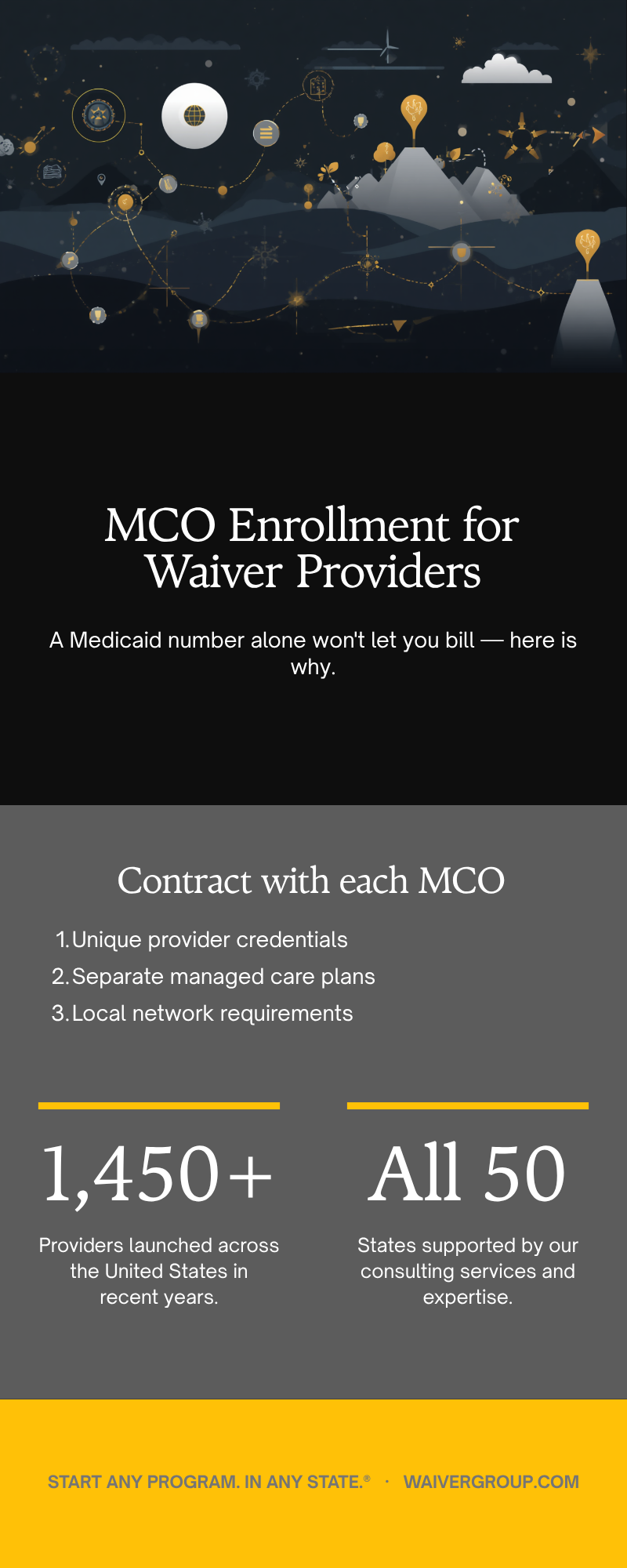
Credentialing is the process by which an MCO verifies your qualifications, training, and operational capacity against their own internal standards. While the state’s licensing board focuses on safety and baseline compliance, MCOs focus on network adequacy, efficiency, and member access. An MCO will verify your staff’s certifications, your physical location, your billing history, and your capacity to serve a specific number of members. Because each MCO is a separate business entity, they each maintain their own independent credentialing portal, application timelines, and documentation standards.
Strategic Alignment: Integrating Credentialing into Your Launch Plan
To avoid a gap in revenue, agencies should treat MCO credentialing as a parallel workstream, starting the moment the state license application is filed. Waiting until you are fully licensed to begin reaching out to MCOs creates a significant "dead zone" where you have the capacity to serve clients but no way to be paid for it. Proactive administrators identify the specific MCOs active in their target counties and map out the unique requirements for each plan.
- Identify every MCO that administers the specific waiver program or service type you are launching.
- Monitor the MCO websites for "Request for Proposals" (RFP) or "Open Network" announcements.
- Build a centralized database for your "credentialing packet," which should include your state license, NPI, tax ID, proof of professional liability insurance, and staff background check certifications.
- Establish a point of contact within the provider relations department of each MCO to track your application status.
The Role of Network Adequacy in MCO Contracting
An important factor often overlooked by new providers is the concept of "network adequacy." MCOs are contractually obligated by the state to ensure that their members have access to a sufficient number of providers within a specific geographic range. If an MCO determines that their current network already meets the demand for your specific waiver service in your county, they may choose to close their network to new providers.
This reality makes the business planning phase critical. Before launching, perform a market analysis to understand the current saturation of providers in your region. If you are entering a saturated market, you must be prepared to articulate why your specific agency is necessary—such as specialized clinical expertise, linguistic capabilities, or the ability to serve members in underserved rural areas. Demonstrating this value can be the difference between an MCO opening a slot for your agency or denying your application based on "no network need."
Managing the Administrative Load Post-Contract
Securing an MCO contract is only the beginning. Once you are credentialed, you must transition your internal processes to support the distinct requirements of each individual payer. This includes mastering different electronic visit verification (EVV) platforms, adhering to varying prior-authorization timelines, and navigating multiple claims submission portals. Because each MCO sets its own clinical policies, documentation for a single member can vary significantly depending on which plan they are enrolled in.
For small to mid-sized agencies, this administrative complexity can become a major operational burden. It is essential to implement robust billing and quality assurance software that can categorize and process claims by payer. Regular training for staff on these varying requirements is vital to prevent claim denials and ensure that your documentation supports the medical necessity standards set forth by each specific MCO.
Frequently Asked Questions
Can I provide services before my MCO contract is fully signed?
Generally, no. Providing services before an effective contract is in place usually results in non-payment, as you are not yet an authorized network provider. Always wait for the formal execution of the contract and confirmation that your agency has been loaded into the MCO’s claims system.
What happens if an MCO denies my application?
Denials are often due to a lack of "network need" or missing documentation. You should request a written explanation for the denial and ask if there is an appeals process or an opportunity to be placed on a waitlist for future network expansion. Reviewing your application for accuracy and ensuring your supporting documents are up to date is the best way to improve your odds in future cycles.
Do I have to contract with every MCO in my state?
You are not legally required to contract with every MCO, but failing to do so may limit your potential member base. A member may be assigned to a plan you are not contracted with, meaning you would have to turn that potential client away. Most successful agencies aim to contract with all major MCOs active in their service area to maximize market access.
Key Takeaway
A license confirms your legal right to exist, and a Medicaid number confirms your baseline qualification to provide care, but an MCO contract is the essential legal instrument that enables your revenue cycle. In a managed care environment, provider success is defined by an agency's ability to navigate the complexities of multiple payer networks, meet network adequacy requirements, and maintain rigorous administrative standards for each plan. Build your infrastructure for credentialing and contract management as a foundational element of your business plan, rather than as an afterthought.
The Waiver Consulting Group has helped launch more than 1,450 providers across all 50 states. We position you to move through licensing, Medicaid enrollment, and MCO credentialing as one coordinated plan. Book a video consultation at waivergroup.com/videoappointment, call 302.888.9172, or email [email protected].