INTERPRETER SERVICES PROVIDER IN OHIO
By Fatumata Kaba · 2025-09-17 · 5 min read
ENSURING EFFECTIVE COMMUNICATION FOR INDIVIDUALS WITH DISABILITIES THROUGH SPECIALIZED INTERPRETATION SUPPORT
Interpreter Services in Ohio provide critical support for individuals with disabilities—including those with hearing, speech, or cognitive impairments—enabling them to access essential services, engage in community life, and communicate effectively with caregivers, providers, and peers. These services are authorized under Ohio Medicaid Home and Community-Based Services (HCBS) Waiver programs to ensure equal access, maintain individual autonomy, and uphold compliance with federal accessibility requirements under the Americans with Disabilities Act (ADA) and Section 504.
What Are the Governing Agencies and Regulatory Frameworks?
The delivery of interpreter services within the Ohio Medicaid ecosystem is a multi-layered regulatory effort. The Ohio Department of Medicaid (ODM) serves as the primary entity responsible for providing Medicaid reimbursement for these services under various approved waiver programs. By standardizing the billing and reimbursement process, ODM ensures that providers can sustain the high level of professional support required for effective communication.
Beyond the primary state Medicaid agency, specialized departments provide targeted oversight based on the needs of the individual. The Ohio Department of Developmental Disabilities (DODD) oversees interpretation services utilized within waiver programs for individuals with intellectual or developmental disabilities (IDD). Simultaneously, the Ohio Department of Aging (ODA) coordinates interpreter supports for older adults, particularly those enrolled in the PASSPORT program. At the federal level, the Centers for Medicare & Medicaid Services (CMS) provides overarching guidance to ensure that all state-level interpreter services meet rigorous HCBS requirements.
What Scope of Services Defines an Approved Interpreter Provider?
Approved Interpreter Services providers are tasked with bridging communication gaps between individuals with disabilities and their service providers, employers, or community resources. This involves the deployment of various modalities tailored to the specific needs of the participant. Successful agencies must be prepared to offer a spectrum of support, ranging from real-time sign language interpretation to nuanced communication strategies for those with cognitive challenges.
- Sign Language Interpretation (ASL): Provision of real-time interpretation for individuals with hearing impairments in various settings.
- Communication Support for Cognitive/Developmental Disabilities: Utilization of simplified language and visual support strategies to enhance understanding.
- Tactile or Close-Vision Interpreting: Specialized support for individuals who are deafblind or have dual sensory impairments.
- Augmentative and Alternative Communication (AAC) Support: Expert assistance in interpreting communication boards, speech-generating devices, or specialized software apps.
- Community and Event Support: Coordination of interpreters for medical appointments, schools, employment, day programs, and community integration activities.
- Documentation and Quality Assurance: Rigorous logging of hours, service locations, communication modalities used, and the outcomes of all interpreted interactions.
How Do You Meet Licensing and Provider Approval Requirements?
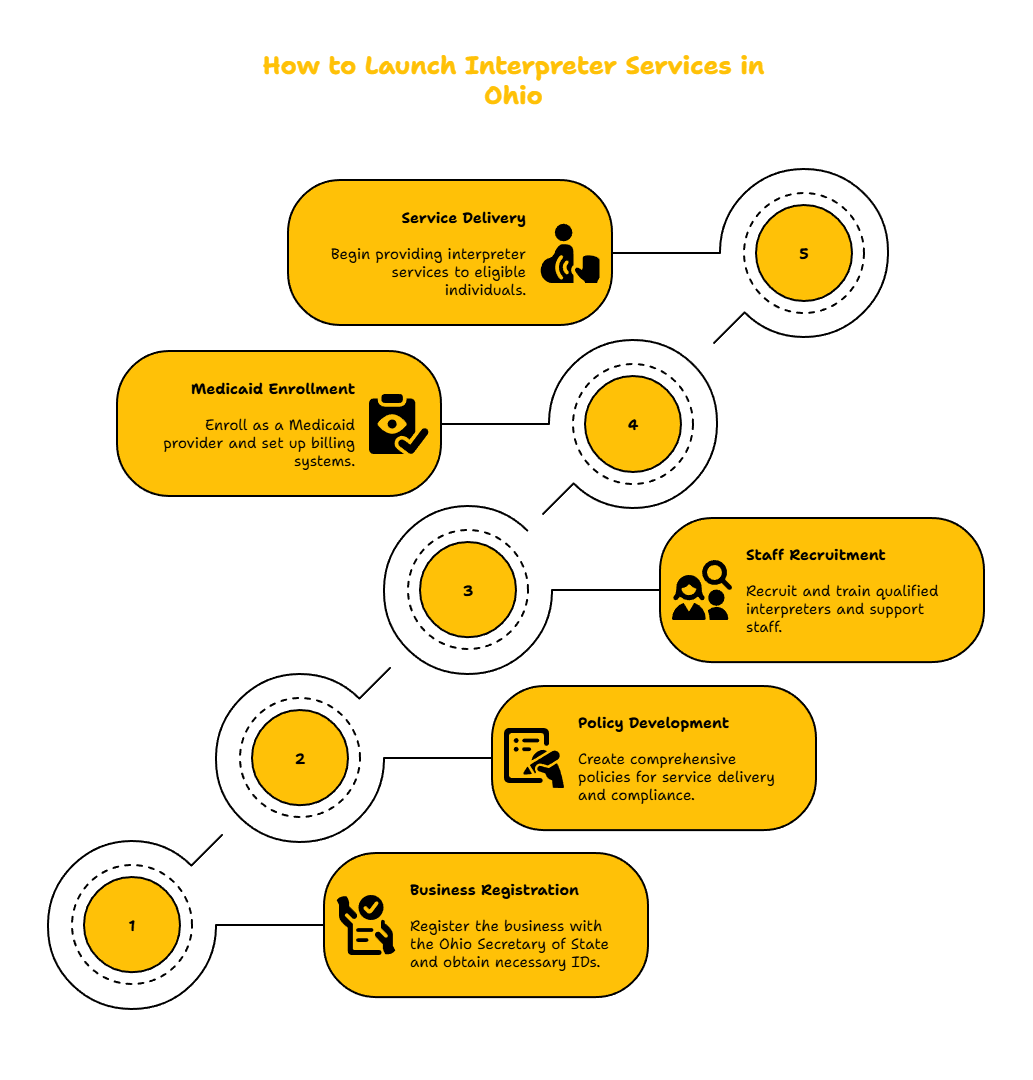
Establishing an agency to provide interpreter services requires meticulous preparation to meet both state and federal standards. Before submitting an application, prospective providers must register their business entity with the Ohio Secretary of State and obtain an Employer Identification Number (EIN) from the IRS. Additionally, obtaining a Type 2 National Provider Identifier (NPI) is a mandatory step for billing services to Medicaid.
Provider approval is contingent upon maintaining comprehensive general and professional liability insurance. Agencies must also demonstrate that they employ or contract with interpreters who hold valid certifications from the Registry of Interpreters for the Deaf (RID), the Board for Evaluation of Interpreters (BEI), or equivalent bodies. Finally, robust internal policies regarding HIPAA compliance, grievance handling, and disability-specific communication training must be established and documented before the agency can be certified to provide services.
What Is the Step-by-Step Ohio Provider Enrollment Process?
The enrollment process is designed to ensure that only qualified, compliant agencies are permitted to bill the Medicaid program. It begins with the submission of a formal application through the Ohio Medicaid Provider Enrollment Portal or through the DODD system, depending on the population the agency intends to serve. This application must be accompanied by comprehensive documentation, including Articles of Incorporation, proof of adequate insurance, and detailed evidence of interpreter credentials.
Following the application submission, a readiness review is conducted by the relevant state agency. During this phase, reviewers evaluate the provider’s service protocols, interpreter qualifications, and adherence to ADA and waiver-specific standards. If the documentation meets all requirements, the provider is granted a Medicaid billing number. Only after receiving this authorization can the agency begin delivering and billing for interpretation services to eligible waiver participants.
What Are the Essential Staffing and Operational Requirements?
Operational success relies heavily on the quality and training of staff. The Interpreter Services Program Director must possess significant experience in disability support, interpretation services, or ADA compliance, along with a deep understanding of Medicaid service models. This leadership role is responsible for overseeing the ethical delivery of services and ensuring all agency personnel remain compliant with evolving state mandates.
All staff—including qualified interpreters and optional communication support specialists—must complete rigorous training programs. These include mandatory modules on ADA and HIPAA compliance, disability sensitivity, and person-centered communication. Furthermore, agencies are required to conduct annual competency assessments and ethics training for all interpreters to ensure that the services provided consistently meet the unique needs of the waiver population.
Frequently Asked Questions
Which Medicaid waiver programs cover interpreter services?
Interpreter services are available under several major programs, including the Individual Options (IO) Waiver, SELF Waiver, Level One Waiver (with limitations), PASSPORT Waiver, Ohio Home Care Waiver, and MyCare Ohio via managed care organizations.
What documentation is required for the enrollment application?
Applicants must submit their business license, IRS EIN confirmation, NPI registration, proof of liability insurance, and a comprehensive Policy and Procedure Manual. This manual should cover scheduling, staff credentialing, HIPAA compliance, service documentation, and quality assurance.
How long does the launch process take for a new agency?
The timeline typically spans several months. Business registration and compliance preparation take 1–2 months, recruitment and policy development take 2–3 months, the enrollment and credential review process takes 60–90 days, and final billing setup takes approximately 30–45 days.
Key Takeaway: Successfully launching an Interpreter Services agency in Ohio requires strict adherence to state regulatory protocols, careful selection of certified personnel, and a robust framework for documenting all service interactions to meet Medicaid and ADA requirements.
WCG supports agencies in launching Medicaid-compliant Interpreter Services in Ohio, including business registration, policy manual creation for interpreter dispatch, staff credentialing tools, billing setup, and ADA compliance reviews. Our Client Portal offers a wealth of resources that you can explore related to various programs and state requirements.
Last verified June 2024. This information is for educational purposes and does not constitute legal or financial advice. Please consult with the Ohio Department of Medicaid and applicable state departments for current rules and regulations regarding Medicaid provider enrollment.