INTERMITTENT EMPLOYMENT SERVICES PROVIDER IN TENNESSEE
By Fatumata Kaba · 2025-10-22 · 5 min read
Intermittent Employment Services in Tennessee provide specialized, flexible support to individuals with intellectual and developmental disabilities (I/DD) who have successfully secured competitive employment but require occasional assistance to maintain their job performance. These services are a critical component of TennCare’s Employment and Community First (ECF) CHOICES Waiver and 1915(c) Waivers, ensuring that participants have a safety net for workplace transitions, new task training, and conflict resolution without the need for constant, full-time supervision.
For provider agencies, establishing an Intermittent Employment Services program requires a robust administrative foundation that aligns with the person-centered planning standards set by the Department of Intellectual and Developmental Disabilities (DIDD). This article outlines the essential regulatory, operational, and documentation requirements necessary to become an authorized provider in the state of Tennessee.
Understanding the Governing Agencies and Regulatory Framework
The delivery of employment-based HCBS waivers is a collaborative effort between state and federal oversight bodies. TennCare serves as the primary Medicaid agency in Tennessee, providing the funding and regulatory structure for ECF CHOICES. Their role is to ensure that all services rendered are medically necessary, person-centered, and consistent with the federal goals of the Americans with Disabilities Act (ADA) and the CMS Home and Community-Based Services Settings Rule.
The Department of Intellectual and Developmental Disabilities (DIDD) acts as the operational arm responsible for the day-to-day administration of the provider network. They manage the provider approval process, conduct quality monitoring audits, and ensure compliance with the specific service standards for employment support. Additionally, the Centers for Medicare & Medicaid Services (CMS) establishes the federal guidelines that dictate how employment supports must be structured within Medicaid waivers to maintain program integrity and federal financial participation.
Defining the Scope of Intermittent Employment Supports
Intermittent Employment Services are designed specifically for individuals who have achieved a level of independence in their work environment. Unlike intensive supported employment, where a coach is present for a large percentage of the work shift, intermittent services are triggered by specific needs or situational changes. By offering "on-call" or occasional support, these services empower individuals to sustain long-term career growth while fostering their natural workplace relationships.
The scope of support typically focuses on problem-solving and skill refinement. Providers assist with:
- On-call job coaching when workplace schedules shift or new job tasks are introduced.
- Travel training refreshers and assistance with transportation coordination.
- Facilitating communication between the employee and employer to address workplace conflicts or performance concerns.
- Providing specific coaching on time management, workplace safety protocols, and professional customer service standards.
- Collaborating with Vocational Rehabilitation and other members of the Individual Support Plan (ISP) team to troubleshoot performance challenges.
Navigating the Provider Enrollment and Licensing Requirements
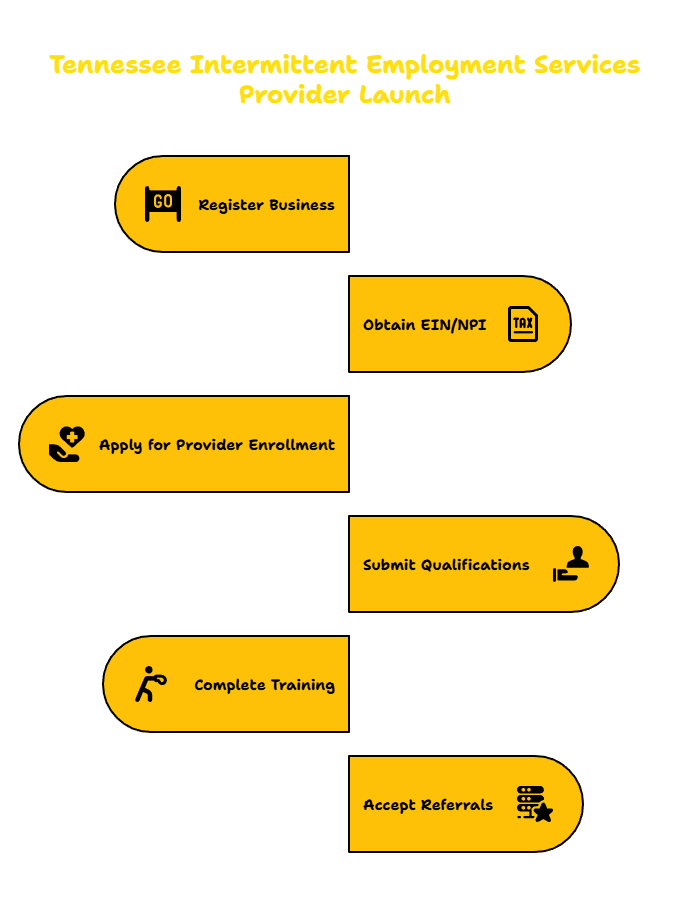
Launching a service agency requires a systematic approach to business registration and credentialing. Before seeking DIDD authorization, an agency must be fully registered with the Tennessee Secretary of State and hold all necessary business tax identifiers, including an Employer Identification Number (EIN) and a Type 2 National Provider Identifier (NPI). This foundational step ensures the agency is recognized as a legitimate business entity capable of entering into state contracts.
Following registration, the provider must apply for enrollment specifically under the ECF CHOICES program for Employment Services. This involves submitting detailed documentation, including comprehensive liability insurance certificates and evidence of data privacy compliance. The state also requires the submission of a robust Policy & Procedure Manual. This manual is not merely a formality; it must clearly articulate how the agency will manage service delivery, document intermittent support encounters, and respond to incidents in alignment with state and federal regulations.
Establishing Operational Documentation and Staffing Standards
The quality of an Intermittent Employment Service program is heavily scrutinized through the documentation it produces. Each service encounter must be linked to a specific, measurable goal outlined in the participant's Individual Support Plan (ISP). Providers must develop and implement standardized forms, such as contact notes and intermittent log sheets, that prove service delivery occurred during moments of genuine need. These records must be readily available for audit purposes to justify billing and to demonstrate the ongoing necessity of the support.
Staffing qualifications are equally critical to the agency's success. Employment Support Professionals and job coaches must meet minimum education standards, typically a high school diploma or higher, and possess verifiable experience in vocational support or workforce development. Because staff are often the primary representatives of the agency at a client's place of work, they must complete rigorous training modules that cover:
- DIDD-mandated Employment Services Training.
- Person-Centered Planning and its application in daily HCBS documentation.
- HIPAA privacy standards and professional workplace etiquette.
- Abuse prevention and emergency safety protocols at off-site locations.
- Employer engagement, advocacy, and effective problem-solving techniques.
Frequently Asked Questions
What is the primary difference between Supported Employment and Intermittent Employment Services?
Supported Employment usually implies a more continuous level of presence and coaching in the workplace, whereas Intermittent Employment Services are reserved for individuals who are largely independent but require periodic, situational support to resolve specific issues or adapt to changes in their work environment.
Can an agency provide these services across all Tennessee Medicaid waiver programs?
While Intermittent Employment Services are a core feature of the ECF CHOICES waiver, they are also available under certain 1915(c) waivers. Coverage is determined by the specific needs identified in the individual’s ISP. Providers must ensure that the participant’s specific waiver enrollment authorizes the service before initiating care.
What is the expected timeline to move from business setup to service delivery?
On average, the process from business registration through policy development and final DIDD enrollment takes approximately 4 to 6 months. This timeline accounts for the time required to secure regulatory approvals, staff training, and the finalization of internal documentation systems.
Key Takeaway
Becoming an approved Intermittent Employment Services provider in Tennessee requires a rigorous commitment to administrative accuracy and a clear understanding of the regulatory landscape defined by TennCare and DIDD. By aligning agency policies with person-centered goals and maintaining meticulous service documentation, providers can effectively support individuals with disabilities in achieving sustainable, long-term employment outcomes. Success in this field relies on the strength of the agency’s professional foundation, the expertise of its staff, and a deep integration with the broader HCBS support team.
Last verified: 2024. This information is provided for educational purposes and does not constitute legal or professional consulting advice. Regulatory requirements are subject to change by TennCare, DIDD, and CMS; providers should consult official state guidance regularly for the most current mandates.