INTENSIVE CARE COORDINATION PROVIDER IN IOWA
By Fatumata Kaba · 2025-07-22 · 5 min read
Intensive Care Coordination (ICC) in Iowa is a specialized, team-based service delivery model designed to support individuals with complex medical, behavioral, and social needs by facilitating seamless communication across multiple systems. As a provider, launching an ICC program requires adherence to strict clinical standards and administrative compliance protocols mandated by the Iowa Department of Health and Human Services (HHS) and contracted Managed Care Organizations (MCOs).
What is the Role of Intensive Care Coordination in Iowa’s Healthcare System?
At its core, Intensive Care Coordination acts as a bridge for high-need participants, particularly children and youth, who are at risk of out-of-home placement, hospitalization, or long-term institutionalization. By utilizing evidence-informed frameworks like the High-Fidelity Wraparound model, ICC providers move beyond standard case management to offer a wraparound-style approach. This process empowers families and youth by placing them at the center of the planning process, ensuring that interventions are not only clinical but also deeply rooted in the participant’s natural support systems.
The primary goal of ICC is to integrate disparate systems—such as schools, juvenile justice, child welfare, and primary care—into a unified, participant-centered plan of care. By maintaining a constant pulse on the participant’s needs and providing 24/7 crisis accessibility, ICC providers reduce the reliance on emergency services and foster sustainable stability within the home and community environment.
How Do Governing Agencies Regulate ICC Services?
The regulatory landscape for ICC in Iowa involves a tiered structure of oversight, ensuring that services remain compliant with both state goals and federal mandates. The Iowa Department of Health and Human Services (HHS), through the Iowa Medicaid Enterprise (IME), serves as the primary governing body. They oversee the implementation of ICC across various waivers and programs, setting the clinical and administrative expectations for all participating agencies.
Managed Care Organizations (MCOs), such as Amerigroup Iowa and Iowa Total Care, act as the intermediaries responsible for the daily authorization and monitoring of ICC services. They ensure that providers adhere to the specific medical necessity criteria and person-centered goals outlined by the state. Finally, the Centers for Medicare & Medicaid Services (CMS) provides federal oversight, guaranteeing that Iowa’s ICC programs align with national Medicaid quality standards, documentation requirements, and participant rights protections.
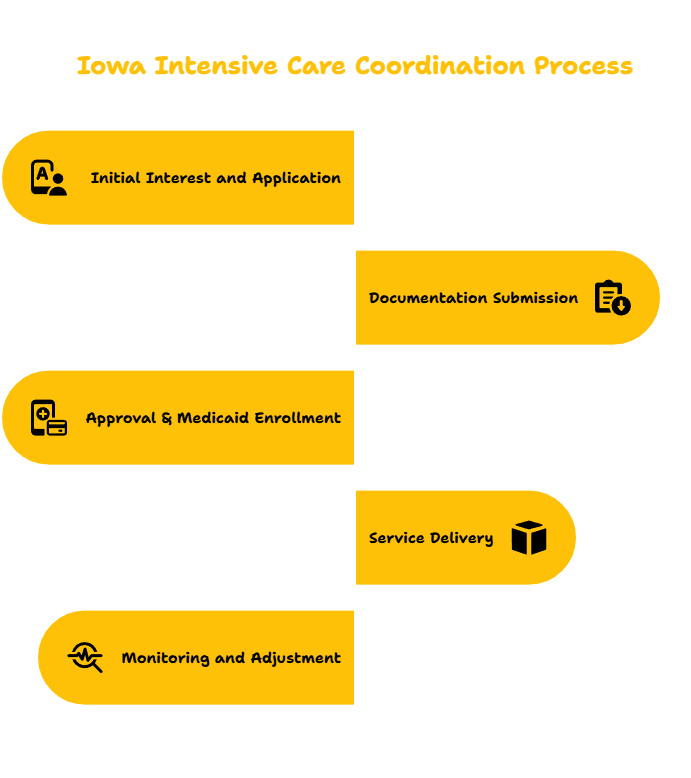
What Steps Are Required to Become an Authorized ICC Provider?
Provider enrollment is a rigorous, multi-stage process that begins with establishing the legal and administrative foundation of the business. Organizations must first register with the Iowa Secretary of State, secure a federal Employer Identification Number (EIN), and obtain a Type 2 National Provider Identifier (NPI). These are the prerequisites for any entity seeking to engage in Medicaid-funded service delivery.
Following business formation, providers must navigate the enrollment system via the Iowa Medicaid Portal Application (IMPA) and seek credentialing through the state’s MCOs. This stage requires the submission of extensive documentation, including organizational policies and procedures that specifically address high-fidelity wraparound protocols, risk stratification methods, and HIPAA compliance. Approval is only granted once the agency demonstrates that its operational infrastructure is capable of sustaining the high-touch, 24/7 requirements of an ICC program.
- Register the business entity with the Iowa Secretary of State.
- Obtain a valid EIN and NPI (Type 2) for billing purposes.
- Enroll in the Iowa Medicaid system via IMPA.
- Obtain specific program credentialing through Amerigroup Iowa and Iowa Total Care.
- Develop a comprehensive Policy & Procedure Manual specific to ICC standards.
- Ensure staff undergo mandatory training for Wraparound facilitation.
What Are the Essential Documentation and Staffing Standards?
To remain audit-ready, ICC providers must maintain robust documentation covering every facet of participant care. This includes detailed intake assessments, individualized care plans, and continuous progress notes that reflect the team-based approach of the wraparound model. Policies must explicitly define how the agency handles 24/7 crisis support, community de-escalation strategies, and the periodic review of service outcomes based on participant and team feedback.
Staffing qualifications are equally prescriptive. The Intensive Care Coordination Supervisor must generally hold a Master’s degree—or a Bachelor’s degree with significant experience—in a human services field, alongside certification in the Wraparound model. Care Coordinators and Wraparound Facilitators typically require at least a Bachelor’s degree and specialized training in behavioral health systems. Incorporating Family or Youth Peer Support specialists is highly encouraged, as these roles bring lived experience that is vital for successful system navigation and participant engagement.
Frequently Asked Questions
Which Medicaid programs reimburse for ICC services?
Intensive Care Coordination is currently reimbursable under the Children’s Mental Health (CMH) Waiver, the Habilitation Services program for adults with chronic mental illness, and through qualified Integrated Health Homes (IHH) that utilize an approved behavioral health coordination model.
How long does the provider enrollment process typically take?
The timeline varies based on organizational readiness, but the full lifecycle—from business formation and policy development to MCO enrollment and final launch—typically spans 6 to 9 months, depending on the volume of applications and the efficiency of the credentialing phase.
Are providers required to follow specific training models?
Yes. Providers are required to adhere to fidelity-based training, such as Wraparound 101 or High-Fidelity Wraparound training. All staff must also maintain certifications in crisis response, trauma-informed care, and HIPAA compliance to ensure the quality and safety of the services provided.
Waiver Consulting Group’s Start-Up Assistance
WCG supports behavioral health agencies, wraparound facilitators, and family/youth support networks in launching Medicaid-compliant Intensive Care Coordination programs across Iowa. The scope of work includes business registration assistance, MCO enrollment support, and the development of essential policy and procedure manuals. We provide the necessary templates for staff credentialing, wraparound fidelity tracking, and documentation systems to ensure that your agency remains audit-ready and aligned with Iowa’s strict Medicaid standards.
Key takeaway: Success as an Intensive Care Coordination provider in Iowa hinges on a rigorous commitment to evidence-informed wraparound fidelity, meticulous documentation of participant progress, and proactive, multi-system collaboration, all while strictly adhering to the regulatory frameworks established by the Iowa HHS and managed care partners.
Last verified: October 2023. Disclaimer: This article is for informational purposes only and does not constitute legal or professional consulting advice. Requirements for Medicaid provider enrollment are subject to change; always consult the Iowa Medicaid Enterprise (IME) and your specific Managed Care Organization (MCO) for the most current rules and regulations.