INDIVIDUAL & FAMILY SUPPORT SERVICES PROVIDER IN VIRGINIA
By Fatumata Kaba · 2026-04-07 · 5 min read
Individual & Family Support Services (IFSS) in Virginia offer person-centered, flexible care designed to empower individuals with disabilities and their families to live safely and independently within their own communities. By bridging the gap between clinical requirements and daily living needs, these services help participants avoid institutionalization while fostering self-determination and strengthening the sustainability of family caregiving.
Administered through the Virginia Department of Medical Assistance Services (DMAS) and facilitated by local Community Services Boards (CSBs), these programs provide a vital layer of support. Whether delivered under the Family and Individual Supports (FIS) Waiver, the Community Living (CL) Waiver, or the Commonwealth Coordinated Care Plus (CCC Plus) Waiver, these services are essential for agencies looking to provide high-impact, community-based care in the state of Virginia.
What Are the Governing Bodies and Their Roles in Service Delivery?
Effective management of Individual & Family Support Services requires a clear understanding of the state’s multi-tiered regulatory structure. The Virginia Department of Medical Assistance Services (DMAS) serves as the primary governing agency, responsible for the oversight of all Medicaid Waiver programs. DMAS defines the operational standards, monitors statewide compliance, and ensures that the delivery of services aligns with federal and state mandates for home and community-based services.
The Department of Behavioral Health and Developmental Services (DBHDS) manages the specific developmental disability (DD) services spectrum. While DMAS maintains the financial and regulatory backbone, DBHDS coordinates the clinical and support aspects, ensuring that individuals receive appropriate care. Locally, Community Services Boards (CSBs) act as the frontline points of contact. CSBs are responsible for authorizing specific services, overseeing the development and implementation of Individual Support Plans (ISPs), and ensuring that the needs of the individual are met through localized service coordination.
What Services Fall Under the Individual & Family Support Umbrella?
Services within this category are intentionally broad and highly individualized, allowing providers to tailor their assistance to the specific needs of the participant and their primary caregivers. Because the goal is to promote independence and family stability, providers must be prepared to offer a mix of practical assistance, skill-building, and emergency support. All services must be identified within the individual's Person-Centered Plan to ensure they are medically necessary and authorized for reimbursement.
Commonly covered services include:
- Assistance with managing medical appointments, transportation coordination, and navigating complex service systems.
- Coordination of educational, social, and community-based resources.
- In-home training and coaching focused on building independent life skills.
- Family and caregiver training sessions to enhance support capacity.
- Crisis support planning and the facilitation of access to backup staff.
- Advocacy training and self-direction skill-building for the participant.
- Facilitation of community engagement and social inclusion activities.
- Flexible respite care options to support unpaid family caregivers.
How Do Agencies Meet Licensing and Provider Approval Requirements?
Becoming an approved Medicaid provider in Virginia is a multi-step process that requires rigorous adherence to state regulations. Before a provider can bill for services, the business must be legally established with the Virginia State Corporation Commission (SCC) and possess an EIN and a Type 2 NPI. The agency must also demonstrate operational readiness, which includes securing comprehensive general liability and workers’ compensation insurance.
Beyond the legal framework, agencies must establish robust internal systems to maintain compliance. This includes the creation of a comprehensive Policy & Procedure Manual that specifically addresses the delivery of Individual & Family Support Services. Providers must also implement secure record-keeping practices for staff training, background checks, and documentation, ensuring that all aspects of the business are "audit-ready" from day one. Contracting with a local CSB is a critical step, as they hold the authority to approve agencies to serve residents within their jurisdiction.
What Is the Sequence for Enrollment and Service Launch?
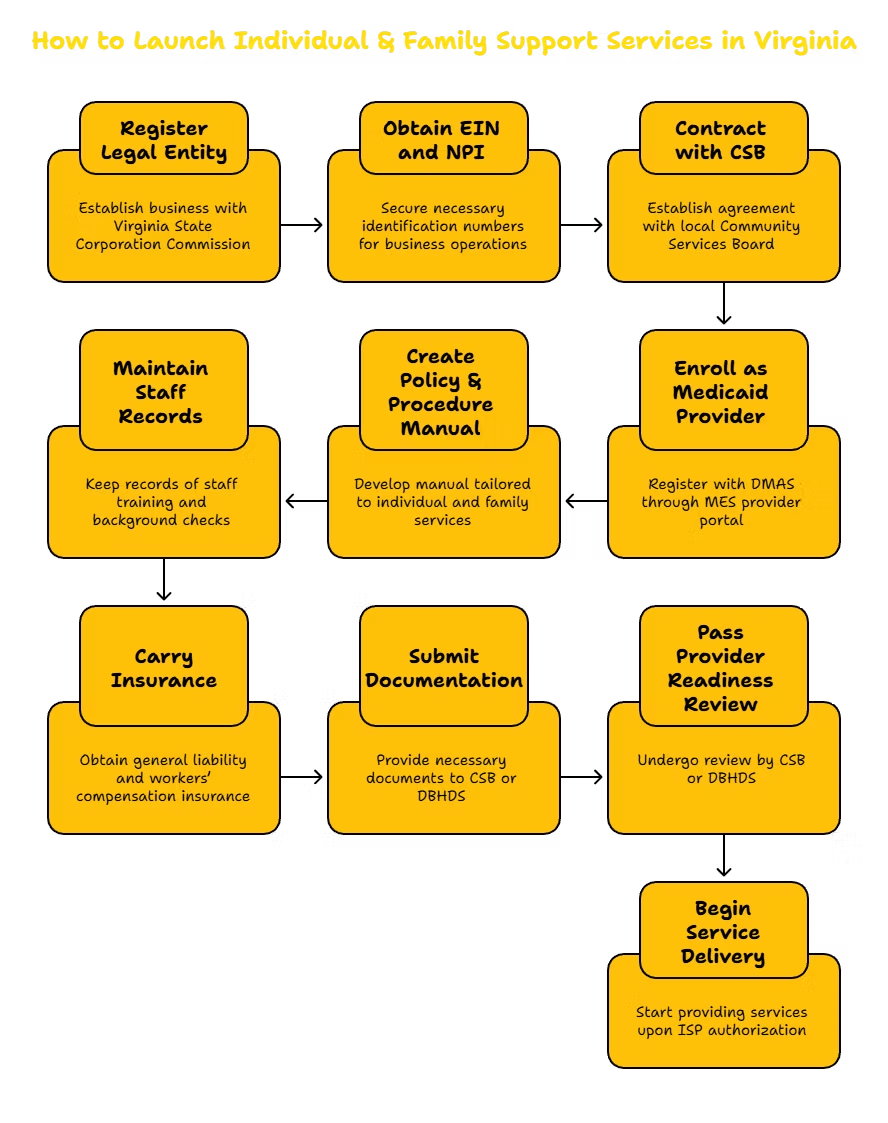
The launch of a Medicaid-approved support program follows a specific, structured sequence. First, the provider must register the legal entity and obtain all necessary tax and identification numbers. Once established, the provider should apply to serve as a contractor with the local CSB, as this is the gateway for receiving client referrals. Simultaneous with CSB coordination, the provider must complete the enrollment application through the DMAS Medicaid Enterprise System (MES) provider portal.
After the initial administrative steps, the provider undergoes a readiness review, which may be conducted by the CSB or DBHDS. This process confirms that the agency has the required manuals, staffing credentials, and insurance documentation to meet state standards. Once the agency is fully enrolled and approved, they can begin delivering services as soon as an individual is referred and their specific service plan is authorized by the CSB.
The general timeline for this launch typically follows this trajectory:
- Business Setup & Policy Development: 3–4 weeks.
- CSB Contracting & DMAS Enrollment: 1–2 months.
- Staff Hiring & Credentialing: 2–3 weeks.
- Service Launch: Begins immediately upon ISP authorization.
Frequently Asked Questions
Which Medicaid Waivers cover Individual & Family Support Services?
These services are primarily authorized under the Family and Individual Supports (FIS) Waiver for those living with families and the Community Living (CL) Waiver for those in their own or provider-operated homes. Additionally, the CCC Plus Waiver may cover certain related supports for adults with physical disabilities or complex health needs.
What are the core requirements for staff, such as Direct Support Professionals?
Direct Support Professionals (DSPs) must typically hold a high school diploma or GED, possess relevant experience with I/DD or behavioral health populations, and pass mandatory background checks and abuse registry clearances. Additionally, all staff must maintain current CPR and First Aid certifications and complete ongoing training in person-centered practices, HIPAA, and documentation.
What must be included in an agency's Policy & Procedure Manual?
The manual must detail the scope of support services, staff roles, and service delivery documentation protocols. It must also clearly outline family communication standards, client rights, HIPAA compliance, grievance procedures, emergency and crisis planning, and the specific procedures for aligning service delivery with the participant’s Person-Centered ISP.
Waiver Consulting Group provides targeted assistance to new and established agencies looking to build effective and compliant support programs. Our services cover the full spectrum of agency development, including CSB contracting, Medicaid provider enrollment, the creation of custom Policy & Procedure Manuals, and the development of documentation tools and staff training materials designed to ensure long-term program success.
Key Takeaway: Successfully operating as an Individual & Family Support Services provider in Virginia hinges on the integration of rigorous administrative compliance, active CSB partnerships, and a deep commitment to person-centered service delivery. By maintaining high standards for documentation and staff training, providers can effectively support individuals with disabilities while navigating the complexities of the Medicaid Waiver system.
Last verified: 2024. This information is intended for educational purposes and does not constitute legal or financial advice. Please consult with the Virginia Department of Medical Assistance Services (DMAS) and your local Community Services Board (CSB) for the most current regulatory updates and specific application requirements.