Indiana Home Care to Home Health: What the Upgrade Really Requires
By Fatumata Kaba · 2026-07-16 · 5 min read
Transitioning from a non-medical home care business to a licensed home health agency in Indiana represents a fundamental shift in both operational complexity and regulatory oversight. While home care focuses on personal assistance and activities of daily living, home health integrates skilled medical services, requiring a complete transition from state registration to comprehensive state licensure and federal certification.
For Indiana providers looking to scale their service offerings, this upgrade is not a minor policy update but a structural reorganization. Navigating the Indiana Department of Health (IDOH) requirements, alongside the rigorous demands of the Centers for Medicare & Medicaid Services (CMS), requires a methodical, step-by-step approach to ensure compliance and clinical readiness.
Why Is the Transition from Home Care to Home Health a Regulatory Leap?
In Indiana, the distinction between home care and home health is established by the scope of services provided. Home care agencies are typically governed by personal services agency regulations, which emphasize non-medical support. Home health agencies, however, provide skilled services—such as nursing, physical therapy, or occupational therapy—that require a physician’s order and systematic clinical oversight.
Because the risk profiles differ, the state treats these as distinct business entities. You cannot simply "add" skilled services to your existing registration. Instead, you must apply for a new home health agency license through the Indiana Department of Health. This application process demands an entirely updated set of policies and procedures that reflect the clinical, administrative, and ethical standards mandated by Indiana law for skilled care providers.
What Are the Indiana Department of Health (IDOH) Licensure Requirements?
The first stage of the transition involves formal licensure through the IDOH. This is a rigorous submission process that requires proof of your agency’s capability to deliver high-acuity care safely. You must submit a formal home health agency license application, which includes detailed documentation regarding your agency’s governance, personnel policies, and clinical procedures.
Compliance during this phase includes:
- Submission of a comprehensive Policy and Procedure manual tailored specifically for home health operations.
- Payment of the required state licensure fees.
- Documentation of clinical leadership, including the appointment of qualified personnel who meet state-mandated experience requirements.
- Verification of administrative space and record-keeping systems that comply with HIPAA and state privacy mandates.
The IDOH will review these documents to ensure your agency has the infrastructure to support patient safety. Unlike simple registration, this process is an evaluative gate that dictates whether your organization is legally authorized to represent itself as a provider of skilled medical care.
How Does Medicare Enrollment Impact Your Agency’s Financial and Operational Path?
To operate as a home health agency, enrollment in Medicare is a practical necessity, as most skilled services are reimbursed through federal programs. Medicare enrollment is significantly more demanding than Medicaid or private pay contracting. You must navigate the federal enrollment application process, which includes a mandatory application fee set annually by CMS—currently $750 for 2026 for institutional providers.
Beyond the application fee, providers must demonstrate fiscal viability. CMS requires proof of reserve operating funds to ensure the agency can sustain services during the initial months of operation without interruption to patient care. This serves as a safeguard to ensure that agencies are not over-leveraged and can meet their obligations to both their staff and their patients.
What Is the Role of the Initial Certification Survey?
The certification survey is the most critical hurdle in the home health upgrade. During this onsite evaluation, state surveyors (or an approved accrediting body) audit your entire operation to ensure it meets the Federal Conditions of Participation (CoPs). This includes auditing clinical records, observing staff interactions, and verifying that your policies and procedures are being applied in practice.
To streamline this process, many providers seek accreditation through a CMS-recognized body. Accreditation can often serve as a bridge to certification, potentially shortening the survey timeline and demonstrating to the state and federal authorities that the agency adheres to national standards of care. Regardless of the route chosen, your clinical staff must be prepared for comprehensive interviews and record audits during the onsite visit.
How Do You Manage Clinical Oversight and Staffing Requirements?
The core of a home health operation is clinical leadership. Under Indiana and federal regulations, you must employ or contract with a supervising Registered Nurse (RN). This individual serves as the heartbeat of your clinical operations, responsible for verifying that all patient care meets the required medical standards.
The supervising RN’s responsibilities typically include:
- Reviewing and approving all patient intakes to ensure clinical appropriateness.
- Developing, updating, and signing comprehensive Plans of Care (POC).
- Providing direct supervision and periodic evaluations of clinical staff, such as Licensed Practical Nurses (LPNs) and home health aides.
- Ensuring documentation reflects the medical necessity of all provided services to maintain compliance with billing regulations.
Frequently Asked Questions
Is it possible to retain my current home care license while operating a home health agency?
Yes, many providers operate both entities. However, they must be maintained as separate legal or operational divisions with distinct policies, billing structures, and staff qualifications, as the regulatory requirements for home care and home health do not overlap.
Can I bill for skilled services immediately upon receiving my state license?
No. While a state license allows you to operate in Indiana, you generally cannot bill Medicare or Medicaid for skilled home health services until you have successfully completed the federal certification process and received your official provider number.
How often are home health agencies audited by the state?
Once you are licensed and certified, your agency will be subject to periodic recertification surveys and complaint investigations. The frequency depends on your agency's compliance history and state-specific audit cycles managed by the Indiana Department of Health.
Key Takeaway
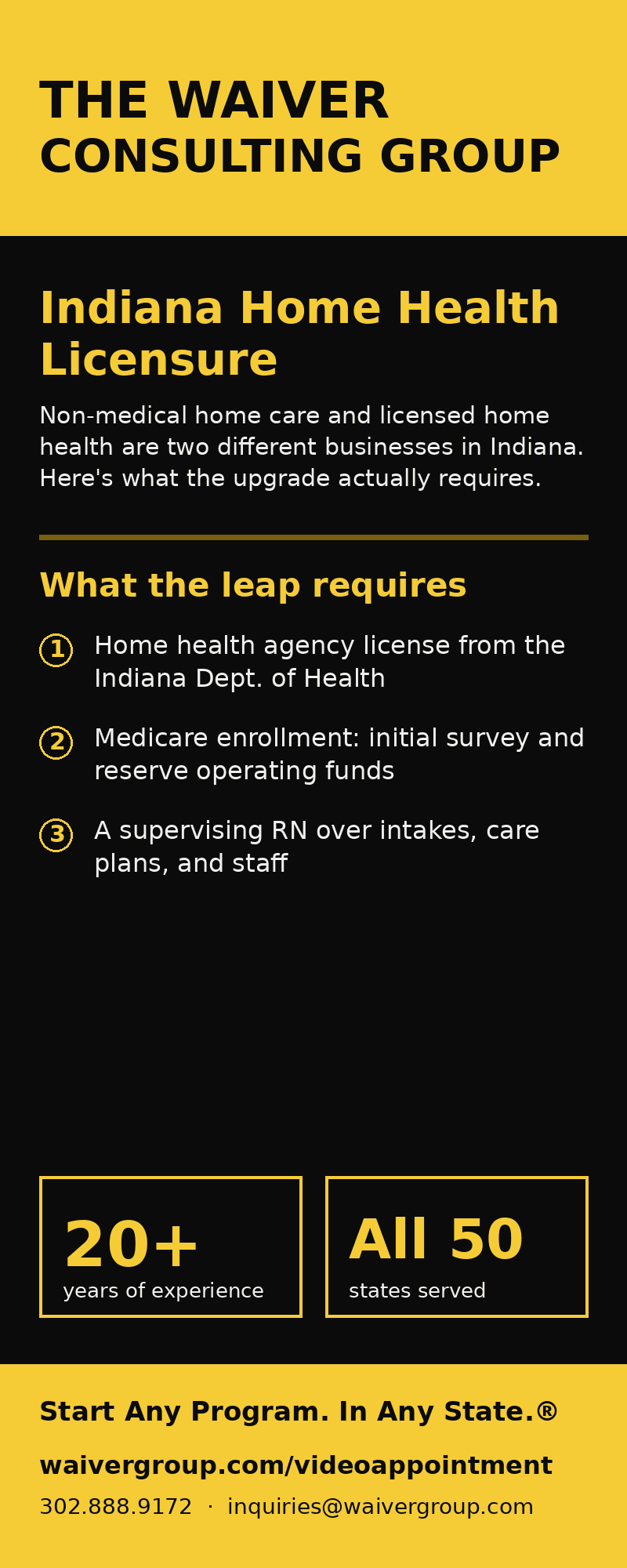
The leap from Indiana home care to licensed home health means a state license, Medicare enrollment with a survey and reserve funds, an updated Medicaid taxonomy, and a supervising RN. This transition requires a dedicated administrative effort and a commitment to meeting both state-level regulatory mandates and federal standards of clinical practice.
Last verified: February 2025. This article is for informational purposes only and does not constitute legal or professional consulting advice. Readers should consult with state agencies or professional advisors regarding specific compliance requirements for their business.