IN-HOME AND COMMUNITY-BASED SERVICES PROVIDER IN NEW JERSEY
By Fatumata Kaba · 2025-09-05 · 10 min read
Establishing an In-Home and Community-Based Services (HCBS) Provider in New Jersey: A Comprehensive Guide for Launching Person-Centered Support.
Launching an In-Home and Community-Based Services (HCBS) provider in New Jersey requires a thorough understanding of state regulations, Medicaid waiver programs, and operational best practices. These essential services, authorized under New Jersey Medicaid Home and Community-Based Services Waiver programs, are crucial for promoting independence and enhancing the quality of life for individuals with disabilities, chronic conditions, or age-related challenges. This guide outlines the key steps and requirements for establishing a compliant and effective HCBS provider in the Garden State.
Navigating the Regulatory Landscape: Key Governing Agencies
Operating an HCBS provider in New Jersey involves working within a defined regulatory framework overseen by several key state and federal agencies. Understanding their distinct roles is fundamental to ensuring compliance and successful program operation. These agencies collaborate to establish standards, authorize funding, and monitor service delivery to protect participants and ensure the effective use of Medicaid funds.
The New Jersey Department of Human Services (DHS) serves as the primary administrator for Medicaid waiver funding dedicated to HCBS. This department is responsible for the overall management of the state's Medicaid program, including provider enrollment, the authorization of services, and the intricate process of reimbursement. They set the foundational rules and guidelines that all HCBS providers must adhere to.
Within the DHS, specific divisions play critical roles. The Division of Aging Services (DoAS) focuses on ensuring that HCBS programs serving the elderly and individuals with age-related needs meet stringent quality standards and are delivered efficiently and compliantly. Similarly, the Division of Developmental Disabilities (DDD) oversees service coordination, eligibility determination, and quality assurance for individuals with developmental disabilities who receive HCBS. Their involvement is crucial for providers targeting this population.
At the federal level, the Centers for Medicare & Medicaid Services (CMS) provides essential oversight for all Medicaid-funded HCBS. CMS ensures that state waiver programs and participating providers meet federal quality standards, uphold the principles of person-centered planning, and implement robust participant protection measures. Adherence to CMS guidelines is paramount for continued federal funding and program integrity.
Understanding the Spectrum of In-Home and Community-Based Services
In-Home and Community-Based Services (HCBS) encompass a broad range of supports designed to enable individuals to live independently and participate actively in their communities. These services are highly individualized, tailored to meet the unique needs, preferences, and goals of each participant as outlined in their Individualized Service Plan (ISP).
Approved providers can offer a variety of critical services. These include Personal Care Assistance, which involves direct support with Activities of Daily Living (ADLs) such as bathing, grooming, feeding, and mobility. Homemaker Services assist with essential household tasks like light housekeeping, meal preparation, laundry, and grocery shopping, helping to maintain a safe and comfortable living environment. For families and primary caregivers, Respite Care offers crucial temporary relief, preventing burnout and supporting sustained caregiving.
Beyond direct personal care, HCBS can extend to more specialized support. Skilled Nursing services may be provided for health monitoring, medication administration, and basic medical care, ensuring participants' health needs are met. Behavioral Support services aim to address challenging behaviors and promote positive social interactions and skill development. Case Management is vital for coordinating comprehensive care plans and connecting individuals with broader community resources. Furthermore, specialized services like Transportation Services ensure access to medical appointments and community activities, while Day Habilitation programs foster the development of social, cognitive, and physical skills. For individuals seeking employment, Supported Employment provides assistance in finding and maintaining community-based jobs. Finally, Home Modifications can be implemented to enhance accessibility and safety within the participant's residence, such as installing ramps or handrails.
Essential Licensing and Provider Approval Requirements
Before an agency can begin providing HCBS in New Jersey, it must successfully navigate a series of licensing and approval processes. This ensures that providers meet the rigorous standards set forth by the state and federal government for safety, quality, and operational integrity.
The initial steps involve establishing the business entity legally. This includes registering the business with the New Jersey Division of Revenue and Enterprise Services, obtaining an Employer Identification Number (EIN) from the IRS, and securing a National Provider Identifier (NPI) (Type 2) for the organization. Crucially, the business must then enroll as a Medicaid Waiver HCBS provider through the dedicated New Jersey Medicaid Provider Enrollment Portal. Depending on the specific services offered, additional licenses or certifications may be required. For instance, providers offering skilled nursing or specialized behavioral support services will need to obtain relevant professional licenses or certifications recognized by the state.
Beyond licensing, providers must demonstrate robust operational capacity and commitment to participant safety. This entails maintaining adequate insurance coverage, including both general liability and professional liability insurance, to protect the agency and its clients. Developing comprehensive policies and procedures is mandatory, covering critical areas such as service planning, health monitoring protocols, and client safety measures. Furthermore, rigorous staff vetting is essential, including comprehensive background checks and health screenings for all personnel, along with documented completion of required training programs.
The New Jersey Medicaid Provider Enrollment Process
Enrolling as an HCBS provider with New Jersey Medicaid is a structured process designed to ensure that all participating agencies meet established criteria. A clear understanding of each stage is vital for a smooth and successful application.
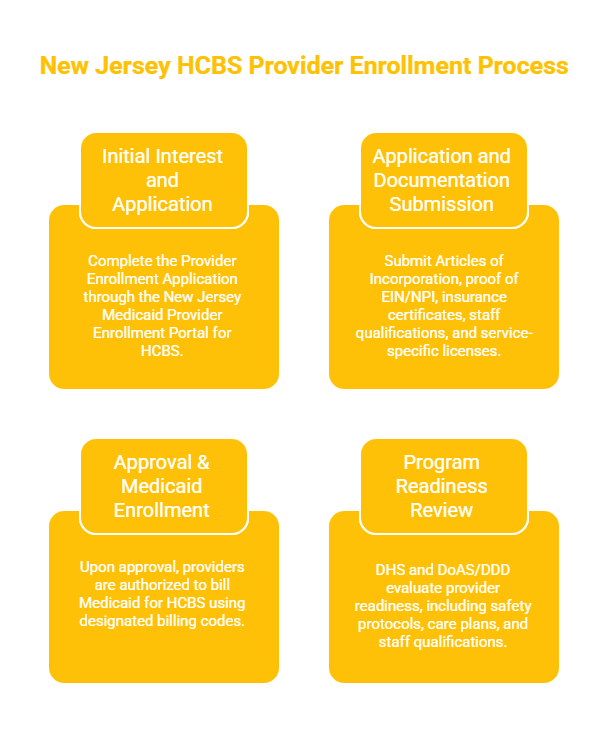
The process begins with expressing initial interest and submitting a formal Provider Enrollment Application. This is typically completed through the New Jersey Medicaid Provider Enrollment Portal, which serves as the central hub for all enrollment-related activities for HCBS providers. Following the initial submission, the applicant will be required to provide a comprehensive package of documentation.
This documentation submission phase requires detailed information and proof of compliance. It includes essential business formation documents such as Articles of Incorporation or equivalent, proof of EIN and NPI, certificates of insurance, documentation of staff qualifications, and any service-specific licenses or certifications obtained. The state agencies then conduct a thorough Program Readiness Review. During this evaluation, the DHS and relevant divisions (DoAS/DDD) assess the provider's preparedness, scrutinizing their safety protocols, the methodology for developing care plans, and the qualifications and training of their proposed staff. Upon successful completion of this review and approval, the provider is officially recognized and authorized to bill Medicaid for HCBS, utilizing the designated billing codes specific to the services rendered.
Required Documentation for Provider Compliance
Maintaining meticulous records and providing comprehensive documentation is a cornerstone of operating a compliant HCBS provider in New Jersey. Agencies must be prepared to submit and maintain a substantial amount of paperwork to satisfy state and federal requirements.
Essential foundational documents include proof of legal business structure, such as Articles of Incorporation or a Business License issued by the New Jersey Division of Revenue. Documentation of federal and national identification numbers, specifically the IRS EIN confirmation and NPI confirmation, is also mandatory. For agencies offering specialized services, relevant licenses or certifications (e.g., for nursing or behavioral support) must be readily available. Proof of adequate insurance coverage, encompassing both general and professional liability, is critical for risk mitigation and regulatory compliance.
A cornerstone of the documentation requirement is a robust HCBS Policy & Procedure Manual. This manual must comprehensively detail the agency’s operational framework and include protocols for participant intake, assessment, and the development of Individualized Service Plans (ISPs). Guidelines for delivering core services like personal care assistance, homemaker tasks, and respite care must be clearly defined. The manual must also outline rigorous staff credentialing, background check procedures, and training requirements. Clear documentation standards for service tracking and Medicaid billing are essential for financial integrity. Furthermore, the manual must address critical compliance areas such as HIPAA adherence, participant rights, grievance handling procedures, safety protocols including emergency response and infection control, and established quality assurance mechanisms for ongoing monitoring and compliance.
Staffing Requirements and Qualifications
The quality and effectiveness of HCBS are directly tied to the qualifications and training of the agency's staff. New Jersey mandates specific requirements for key roles within HCBS provider agencies to ensure participant safety and quality of care.
At a leadership level, an HCBS Program Director is often required. This role typically necessitates a Bachelor’s degree in a relevant field such as healthcare, human services, or a related discipline, with prior supervisory experience being a strong preference. For direct service provision, Direct Support Professionals (DSPs) are the frontline caregivers. Minimum requirements generally include a high school diploma or GED, current CPR/First Aid certification, documented training in supporting ADLs and Instrumental Activities of Daily Living (IADLs), and successful completion of background clearances.
For agencies offering specialized care, additional licensed professionals are necessary. If skilled nursing services are provided, licensed Nurses (RN or LPN) holding a valid New Jersey license and possessing experience in home healthcare are required, along with background clearances. Similarly, agencies providing behavioral support services must employ qualified Behavioral Specialists, often requiring certification in behavioral analysis or a related field, experience in therapeutic interventions, and background clearances.
Regardless of their specific role, all staff members must complete a foundational set of training. This typically includes comprehensive training in client safety, proper techniques for personal care, and infection control measures. Education on HIPAA compliance and participant rights is also mandatory. Ongoing professional development is crucial, necessitating annual competency evaluations and continuous training to stay abreast of best practices and regulatory updates. Safety training, including emergency preparedness, is a critical component for all personnel.
Key New Jersey Medicaid Waiver Programs for HCBS
New Jersey offers a variety of Medicaid waiver programs that authorize and fund HCBS, each tailored to serve specific populations and needs. Understanding these programs is essential for providers to align their services with eligible recipients.
The primary waiver programs that facilitate HCBS delivery in New Jersey include the Community Care Program for the Elderly and Disabled (CCPED), which targets seniors and individuals with disabilities needing support to remain in their homes. The Supports Program Waiver provides a range of individualized services to individuals with intellectual and developmental disabilities. For individuals who have sustained a brain injury, the Acquired Brain Injury (ABI) Waiver offers specialized services and supports. The Personal Care Assistant (PCA) Waiver focuses on providing assistance with ADLs and IADLs, and the overarching Home and Community-Based Services (HCBS) Waiver serves as a broad umbrella for various services aimed at supporting independence in the community.
The services available under these waivers are diverse and designed to meet a wide spectrum of needs. Common offerings include in-home personal care and health monitoring, enabling individuals to receive necessary assistance in their familiar surroundings. Community-based support and engagement activities foster social inclusion and participation in community life. Skilled nursing and other health-related services are provided for those with ongoing medical needs. Behavioral interventions and case management services are crucial for individuals requiring specialized support and coordinated care. Finally, transportation and mobility support are often included to ensure access to essential services and community participation.
Frequently Asked Questions
What is the primary role of the New Jersey Department of Human Services (DHS) in HCBS?
The New Jersey Department of Human Services (DHS) is the primary agency responsible for administering Medicaid waiver funding for In-Home and Community-Based Services (HCBS). They manage provider enrollment, authorize services, and oversee the reimbursement process, setting the foundational rules for HCBS providers in the state.
What types of services can an HCBS provider offer in New Jersey?
HCBS providers in New Jersey can offer a wide array of services, including Personal Care Assistance, Homemaker Services, Respite Care, Skilled Nursing, Behavioral Support, Case Management, Transportation Services, Day Habilitation, Supported Employment, and Home Modifications, all delivered according to an Individualized Service Plan (ISP).
How long does the New Jersey Medicaid provider enrollment process typically take?
The New Jersey Medicaid provider enrollment process, from initial application to readiness review and final approval, can take approximately 60 to 90 days. This timeline can vary based on the completeness of the application, the agency's readiness, and the volume of applications being processed by the state.
Key takeaway: Establishing an In-Home and Community-Based Services (HCBS) provider in New Jersey requires a detailed understanding of state and federal regulations, a commitment to person-centered care, and meticulous adherence to licensing, enrollment, and operational standards. Careful planning and execution across all stages, from business formation to staff training and service delivery, are essential for successful and compliant operation.
Waiver Consulting Group (WCG) provides comprehensive start-up assistance for agencies aiming to launch Medicaid-compliant HCBS in New Jersey. Our services include expert guidance on business registration, Medicaid enrollment, and licensing, alongside the development of essential policy manuals for care planning and safety management. We also support staff credentialing, provide training program templates, and assist with Medicaid billing setup and audit-prepared financial management. Additional offerings include branding, website development, community engagement strategies, robust quality assurance systems, and collaboration with healthcare and community organizations.
Our Client Portal offers a wealth of resources that you can explore related to various programs and state requirements.