Illinois Medicaid Waivers: Who Runs Each Program — and How to Expand
By Fatumata Kaba · 2026-08-08 · 6 min read
Understanding the Illinois Medicaid Waiver Landscape
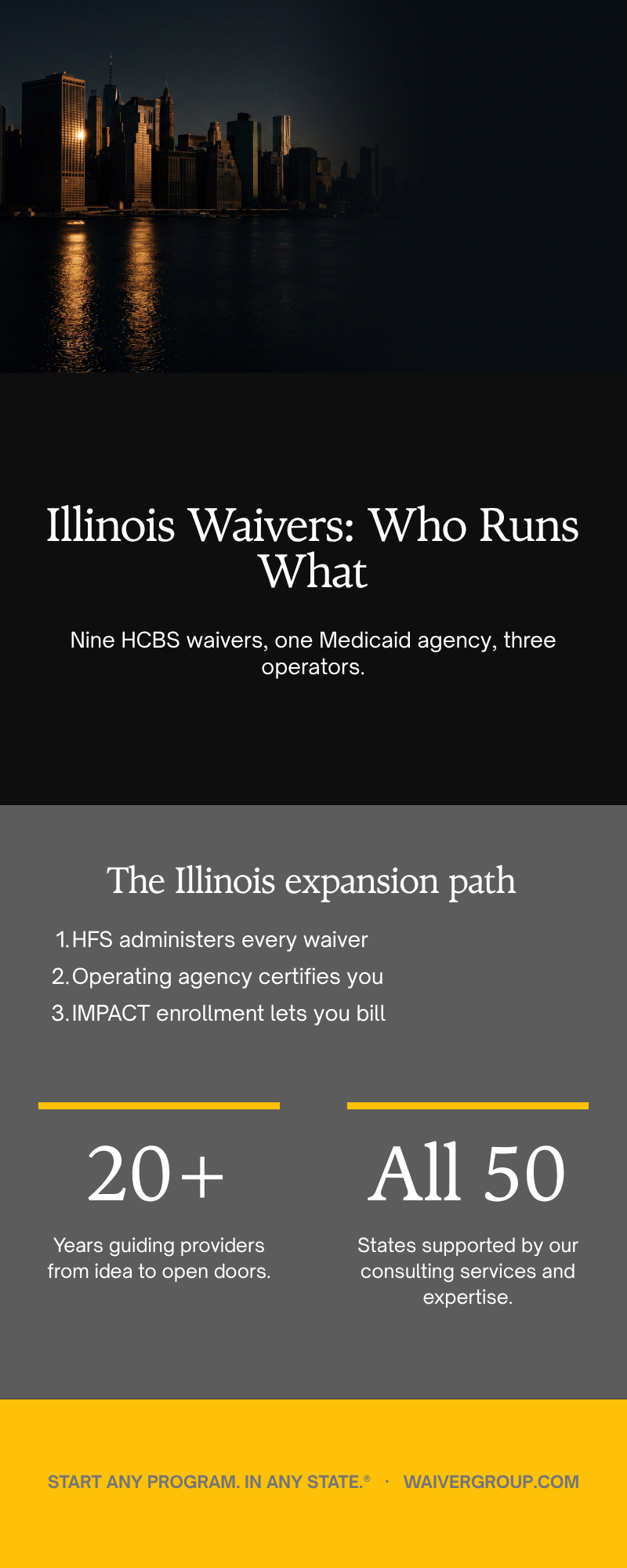
Illinois operates nine distinct Medicaid Home and Community-Based Services (HCBS) 1915(c) waivers, each designed to serve specific populations with unique clinical and social needs. If you are a provider agency founder looking to expand your services or enter a new market, you must recognize that while the Illinois Department of Healthcare and Family Services (HFS) serves as the state’s single Medicaid agency, it delegates the operational oversight of eight of these nine programs to specific sister agencies. Consequently, your path to certification, compliance, and clinical oversight depends entirely on the operating agency governing your target waiver.
Successfully navigating Illinois’s regulatory environment requires a granular understanding of which state department holds authority over your specific service line. Because administrative standards and provider enrollment requirements are not uniform across departments, attempting to apply a "one-size-fits-all" approach to your business operations will lead to significant delays. To expand effectively, you must map your proposed service to the correct operating agency, align your internal quality assurance programs with their specific standards, and manage your enrollment through the state's centralized systems.
Mapping Programs to the Correct Operating Agency
The first step in any expansion strategy is identifying the agency responsible for your target waiver. While HFS maintains financial oversight and final authority over the Medicaid program, the day-to-day administration—including provider certification and clinical requirements—is decentralized. For example, the Illinois Department on Aging (IDoA) maintains the Persons who are Elderly waiver. If your agency is targeting this demographic, you are subject to the standards set by IDoA, not the standards used by the Department of Human Services (DHS).
The DHS itself is split into specific divisions, each managing different waiver populations. The Division of Developmental Disabilities (DDD) oversees the waiver for adults with developmental disabilities, while the Division of Rehabilitation Services (DRS) manages the waivers for persons with disabilities, brain injury, and HIV/AIDS. Finally, HFS retains direct operational control over the Supportive Living Program (SLP). Knowing this hierarchy is critical because certification does not transfer; obtaining credentials to serve individuals under a DRS-managed waiver does not authorize you to operate within a DDD-managed program.
Why Operating Agency Authority Dictates Your Growth
Operational silos in Illinois mean that your administrative burden will vary significantly depending on the waiver. Each operating agency maintains its own set of provider standards, audit protocols, and approval processes. If your agency intends to launch a new service line, you cannot assume that existing compliance policies will suffice. You must research the specific manual or policy handbook associated with that waiver’s operating agency to ensure your staff training, clinical documentation, and reporting protocols meet their distinct expectations.
Furthermore, these agencies operate under different administrative priorities. A provider certified by the Department on Aging must navigate a different inspection cadence and documentation requirement than a provider working under the DHS Division of Developmental Disabilities. Agencies that fail to differentiate between these regulatory environments often face rejected applications or significant audit findings during their first year of operation. Prior to committing financial or human resources to a new program, you should conduct a gap analysis between your current compliance framework and the requirements of the new operating agency.
Navigating the IMPACT Enrollment System
While operating agencies handle certification and programmatic oversight, the Illinois Medicaid Program Advanced Cloud Technology (IMPACT) portal remains the centralized hub for all provider enrollment and revalidation. Run by HFS, IMPACT is the gatekeeper for your Medicaid billing status. Regardless of which waiver you are pursuing, you must ensure your enrollment record in IMPACT accurately reflects your service offerings, provider type, and specialty. Your ability to receive payment is directly tied to the information stored in this system.
When adding a new service line to your agency, your IMPACT profile must be updated to include the appropriate taxonomy and provider enrollment data to match the specific waiver you are entering. Failing to align your IMPACT record with your certified service offerings is a common cause of claim denials. Consider your IMPACT enrollment as a dynamic record that requires ongoing maintenance; every time you receive a new certification from an operating agency, ensure that the corresponding administrative update is made in the portal to allow for seamless billing.
Managing Managed Care Credentialing
In Illinois, a significant portion of the Medicaid population is served through Managed Care Organizations (MCOs). If your target waiver members are enrolled in managed care, simply being state-certified and active in IMPACT is only part of the process. You must treat MCO credentialing as a separate, distinct workstream. MCOs often have their own internal criteria that exceed the state’s minimum requirements, and you will need to negotiate individual contracts with these health plans to receive reimbursement for waiver services.
It is common for provider agencies to receive state approval but experience delays in receiving payments because their managed care contracts are not yet finalized. To streamline this process, you should reach out to the MCOs active in your target region early in your planning phase. Request their specific credentialing packets and confirm whether they require additional clinical documentation or staffing credentials beyond those mandated by the operating agency. Treating MCO credentialing as a parallel process to your state certification is the most efficient way to ensure revenue flow upon program launch.
Frequently Asked Questions
Can I use my current DDD certification to provide services under a DRS waiver?
No. Certification in Illinois is waiver-specific and operating-agency-specific. Because the Department of Human Services (DHS) Division of Developmental Disabilities (DDD) and the Division of Rehabilitation Services (DRS) maintain different provider standards and regulatory protocols, you must seek and obtain separate certification for each program.
Is the IMPACT portal the only system I need to register with to start providing services?
No. IMPACT is the centralized portal for Medicaid provider enrollment and claims, but it does not replace the specific certification or licensure process required by the operating agency (e.g., Department on Aging or DHS). You must first achieve certification through the relevant operating agency, then update your IMPACT enrollment to reflect that status.
Does HFS operate all nine Medicaid waivers directly?
While HFS is the single state Medicaid agency responsible for the administration of all nine 1915(c) waivers, it delegates the day-to-day operations of eight of them to the Department on Aging and the Department of Human Services (DHS). HFS only directly operates the Supportive Living Program (SLP).
Strategic Sequencing for Agency Expansion
To successfully expand your operations in Illinois, follow a strict sequence of operations: first, identify your target waiver and its corresponding operating agency. Second, conduct a thorough review of that agency's specific provider standards, as these will form the basis of your internal policies and procedures. Third, initiate the certification process with the operating agency. Fourth, ensure your IMPACT enrollment is current and mirrors your approved service lines. Finally, initiate the credentialing process with MCOs if the waiver population is subject to managed care.
By following this sequence, you minimize the risk of operational bottlenecks. Many providers stumble by focusing on billing before certification or by attempting to navigate MCO requirements before the state has confirmed their program status. By treating each of these steps as a discrete phase in your expansion plan, you protect your agency's cash flow and ensure compliance with the specific mandates of the operating agency governing your target waiver.
Key takeaway: In Illinois, the waiver you choose determines the agency you answer to. Map your target waiver to its operating agency — Aging, DDD, or DRS — then plan certification, IMPACT enrollment, and managed-care credentialing in that order.
Last verified August 8, 2026. General information about Illinois requirements, not legal or regulatory advice — confirm current rules with the Illinois Department of Healthcare and Family Services and the relevant operating agency.