Illinois Adult Day Services and Home Care: Two Licenses, Two Rulebooks
By Fatumata Kaba · 2026-07-03 · 5 min read
In Illinois, launching a senior care business requires navigating two distinct regulatory environments: the Department on Aging (IDoA) for site-based services and the Illinois Department of Public Health (IDPH) for home-based services. Understanding that these two service models operate under separate statutes and oversight bodies is critical for ensuring compliance and avoiding operational delays during the startup phase.
Understanding the Regulatory Divide in Illinois
The distinction between adult day services and non-medical home care in Illinois is rooted in the physical versus the mobile nature of the service. Because these services serve different needs for the senior and disability populations, the state has compartmentalized the oversight to ensure specific safety and quality metrics are met for each environment.
For entrepreneurs, the primary challenge is not just meeting the requirements of each agency, but managing the sequencing of the application processes. Failing to recognize the difference between a site-specific certification and a service-agency license often leads to significant bottlenecks. Providers must decide early in their business planning whether to pursue one, the other, or a hybrid model, as the administrative burden and capital requirements vary significantly between the two paths.
Adult Day Services: Mastering the Facility-Based Requirements
Adult day services in Illinois are governed by the Department on Aging under the Community Care Program (CCP). Because this service involves bringing participants to a physical location, the certification process is heavily centered on the environment itself. The state requires that the facility must be safe, accessible, and designed to support the specific health and social needs of the participants.
The regulatory scrutiny for adult day programs begins with the physical infrastructure. Before the program can be certified, the provider must navigate local zoning ordinances, submit detailed floor plans for state review, and pass rigorous fire safety inspections. These hurdles are designed to confirm that the space can safely accommodate individuals with various mobility issues or cognitive impairments.
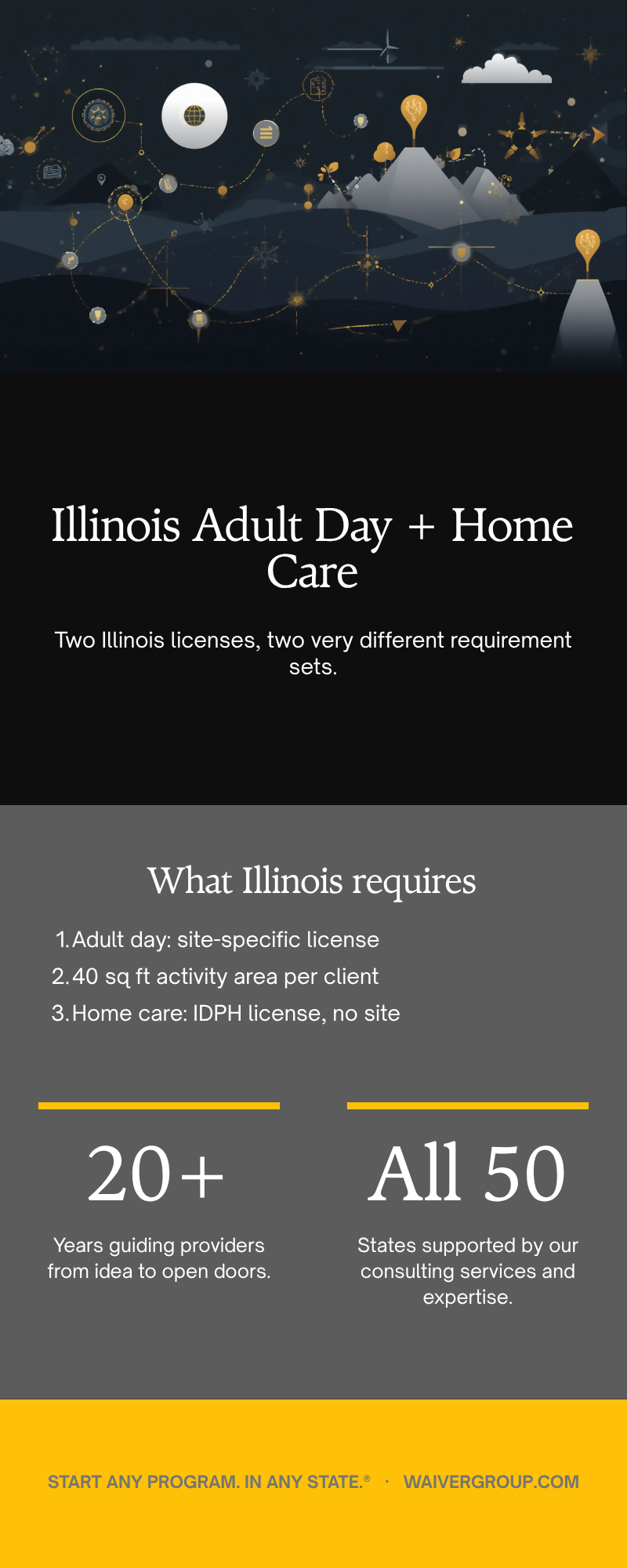
A critical technical requirement for adult day providers is the space-to-participant ratio. Under the CCP rules, providers are mandated to maintain 40 square feet of activity area per participant. It is vital to note that this calculation excludes non-program areas such as exits, offices, storage rooms, and restrooms. Consequently, when assessing potential real estate, founders must calculate their "usable" square footage carefully to avoid overestimating their program’s true operational capacity.
Home Services Agencies: Navigating the IDPH Path
Unlike adult day programs, non-medical home care is regulated by the Illinois Department of Public Health (IDPH) as a Home Services Agency, specifically governed by 210 ILCS 55. This licensing path is distinctly different because it is not tied to a brick-and-mortar facility. Instead, the focus is on organizational policy, background check compliance, and the ability to manage a mobile workforce of caregivers.
Because there is no facility to inspect, the licensure process centers on the creation of a comprehensive Policy and Procedure manual that governs every aspect of care delivery. This includes hiring protocols, clinical supervision, reporting requirements for abuse and neglect, and intake documentation. Even without a physical site requirement, the state mandates that the agency maintains a designated office space that serves as the administrative hub for record-keeping and business operations.
The application for a Home Services Agency license requires a meticulous approach to administrative readiness. Operators must ensure that they have a compliant quality assurance program in place even before they see their first client. While this path avoids fire inspections and local zoning hearings, it requires significant attention to detail regarding state statutes to ensure the agency remains in good standing during subsequent IDPH surveys.
Operational Sequencing: Managing Dual Licensing
Many providers choose to operate both adult day services and non-medical home care under one corporate entity to capture a larger share of the Medicaid HCBS market. While this is permissible, it is vital to understand that the Medicaid enrollment timeline for each program is independent. An entity cannot simply assume that having one license automatically confers status for the other.
The sequence of implementation is often the difference between a smooth launch and a protracted waiting period. Providers should generally focus on securing the site-specific requirements for the adult day program while simultaneously drafting the administrative policies for the Home Services Agency. By running these processes in parallel, an agency can avoid the trap of neglecting the administrative nuances of the IDPH path while preoccupied with the structural challenges of the IDoA certification.
- Identify the specific geographic service area for the Home Services Agency early to satisfy state requirements.
- Ensure that the facility lease or ownership structure for the adult day program aligns with the zoning requirements before signing any long-term contracts.
- Keep separate sets of administrative files for each license to ensure that audits by the Department on Aging and the IDPH remain isolated and clean.
- Budget sufficient time for the Medicaid enrollment portal processes, which are separate for home-based versus facility-based providers.
Common Administrative Hurdles for New Providers
One of the most frequent mistakes in the Illinois startup market is underestimating the time required for state background checks and personnel credentialing. Both the IDoA and IDPH have strict rules regarding who can provide direct care. Assembling a compliant staff roster is not merely an HR task; it is a regulatory requirement that must be documented thoroughly before the agency can be deemed "operational" by the state.
Another hurdle involves the Medicaid enrollment system. The Illinois Medicaid program requires specific documentation that validates your compliance status. If your Home Services Agency license is active but your Medicaid enrollment in the state’s provider portal is pending or flagged for incomplete information, the service delivery cannot begin. Founders must familiarize themselves with the specific electronic submission requirements for both programs to avoid unnecessary delays in reimbursement.
Frequently Asked Questions
Can I use the same office space for both an adult day program and a home services agency?
Yes, you can operate both under one corporate umbrella. However, the adult day facility must meet the specific CCP zoning and floor plan requirements, while your home services administrative office must meet the IDPH requirements for record security and accessibility, even if they occupy the same building.
Do I need a fire inspection if I am only providing non-medical home care?
Generally, no. Because non-medical home care is a community-based service provided in the client's home, you are not subject to the fire safety inspections required for adult day facility licensure under the Department on Aging.
Is the 40-square-foot rule applicable to the office of the Home Services Agency?
No, the 40-square-foot rule specifically applies to the activity area of an adult day service site under the Department on Aging’s Community Care Program. Home Services Agencies are not subject to these space-per-person requirements.
Key Takeaway
Adult day is a site-specific certification from the Department on Aging; non-medical home care is a facility-free Home Services Agency license from IDPH. Sequence them correctly and you open on time.
Last verified: October 2023. This information is intended for educational purposes and does not constitute legal or professional advice. Always consult with state agency representatives and qualified legal counsel to ensure compliance with the most current Illinois administrative codes and Medicaid waiver requirements.