How to Start a Non-Medical Home Care Agency in Michigan
By Fatumata Kaba · 2026-06-16 · 5 min read
Starting a non-medical home care agency in Michigan is a unique process because the state does not require a standalone home care license. Instead, prospective agency owners must focus on meeting Michigan Department of Health and Human Services (MDHHS) qualifications and credentialing through regional waiver agents to provide services under programs like the Michigan Choice waiver.
This guide outlines the regulatory roadmap for launching your agency. By navigating the specific requirements for MDHHS qualification, background checks, and electronic visit verification (EVV) readiness, you can establish a compliant operation capable of serving both private-pay clients and Medicaid-funded participants.
Understanding the Michigan Regulatory Landscape
Unlike many other states that mandate a home health or home care licensure process involving significant state-level surveying, Michigan operates under a provider qualification model. Because there is no specific "non-medical home care license," the barrier to entry is fundamentally different; it shifts the focus from state licensing boards to administrative enrollment and programmatic compliance.
In this framework, non-medical services—such as personal care and homemaker support—are delivered through specific state initiatives. Successfully launching an agency requires you to integrate yourself into the existing infrastructure of the Michigan Home Health program and the Michigan Choice waiver. Your primary objective is to demonstrate that your business meets the operational and ethical standards required to be an authorized vendor for these state-run systems.
Qualifying Through MDHHS
Since a license is not the gatekeeper in Michigan, qualifying through the MDHHS is the functional equivalent. This process involves proving that your agency has the administrative infrastructure to support vulnerable populations. You are essentially building a foundation that is robust enough to handle the oversight requirements of both private-pay models and Medicaid operations simultaneously.
To succeed, you must ensure that your business entity is fully formed and that your internal governance structures align with state expectations. This includes drafting comprehensive operational documents that reflect your intent to provide services under the Michigan Choice waiver guidelines. While the lack of a license simplifies the initial paperwork, it increases the importance of your internal policies, as these will be the primary documents reviewed during your enrollment process.
The Essential Role of Background Checks and Enrollment
Compliance is non-negotiable in the home care sector. Every individual associated with your agency, particularly those who will have direct contact with clients, must clear criminal background checks through iChat (Internet Criminal History Access Tool). The state uses this system to ensure that providers maintain the integrity and safety standards required for the protection of waiver participants.
Once your background checks are in order, the focus shifts to the Medicaid provider application. While your agency may begin with private-pay clients, seeking Medicaid reimbursement requires a formal, rigorous application process. You will often find that a physician’s recommendation or certification is required for the authorization of non-medical care under these programs, making it essential to have clear referral pathways and a thorough understanding of the clinical necessity documentation required by the state.
Integrating Clinical Oversight and Compliance
Even for non-medical agencies, Michigan requires appropriate oversight to ensure that the services being provided match the actual needs of the individual. A qualified nurse must assess the client to determine if the requested services are appropriate. This step is a critical component of your operational compliance and cannot be bypassed.
The nurse responsible for these assessments does not necessarily need to be a full-time W-2 employee; they can be a 1099 contractor, provided they maintain the necessary credentials and follow state guidelines. Your agency must also maintain a comprehensive policy and procedure manual. This document serves as the "source of truth" for your staff and auditors, detailing how you handle everything from emergency protocols to client rights and privacy.
Preparing for EVV and Operational Readiness
Modern home care management is tethered to Electronic Visit Verification (EVV). Michigan, like other states, utilizes EVV to track service delivery in real-time. Before you can be fully credentialed as a Medicaid provider, your agency must prove it is EVV-ready. This means selecting a software platform that integrates with state requirements and ensuring your staff is trained on its usage.
Operational readiness extends beyond technology. You must demonstrate that your agency is organized and prepared to handle the documentation volume required for Medicaid billing. This includes proper time-tracking, visit verification, and maintaining clear records that justify the hours billed. Being "EVV-ready" is not just a technical box to check; it is a fundamental aspect of your agency's fiscal and operational accountability.
Establishing Your Launch Timeline
The total time required to go from a business idea to an active, reimbursed agency typically ranges from 12 to 20 weeks. Registration should always be your first phase, as this allows you to begin establishing your business identity and potentially start operations with private-pay clients who do not require state-level credentialing.
By prioritizing private-pay clients while you navigate the more complex Medicaid credentialing steps, you can generate revenue and build your team while waiting for official approval. This staggered approach mitigates the financial strain of the startup phase and ensures that your administrative team is well-versed in your policies before you take on the additional demands of Medicaid-funded participants.
Frequently Asked Questions
Is a home care license required in Michigan?
No, Michigan does not issue a separate home care license. Instead, providers must qualify through MDHHS and complete the Michigan Choice waiver agreement to become an authorized provider.
What is the role of the nurse in a non-medical agency?
A nurse must assess whether services are appropriate for each client. This role is vital for compliance and can be filled by either a W-2 employee or a 1099 contractor.
How long does the startup process usually take?
The full path from initial registration to Medicaid contracting typically takes between 12 to 20 weeks, depending on your readiness and the speed of the credentialing process.
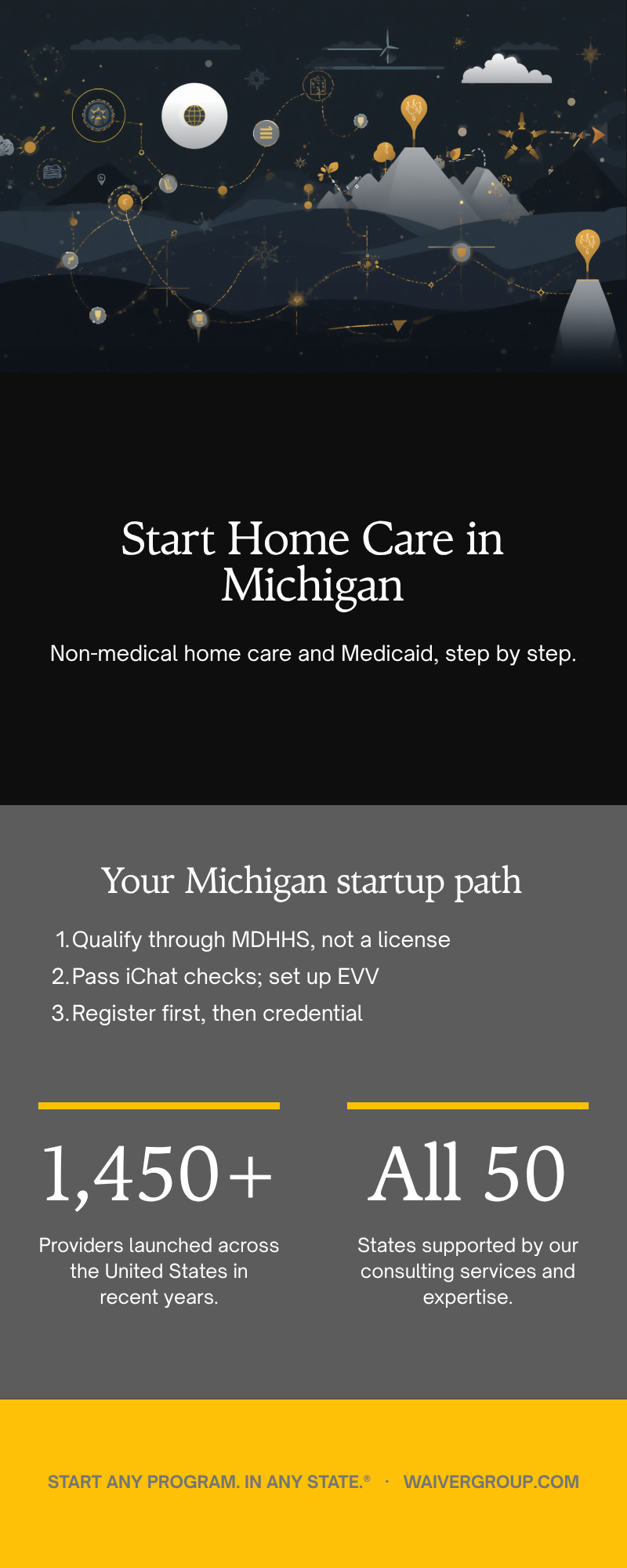
Key takeaway: Michigan has no separate home care license. Qualify through MDHHS, clear iChat checks, get EVV-ready, and register first.
Start Any Program. In Any State.® We've helped launch more than 1,450 providers across all 50 states over 20-plus years, and we position you to move from registration to Medicaid contracting with fewer delays. Book a video consultation at waivergroup.com/videoappointment, call 302.888.9172, or email [email protected].
Last verified: May 2024. The information provided is for educational purposes only and does not constitute legal or professional advice. Always verify requirements with the relevant state agency before making business decisions.