How to Open a Residential Care Home in Delaware
By Fatumata Kaba · 2026-07-11 · 6 min read
Opening a residential care home in Delaware is a rigorous process that centers on obtaining licensure through the Division of Health Care Quality (DHCQ), a division of the Delaware Department of Health and Social Services (DHSS). Prospective providers must demonstrate compliance with strict safety, administrative, and clinical standards to ensure the protection of vulnerable residents before the facility is authorized to operate.
Understanding the Role of the Division of Health Care Quality (DHCQ)
The DHCQ serves as the primary regulatory body for long-term care in the state. Its mission is to ensure that healthcare facilities meet the minimum standards necessary for resident health, safety, and welfare. Because the agency oversees everything from residential care facilities to rest homes, understanding its specific regulatory framework is the foundational step for any provider.
When you initiate the process, you are essentially entering into a long-term relationship with the DHCQ. You must build your operational plan, staff training modules, and facility policies around the DHCQ’s current requirements. Engaging with the agency early ensures that your facility design and administrative procedures align with the state’s expectations for care quality and facility oversight.
Because the DHCQ acts as the gatekeeper for operational authority, providers must treat the agency’s guidelines as the baseline for all internal facility policies. Failure to align facility culture and administrative processes with DHCQ expectations during the pre-licensure phase often results in extended review times and multiple rounds of revisions.
Establishing the Legal Foundation of Your Business
Before submitting an application to the DHCQ, you must establish the legal entity that will hold the license. This involves standard business formation procedures that provide the necessary documentation for regulatory filings. Without a verified legal structure, state agencies cannot process licensing applications, as they require a clearly defined responsible entity.
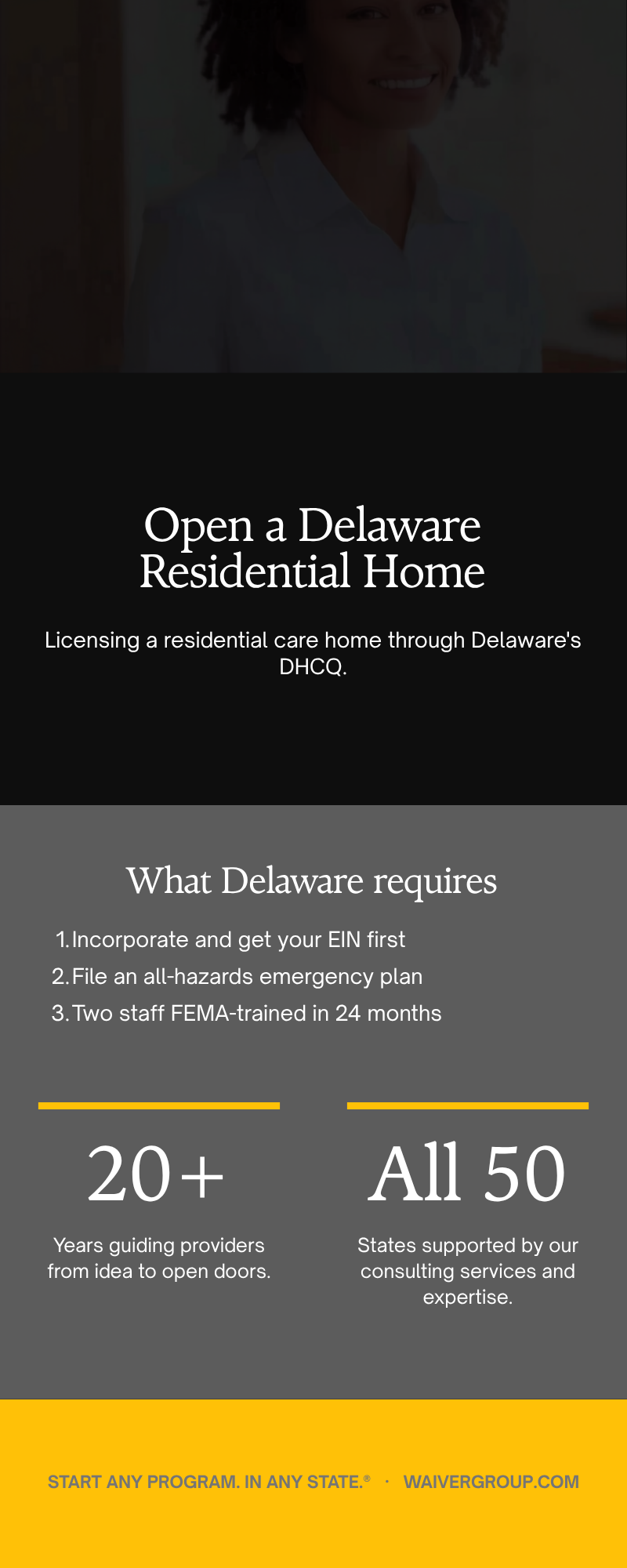
This phase is primarily administrative but critical for long-term compliance. You must file your articles of incorporation with the Delaware Secretary of State and secure a federal Employer Identification Number (EIN) from the IRS. These documents serve as proof of identity for your business, allowing you to open a commercial bank account and execute the legal contracts required to sign property leases or purchase care home assets.
Beyond basic incorporation, ensure that your organizational documents explicitly state the business's intent to operate a residential care facility. State inspectors will verify that the entity listed on your application matches the corporate documentation filed with the Secretary of State, ensuring that liability and ownership responsibilities are clearly mapped before operations begin.
Preparing Mandatory Safety and Emergency Documents
Delaware takes emergency preparedness very seriously, and the DHCQ requires extensive documentation regarding how your home will function during a crisis. An incomplete or inaccurate submission of your emergency plan is a primary cause of licensing delays, making it essential to prioritize this documentation during the pre-application phase.
Your application package must include a comprehensive "all-hazards" emergency plan. This document should detail exactly how your home will respond to environmental, medical, or security-related threats to ensure resident safety. Furthermore, you must provide proof that at least two full-time employees have successfully completed specific FEMA training courses within the last 24 months:
- ICS-100: Introduction to the Incident Command System
- NIMS-700a: National Incident Management System, An Introduction
In addition to these specific certifications, the plan should outline evacuation routes, communication strategies with local first responders, and protocols for sheltering in place. The DHCQ assesses these plans not merely as paperwork, but as a direct reflection of the provider's capability to manage high-stakes, real-world crises.
Ensuring Facility Compliance and Staffing Requirements
The physical structure of your residential care home must meet state health and fire safety standards. The DHCQ will often coordinate with other state departments to ensure that your facility is properly equipped, accessible, and safe for the intended resident population. Providers should conduct a thorough walkthrough of the physical space to ensure it complies with local building codes before inviting state inspectors for a formal review.
Beyond the physical building, you must maintain a staffing level that meets the state's requirements for oversight and care. This includes ensuring that personnel are qualified for their roles and that you have evidence of background checks and required certifications. Documentation of these staff credentials must be kept organized and accessible, as they will be subject to review during initial licensing inspections and subsequent monitoring visits.
Staffing compliance also extends to the quality of training provided. It is not enough to simply hire personnel; administrators must maintain logs indicating when orientation was completed, when ongoing competency testing occurred, and how the facility ensures that staff members remain in compliance with annual health and safety training mandates.
Navigating the Application and Inspection Process
The formal application process is sequential and requires precise attention to detail. Once you submit your application to the DHCQ, the agency will review the submitted materials for accuracy and regulatory compliance. It is common for the DHCQ to request clarification or supplemental documentation before proceeding to the next stage.
Following the document review, the DHCQ will coordinate a site inspection. This is the critical phase where state officials visit your location to verify that the facility is prepared to operate according to the information provided in your application. They will evaluate your fire safety protocols, resident records, staff training documentation, and general environment to confirm that you are ready to provide the level of care promised in your operational plan.
During the inspection, remain transparent and prepared. Inspectors look for consistency between your written policies and your daily operational procedures. Successful providers utilize a checklist based on the DHCQ's standards to conduct "mock inspections" prior to the official state visit to ensure no gaps exist in their safety or administrative documentation.
Maintaining Long-Term Regulatory Success
Licensure is not a one-time event but an ongoing obligation. Once your facility is operational, the DHCQ will conduct periodic surveys and inspections to ensure continued compliance. Maintaining a culture of audit-readiness—where staff are trained to follow regulations daily rather than just before an inspection—is the hallmark of a successful residential care home.
Administrators should develop a system for tracking policy updates from the DHCQ. Regulations regarding long-term care can evolve, and providers are expected to remain current on all changes. By establishing a central repository for all regulatory correspondence, inspection reports, and corrective action plans, you protect your facility’s standing and ensure the highest standard of care for your residents.
Frequently Asked Questions
Is an EIN required before I contact the DHCQ?
Yes. You must secure your EIN and complete your articles of incorporation prior to submitting your licensing application. These documents are necessary to verify your business status with the state and to satisfy the administrative requirements for opening a licensed residential care facility.
What happens if my staff members haven't taken the FEMA training?
If your staff has not completed the required ICS-100 and NIMS-700a training within the past 24 months, your application is considered incomplete. You must ensure that at least two full-time staff members have these credentials, and you must submit proof of completion to avoid unnecessary delays during the application review process.
How can I avoid delays in the licensing process?
The most effective way to avoid delays is to ensure your initial application is complete and accurate. Verify current requirements directly with the DHCQ before submission, ensure all emergency plans are finalized and aligned with state expectations, and keep your documentation organized to respond promptly if the DHCQ requests additional information or clarification.
Key takeaway: In Delaware, the Division of Health Care Quality licenses residential care and rest homes. Incorporate, get your EIN, file an all-hazards emergency plan, and keep two staff FEMA-trained.
Last verified: May 2024. This information is for educational purposes only and does not constitute legal or professional advice. Always verify current state regulations and agency requirements directly with the relevant licensing authority before initiating your business plan.