How to Launch a Peer-Led Recovery Support Services Organization
By Fatumata Kaba · 2026-06-17 · 5 min read
Launching a peer-led recovery support services organization requires a strategic alignment of state-specific Medicaid policy, operational infrastructure, and a clear understanding of the regulatory landscape governing behavioral health delivery. By navigating the distinct requirements for peer certification, provider enrollment, and billing authorization, organizations can transform lived experience into a billable, sustainable clinical asset that supports long-term recovery outcomes.
Understanding the Strategic Value of Peer-Led Services
Peer recovery support services (PRSS) leverage the unique power of lived experience to provide non-clinical, strength-based support to individuals navigating substance use disorders or mental health challenges. As states increasingly integrate these services into their Medicaid HCBS waiver programs and state plan amendments, the role of the peer support specialist has evolved from a grassroots volunteer model to a recognized, reimbursable component of the continuum of care.
For provider agency founders, the shift toward peer-led models represents an opportunity to improve engagement and retention in behavioral health systems. Unlike traditional clinical models, peer-led programs focus on recovery navigation, social support, and skill-building in the community, often resulting in higher patient satisfaction and reduced recidivism in inpatient or emergency settings. Aligning with these state objectives is the first step toward building a successful and sustainable organization.
Distinguishing Between Peer-Led and Clinician-Delivered Models
When structuring a new organization, administrators must first determine the operational framework dictated by their state’s Medicaid authority. States generally categorize these services into two primary pathways: clinician-delivered and peer-led.
- Clinician-Delivered Models: In this framework, peer support specialists are integrated into a larger, licensed clinical practice. They work under the direct supervision of a licensed mental health professional, and the agency bills through the provider’s existing credentials.
- Peer-Led Models: This designation grants the organization status as a primary service provider. Peers function as the central service model, often requiring the organization to meet specific administrative criteria regarding peer-to-supervisor ratios and recovery-oriented mission requirements.
The model selected directly dictates licensing requirements, staff credentialing, and the complexity of the Medicaid billing process. Peer-led organizations typically face more rigorous scrutiny regarding internal policies, as they are often responsible for maintaining their own quality assurance and supervision protocols without the protective umbrella of a larger clinical host.
Selecting the Optimal Regulatory Jurisdiction
Medicaid administration is not a monolith; states often delegate the oversight of recovery services to regional entities, local behavioral health authorities, or specific managed care organizations (MCOs). Identifying which region offers the most streamlined path to approval can significantly impact the initial runway of a new provider organization.
Founders should conduct a landscape analysis to determine which jurisdictions are actively prioritizing the expansion of peer services. Some regions may have shorter approval windows, less administrative backlog, or specialized technical assistance programs for new entrants. Prioritizing regions where the state's Medicaid program has a documented need for increased peer capacity can shorten the overall path to becoming an active provider and receiving authorization to bill.
Establishing a Robust Operational Foundation
Success in the Medicaid space relies on the strength of an organization’s operational infrastructure. This foundation goes beyond simple incorporation; it requires a comprehensive suite of policies and procedures that reflect both state regulatory standards and clinical best practices. An agency must demonstrate its capability to manage documentation, maintain privacy under HIPAA, and track service outcomes.
Before submitting enrollment applications, the organization must ensure the following components are finalized:
- Corporate Formation: Proper legal status with the secretary of state that aligns with behavioral health provider classifications.
- Policy Development: Clearly defined incident reporting, supervision requirements, and staff code of ethics.
- Credentialing Infrastructure: A system to track and verify peer certifications, background checks, and ongoing training requirements.
- Billing Readiness: Implementation of a secure, compliant electronic health record (EHR) system capable of generating Medicaid-compliant claims.
Navigating Medicaid Provider Enrollment and Managed Care
Securing a National Provider Identifier (NPI) is only the beginning of the enrollment process. To bill Medicaid for peer support, the organization must undergo a formal vetting process through the state’s Medicaid portal. This involves verifying that the agency meets all state-specific provider type requirements, which may include physical location inspections or audits of operational policies.
Once the agency is a recognized Medicaid provider, it must often contract with individual Managed Care Organizations (MCOs) if the state utilizes a managed care delivery system. Each MCO may have its own credentialing process, service authorization requirements, and billing portals. Developing a strategy to manage these relationships concurrently with state enrollment is essential for accelerating the time from "approved provider" to "billable services."
Frequently Asked Questions
What are the typical staff supervision requirements for peer-led organizations?
States vary in their mandates, but most peer-led organizations are required to provide regular, documented supervision from a qualified supervisor. This individual is often required to hold a specific professional license or, in some states, be a "certified peer supervisor" with advanced training in recovery coaching.
Can a peer-led organization provide services outside of a clinical setting?
Yes, one of the primary benefits of peer-led recovery support is its community-based nature. Most Medicaid programs encourage or require these services to be provided in locations where the individual lives, works, or socializes, such as homes, community centers, or recovery housing, rather than exclusively in an office or clinic.
What documentation is required to ensure compliant Medicaid billing?
Documentation must reflect the person-centered nature of the support provided. This typically includes a goal-oriented service plan, progress notes that explicitly connect the service to the individual’s recovery plan, and verification of the time and duration of the peer support interaction, ensuring that the service is neither duplicative of other clinical services nor purely social in nature.
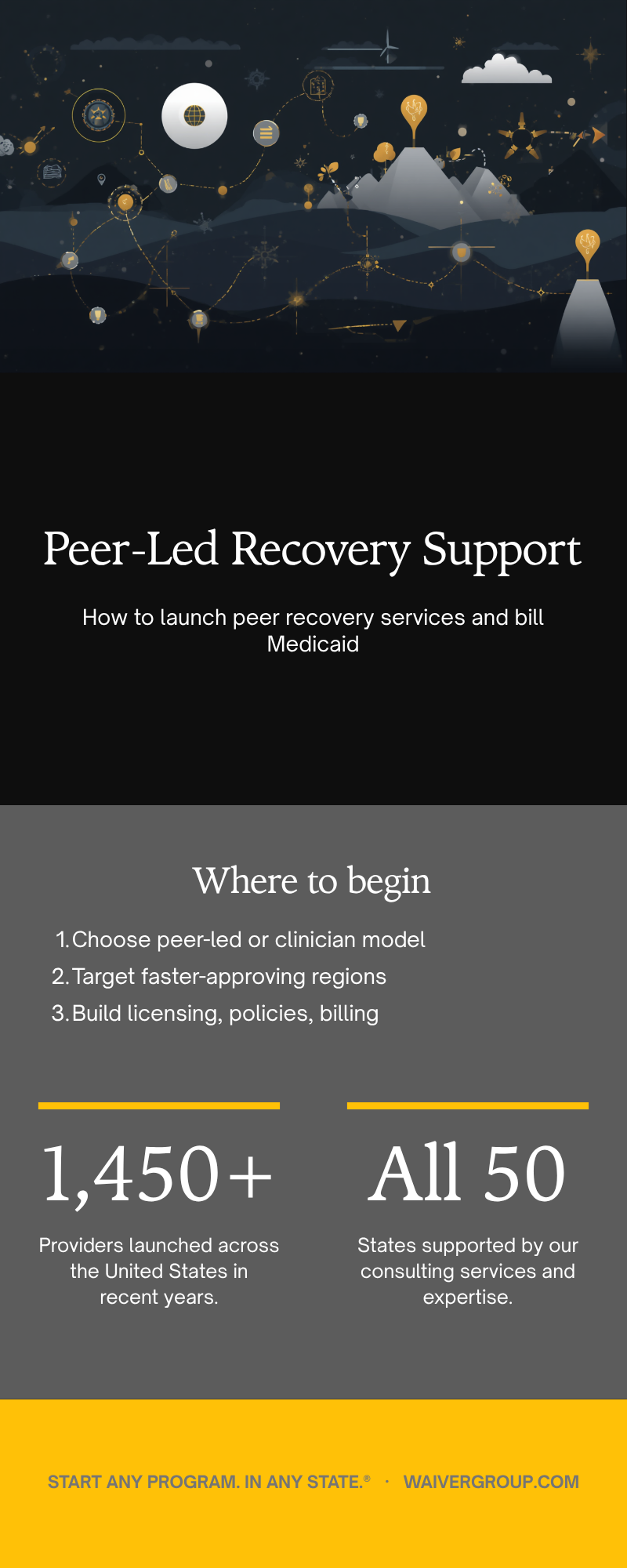
Key takeaway: Launching peer-led recovery support starts with the right service model and region, then a solid licensing, policy, and billing foundation. We prepare you for each milestone and position you to launch with confidence.
Start Any Program. In Any State.®
We have helped launch more than 1,450 providers across all 50 states. Book a video consultation at waivergroup.com/videoappointment, call 302.888.9172, or email [email protected].
Last verified: May 2024. This information is provided for general educational purposes and does not constitute legal or professional advice. Requirements for Medicaid provider enrollment and state-specific HCBS waiver programs are subject to change. Consult with your local state Medicaid agency or a qualified professional for guidance specific to your organization’s circumstances.