How to Become a Medicaid Waiver Provider in Michigan
By Fatumata Kaba · 2026-07-11 · 6 min read
Navigating Michigan Medicaid Waiver Provider Enrollment: A Comprehensive Guide
Becoming a Medicaid waiver provider in Michigan requires a structured approach to credentialing, technical compliance, and alignment with the Michigan Department of Health and Human Services (MDHHS) requirements. By mastering the Community Health Automated Medicaid Processing System (CHAMPS) and ensuring your agency’s operational policies strictly mirror your scope of service, you can successfully navigate the transition from a startup agency to a state-approved Medicaid provider. This comprehensive guide outlines the essential steps and considerations for agencies looking to serve Michigan's beneficiaries through home and community-based services waivers.Understanding Michigan's Home and Community-Based Services (HCBS) Waivers
Michigan’s Home and Community-Based Services (HCBS) waivers, such as the MI Choice Waiver, are crucial programs designed to empower individuals to receive long-term care services within their own homes and communities, offering a vital alternative to institutional settings. For agency founders and administrators, this translates to operating within a meticulously regulated framework that places paramount importance on beneficiary safety, the delivery of high-quality care, and stringent fiscal accountability. A thorough understanding of these principles is fundamental before embarking on the enrollment journey.
Before initiating the formal enrollment process, it is imperative to precisely define the specific waiver services your agency intends to offer. Each service category within Michigan's HCBS waiver programs carries its own unique set of certification requirements, distinct staff qualifications, and specific documentation standards. Identifying and solidifying your agency’s niche within the Michigan landscape early in the planning phase is critical. This proactive approach helps prevent costly administrative delays, potential re-submissions, or outright denials during the enrollment phase, ensuring a more efficient and successful pathway to becoming a recognized provider.
Leveraging MiLogin and CHAMPS for Provider Enrollment Success
In Michigan, the gateway to all Medicaid provider enrollment activities is the Community Health Automated Medicaid Processing System, widely recognized as CHAMPS. This robust platform functions as the central repository for all provider enrollment applications, claims processing, and the verification of beneficiary eligibility. Prior to engaging with CHAMPS, however, it is a mandatory first step to establish a secure MiLogin account.
MiLogin serves as the state of Michigan's secure authentication gateway, providing a unified, single sign-on experience for a broad spectrum of state government services. Access to the critical provider enrollment modules within CHAMPS will remain restricted without a properly verified MiLogin account. Therefore, it is of paramount importance that your agency’s designated administrative personnel obtain the appropriate MiLogin access levels well in advance of attempting to register your business entity within the system. This ensures a smooth and uninterrupted start to your enrollment process.
- Initiate the credentialing process by registering for a MiLogin for Business account.
- Complete the initial agency enrollment profile within the CHAMPS portal, providing all required organizational details.
- Verify that all National Provider Identifier (NPI) information is accurately associated with your agency's Michigan tax identification details.
The Indispensable Role of Policy and Procedure Manuals in Approval
A frequently encountered obstacle for new agency applicants lies in a critical misalignment between their internally developed policy and procedure manuals and the actual services they intend to bill through the Medicaid program. MDHHS evaluators meticulously review these manuals to confirm that your agency possesses a comprehensive understanding of the clinical and administrative requirements intrinsic to the specific waiver services you aim to provide. For instance, if your application indicates a provision of skilled nursing services, yet your policies lack detailed protocols for medication administration, the management of G-tubes, or tracheostomy care, your enrollment application is highly likely to stall or be denied.
Your policy and procedure manual must function as a dynamic, "living" document that accurately reflects the realities and intricacies of your agency’s daily operational activities. Each section of the manual should clearly delineate robust oversight mechanisms, comprehensive staff training requirements, effective incident reporting procedures, and unwavering adherence to all state-mandated quality standards. Treating these essential documents as mere formalities or administrative checkboxes during the enrollment process is a common and often costly reason for significant delays in obtaining an active Medicaid provider identification number.
Ensuring Operational Readiness and Adequate Financial Reserves
New providers often underestimate the considerable time lag that can occur between the submission of a comprehensive application and the receipt of the first successful claim payment. Because the enrollment process involves multiple verification cycles and intricate internal system processing by MDHHS, the pathway to reimbursement can extend for several weeks, or even longer. Establishing a robust operating reserve before officially opening your doors for business is an absolutely foundational step in effectively managing your agency's cash flow and ensuring the continuity of staffing and essential services.
Financial stability is not merely a buffer; it is an enabling factor that allows your agency to concentrate its efforts on delivering clinical excellence and maintaining steadfast compliance, rather than being forced to react to unpredictable administrative delays. By diligently factoring in the expected timeline for billing activation during your initial business planning phase, you can proactively ensure that your agency remains fully operational and financially sound while the state meticulously processes your submitted data. It is highly recommended to confirm the current CHAMPS enrollment status and anticipated processing timelines directly through official MDHHS provider updates to maintain realistic expectations and manage resources effectively.
Sustaining Compliance Post-Enrollment: An Ongoing Commitment
Achieving approval as a Medicaid waiver provider is a significant milestone, but it represents only the initial step in a continuous journey. Maintaining ongoing compliance is not an occasional task but an absolute, daily requirement for all enrolled providers. Once your agency is officially enrolled in CHAMPS, strict adherence to all applicable state and federal HCBS regulations becomes mandatory. It is crucial to recognize that these regulations are subject to periodic updates and amendments.
The cornerstones of a successful and sustainable Medicaid provider agency include rigorous regular audits, consistent and comprehensive staff retraining programs, and meticulous documentation of all services rendered to beneficiaries. A failure to diligently maintain compliance can lead to severe repercussions, including the potential revocation of your provider status or the mandatory recoupment of previously paid claims. Therefore, it is imperative to establish robust internal quality assurance protocols that closely mirror and align with the specific requirements set forth by MDHHS. This includes diligent monitoring of staff certifications and licenses, rigorous verification of all background checks, and ensuring that every clinical intervention and service provided is documented in strict accordance with state guidelines and best practices.
Frequently Asked Questions
What is the fundamental difference between a MiLogin account and CHAMPS?
MiLogin serves as the secure, statewide authentication gateway designed to rigorously verify user identity across a variety of Michigan government services. CHAMPS, on the other hand, is the dedicated Medicaid management portal that operates behind this secure gateway. It is exclusively utilized for provider enrollment, the submission and processing of claims, and the comprehensive management of beneficiary information and services.
Is it possible to update my agency's scope of service after the initial enrollment is complete?
Yes, Michigan Medicaid waiver providers do have the ability to update their authorized scope of service. However, this process necessitates submitting a formal modification request directly through the CHAMPS portal. Critically, any proposed changes to the services your agency provides must be accurately and fully reflected in your agency’s updated policy and procedure manual before you attempt to bill for these new service types.
How can I effectively determine if my provider enrollment application is actively being processed?
Once you have successfully submitted your application via CHAMPS, you can diligently monitor its progress through your dedicated provider dashboard within the system. MDHHS provides regular status updates directly within this portal. It is strongly recommended to check this dashboard frequently for any requests for additional information, notifications of pending steps, or official confirmation of approval.
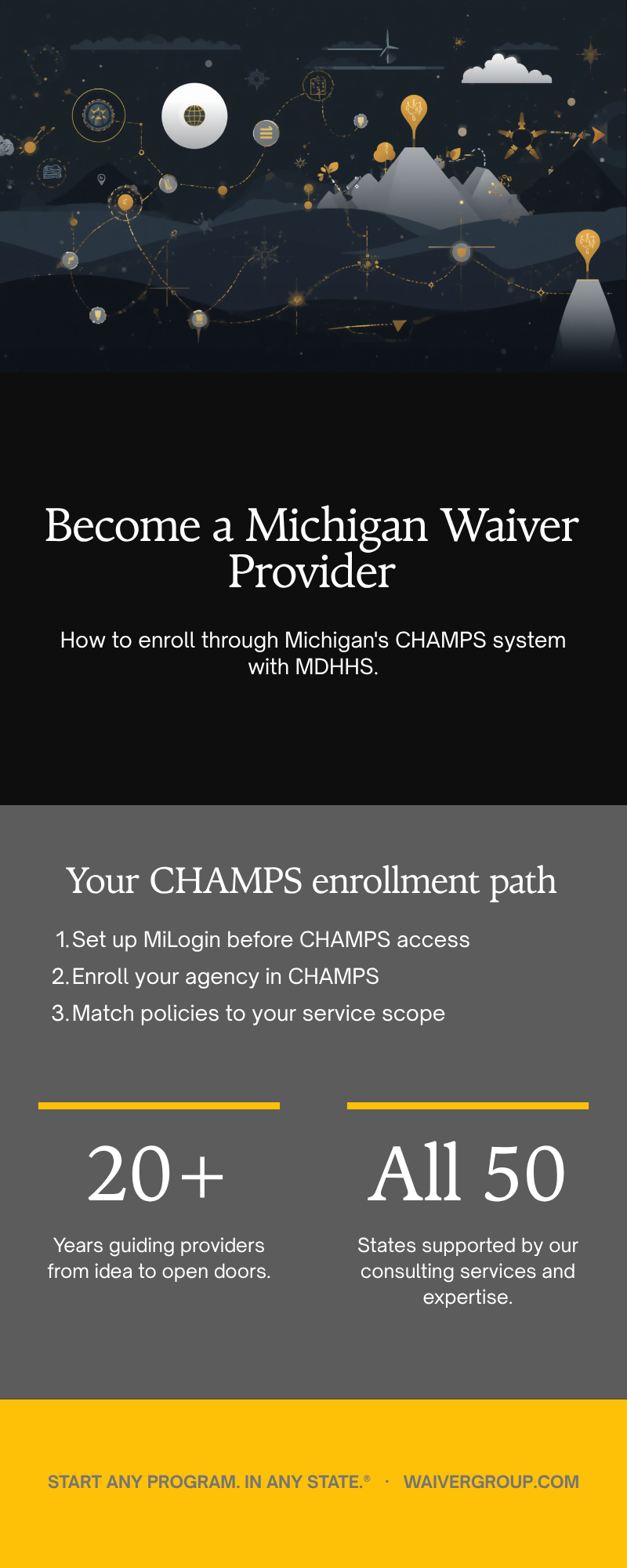
Key takeaway: In Michigan, the enrollment process begins with securing a MiLogin account, followed by registering your agency within CHAMPS via MDHHS. Ensuring your agency's policies meticulously align with every service you intend to bill is paramount for success. Thorough preparation, particularly concerning your policy manual and the establishment of adequate financial operating reserves, is essential for a smooth and sustainable launch as a Medicaid waiver provider.
Last verified: November 2024. This information is intended for educational purposes only and does not constitute legal or regulatory advice. Please consult with the Michigan Department of Health and Human Services (MDHHS) or a qualified consultant to address specific agency requirements and local regulations.