How to Add Children's HCBS Waiver Services to an Existing Home Health License
By Fatumata Kaba · 2026-06-17 · 6 min read
Expanding an existing home health agency to include children’s Home and Community-Based Services (HCBS) waiver programs is a strategic method to diversify service offerings and meet the growing demand for specialized pediatric care. Because you already hold a valid home health license, you can often leverage your existing infrastructure, clinical oversight, and compliance frameworks to pursue a certification, designation, or provider enrollment amendment rather than initiating a new, standalone license application.
Why Leverage an Existing Home Health License for HCBS?
For established home health providers, the transition into children’s HCBS represents a vertical expansion rather than a horizontal startup. State Medicaid programs often prefer to work with entities that have demonstrated expertise in home-based clinical delivery, patient privacy (HIPAA), and documentation integrity. By utilizing your current licensure, you bypass many of the initial administrative hurdles associated with brand-new entities, significantly shortening the path to program launch.
The operational synergy between home health and HCBS is significant. Many of the systems you have already perfected—such as background screening protocols, incident reporting, and electronic health record (EHR) management—are foundational requirements for pediatric waiver programs. Aligning these systems allows you to maintain consistent quality standards across both clinical and supportive care service lines, reducing redundant administrative work and ensuring that compliance is maintained as a core agency competency.
Understanding the Certification Process Versus New Licensure
In most jurisdictions, children’s HCBS services are governed by state-specific Medicaid waivers that operate under the Centers for Medicare & Medicaid Services (CMS) authorities. While a home health license provides the regulatory "floor" for your operations, the HCBS certification serves as a program-specific "top-off" that proves you meet the distinct requirements for serving children with developmental and behavioral health needs.
This process typically involves an amendment to your current provider agreement or a programmatic certification audit. Regulatory bodies will evaluate your agency based on its ability to provide specialized services such as community habilitation, respite care, and day programs. You must be prepared to demonstrate that your agency possesses the additional personnel training and operational capacity required to support pediatric populations with complex needs beyond traditional skilled nursing or therapy.
Navigating the Multi-Agency State Review
Preparing for an HCBS certification requires coordination with multiple state stakeholders. Because these programs are often funded through a combination of state and federal Medicaid dollars, you may face reviews from both the state Department of Health (DOH) and the state Department of Developmental Services or Office of Mental Health. Each agency maintains its own focus and regulatory priority:
- Department of Health: Reviews clinical documentation, infection control protocols, and overall facility/administrative compliance to ensure the agency remains in good standing.
- Department of Developmental Services/Behavioral Health: Evaluates your specialized staffing model, including mandatory training on trauma-informed care and behavioral support interventions.
- Medicaid Fiscal Agency: Reviews financial viability, including proof of adequate insurance, surety bonds, and fiscal solvency to ensure long-term stability for vulnerable populations.
Key Documentation for Approval
The speed at which you receive approval is largely contingent on the quality and organization of your application materials. State reviewers look for evidence that your agency has successfully transitioned from a medical-model mindset to a person-centered, community-based care model. Your documentation package should be robust, transparent, and clearly aligned with state-specific waiver language.
First, ensure your updated policies and procedures clearly distinguish between clinical home health tasks and waiver-based habilitation or respite tasks. Second, provide comprehensive training logs that show your staff has received specialized training relevant to the pediatric waiver population, including de-escalation techniques and individualized support planning. Finally, include letters of support from local school districts, advocacy groups, or pediatric networks to demonstrate a clear understanding of the local need for the services you are proposing to offer.
Managing the Shift to Person-Centered Care
One of the most critical aspects of adding HCBS services is the transition to a person-centered planning approach. Unlike home health, where the focus is often on treating a medical condition, HCBS programs focus on the child’s goals for community participation and independence. Your agency must demonstrate that it has implemented policies that empower the child and the family to direct their own care, which often requires a shift in how staff interact with clients and record their daily progress.
Documentation in the HCBS world is focused on habilitative progress—what the child is learning or accomplishing—rather than strictly medical recovery or maintenance. To gain certification, you will need to update your EHR system or documentation templates to capture these qualitative outcomes. Ensuring that your clinical staff understands this distinction is essential to passing the initial certification audit and preventing audit findings later on.
Moving from Certification to Active Billing
Once the certification audit is successfully completed, the final hurdle is transitioning into the billing ecosystem. This involves the activation of your unique National Provider Identifier (NPI) sub-parts for specific HCBS service codes within the state’s Medicaid Management Information System (MMIS). This step often coincides with managed care organization (MCO) credentialing, which is a common requirement in many states managing these waivers through private health plans.
Credentialing with the specific health plans that manage the pediatric waiver program is a mandatory final step. You will need to submit your newly granted certification as proof of eligibility to provide these services under the managed care contract. This process ensures that you are set up for automated claim adjudication, allowing you to begin serving families and billing the Medicaid program with confidence once all technical connections are verified.
Frequently Asked Questions
Does my existing home health medical director need to oversee HCBS services?
In many states, waiver services do not require the same clinical oversight as home health nursing services. However, you must verify if your state requires a qualified professional (such as a QIDP or a licensed social worker) to oversee the behavioral and habilitation plans for your pediatric clients. Often, a program coordinator or clinical supervisor with specific experience in developmental disabilities is the required lead.
Is it possible to be denied the HCBS certification if my home health license is in good standing?
Yes. Even with a clean home health survey history, you can be denied if your agency fails to demonstrate specific readiness for the HCBS population. Reviewers focus on the "community-based" aspect, meaning they will look closely at your community-integration and safety protocols rather than just your clinical competence. Failure to articulate how you will handle behavioral crises or community safety can lead to an unsuccessful application.
How long does the certification process usually take?
Timelines vary significantly based on state department workloads and the volume of applicants. Factors that typically delay the process include incomplete staff training certifications, inconsistencies between your proposed operational policies and state waiver requirements, and gaps in fiscal documentation. Proactive communication with your state representative and ensuring all supplemental documentation is cross-referenced can help move the process forward more efficiently.
Key Takeaway
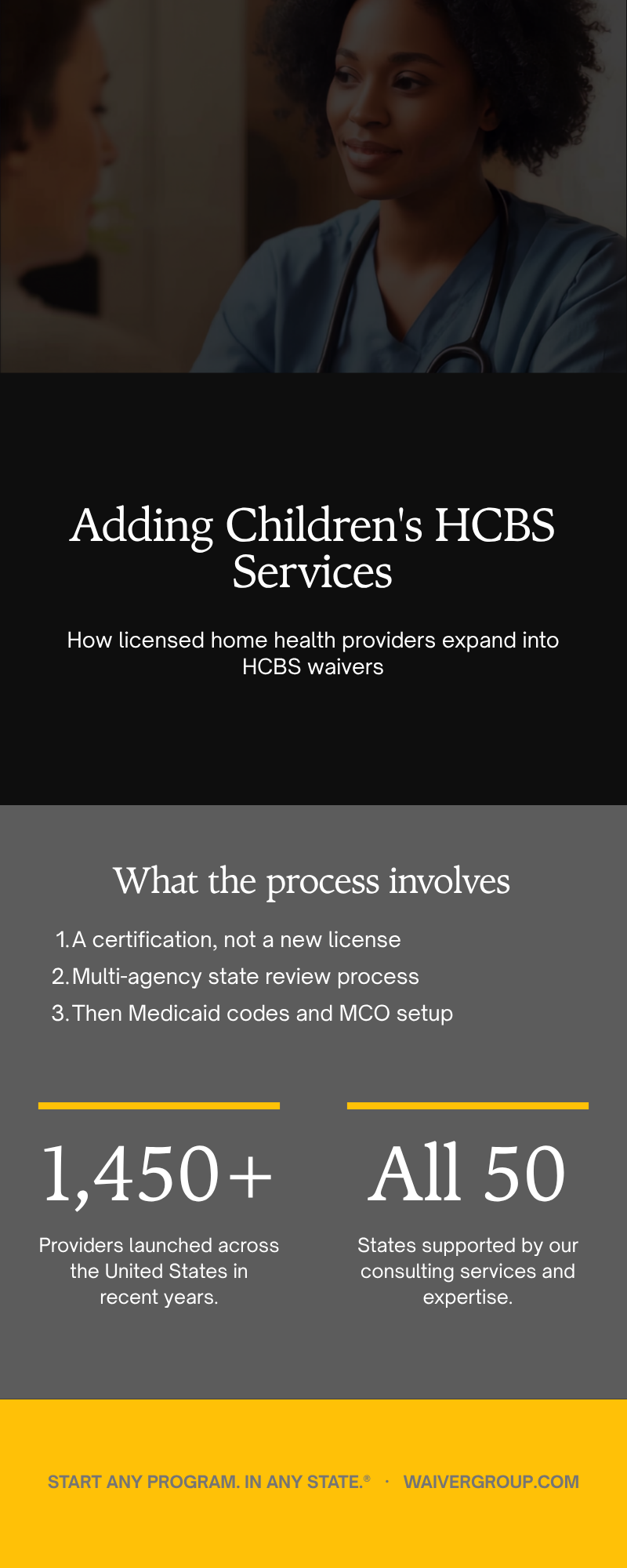
Adding children's HCBS services to an existing license is often a certification, not a new application. Careful preparation of your operational policies, staff training records, and integration of person-centered care models positions you to move through the state review process with confidence. Start Any Program. In Any State.® We have helped launch more than 1,450 providers across all 50 states. Book a video consultation at waivergroup.com/videoappointment, call 302.888.9172, or email [email protected].
Last verified: May 2024. The information provided in this article is for educational purposes only and does not constitute legal or professional consulting advice. Requirements for Medicaid HCBS waivers vary by state; always consult with state regulatory agencies or professional advisors to confirm current statutes and application procedures.