How Much Money Do You Really Need to Show for Provider Licensing?
By Fatumata Kaba · 2026-06-23 · 6 min read
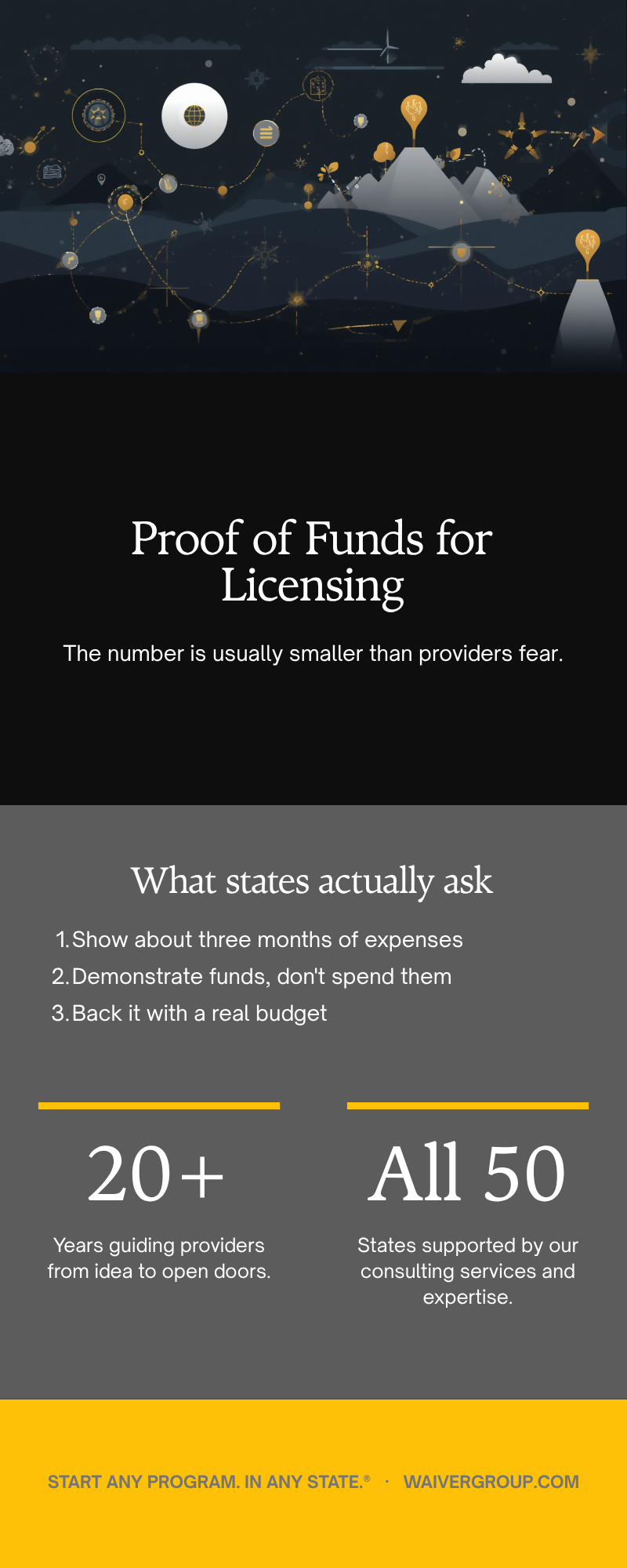
When preparing to launch a Home and Community-Based Services (HCBS) agency, many founders are paralyzed by the misconception that they must possess significant liquid capital to secure licensure. In reality, most state licensing bodies do not require a massive endowment; instead, they mandate proof of financial solvency sufficient to cover approximately three months of projected operating expenses.
This requirement exists to protect program participants, ensuring that a new agency has the runway to provide consistent, uninterrupted services while waiting for initial Medicaid reimbursements to flow. Understanding how to calculate and document this capacity is a foundational step in the licensure process, transforming a daunting barrier into a manageable administrative task.
Demystifying the "Three-Month Rule" for HCBS Providers
The financial requirements for Medicaid waiver programs are designed to evaluate operational stability rather than accumulated wealth. State agencies are primarily interested in whether a startup can maintain its service delivery obligations during the "startup lag," the period between receiving a license and processing the first successful claims for services rendered.
In most jurisdictions, the "three-month rule" functions as a stress test for an agency's business model. It is not an arbitrary number; it is a calculated estimate of fixed and variable costs. Licensing reviewers want to see that you have mapped out your essential outlays—such as administrative overhead, essential staffing, and compliance-related costs—and have identified the liquid assets available to cover these expenses before revenue streams are fully established.
Founders often hear rumors of exorbitant capital requirements, but these figures are frequently confused with the total costs of long-term scaling or are anecdotal accounts from highly complex, inpatient-style facilities. For standard HCBS waiver programs, the focus remains on essential, realistic liquidity.
Why Demonstrating Capacity Is Not the Same as Spending
A critical point of confusion for new providers is the distinction between showing funds and escrowing funds. In the vast majority of state licensure applications, you are not required to deposit money into a state-controlled account or "spend" it to prove you have it. You are providing evidence of financial availability.
This evidence is typically submitted through financial statements, bank statements, lines of credit, or letters of intent from financial institutions. The state agency merely needs to verify that the capital is accessible should an emergency or operational disruption occur during the initial months of service delivery.
- Liquid Assets: Standard checking or savings accounts are the most direct way to show availability.
- Lines of Credit: Some states accept proof of a secured line of credit, which shows that you have a bridge for operational costs.
- Financial Statements: Audited or notarized balance sheets provide a snapshot of your current net worth and liquidity positions.
How to Construct a Credible Operating Budget for Licensing
Licensing reviewers are highly skilled at spotting "padding" or unrealistic budget projections. An authoritative budget should be lean, evidence-based, and reflective of your actual operational plan. If you are starting as a sole practitioner or a lean operation, the budget should reflect that intent rather than projecting a large, multi-staffed organization that does not yet exist.
Your budget must account for the specific requirements of the state where you are applying. Items that must be clearly represented include:
- Administrative Overhead: Rent, insurance (general liability and professional liability), and utilities.
- Personnel Costs: If you are hiring staff immediately, include competitive salaries and payroll taxes. If you are the primary service provider, factor in your own basic compensation or draw.
- Compliance and Licensing Fees: These are often overlooked but are mandatory early-stage expenses.
By creating a bottom-up budget—starting with essential costs and building outward—you demonstrate to the state that you understand the mechanics of the specific waiver program you are entering. This transparency often builds trust with the licensing board, suggesting a higher level of administrative readiness.
Key Variables That Influence Financial Requirements
While the three-month rule is standard in many states, specific programs may impose additional variables based on the service model. For example, an agency providing residential services (group homes) may face different capital requirements than an agency providing community-based personal care, primarily due to the differences in physical infrastructure and property management costs.
Furthermore, some states adjust requirements based on the proposed census of the agency. If you are planning to scale quickly, the state may expect a higher demonstration of financial depth. It is essential to review the specific "Provider Manual" or "Licensing Regulations" portal for the waiver programs you are targeting, as these documents dictate the exact fiscal thresholds for your specific region.
When calculating these figures, always consult the most current version of the state’s licensing handbook. Requirements can fluctuate with legislative updates, and relying on outdated information is the most common cause of application delays or rejections.
Addressing Common Misconceptions About Financial Stability
Many applicants fear that their application will be denied if they do not have a substantial net worth. However, states are concerned with the *availability* of operating capital, not the total wealth of the agency’s owners. You can demonstrate financial solvency through multiple vehicles, and many agencies successfully launch using a combination of personal capital, business loans, and projected revenue models that have been vetted for feasibility.
The evaluation process is inherently risk-based. If your budget is logical and your financial documentation is clean and consistent, you satisfy the requirement. The goal is to provide a clear, accurate, and professional picture of your business’s financial health to the licensing authority, minimizing the need for follow-up inquiries or requests for clarification.
Frequently Asked Questions
Does the state require the money to be in a business account for a specific amount of time?
Most states do not dictate how long the funds have been in the account, provided the documentation is current and reflects the account's status at the time of submission. Some states may require "seasoned" statements, but this is typically specified in the application instructions.
Can personal assets be used to satisfy the financial requirement?
Yes, in most cases. If the agency is structured as a sole proprietorship or if the business owner is providing a personal guarantee for a line of credit or business loan, personal assets are often accepted. You should ensure your documentation clearly links these assets to the business entity.
What happens if my projected budget changes after I receive my license?
Once you are licensed, you are responsible for maintaining ongoing financial viability. If your operational costs increase, it is standard practice to manage your cash flow accordingly. However, your initial budget serves as a baseline to prove you have the foundational knowledge and resources to operate the agency as initially described in your application.
Key Takeaway
Most states ask you to demonstrate roughly three months of projected operating expenses, shown as available rather than spent. A clear, realistic budget is what makes the figure credible, and ensuring that your financial documentation reflects your actual operational plan is the most effective way to navigate the licensing process successfully. Focus on precision in your budget to prove administrative capacity, and you will find the financial requirements for HCBS licensing are highly achievable for well-prepared agencies.
Last verified: 2024. All information provided is for educational purposes only and does not constitute legal or financial advice. We recommend consulting with your state’s specific Medicaid agency or a qualified professional for guidance tailored to your jurisdiction and specific waiver program requirements.