HOST HOME SERVICES PROVIDER IN UTAH
By Fatumata Kaba · 2026-04-01 · 5 min read
CREATING SAFE, FAMILY-LIKE ENVIRONMENTS WHERE INDIVIDUALS WITH DISABILITIES CAN THRIVE WITH PERSONALIZED, 24-HOUR SUPPORT
Host Home Services in Utah provide a community-based residential alternative for individuals with intellectual or developmental disabilities (ID/DD) who require full-time, personalized support in a family-like setting. As a Host Home Provider—often referred to as a Professional Parent—individuals open their private homes to one or two participants to deliver essential personal care, habilitation, and community integration services authorized under the Community Supports Waiver (CSW) and overseen by the Utah Division of Services for People with Disabilities (DSPD).
What Are the Governing Bodies and Regulatory Frameworks?
Operating a Host Home in Utah requires strict adherence to state and federal regulations to ensure participant safety and quality of care. The Utah Department of Health and Human Services (DHHS), specifically the Division of Services for People with Disabilities (DSPD), acts as the primary agency responsible for authorizing Host Home placements, managing service planning, and monitoring compliance with Medicaid Home and Community-Based Services (HCBS) waiver requirements.
Simultaneously, providers must interface with the Office of Licensing (OL) under the Utah DHHS. The OL is responsible for the formal licensing of Host Homes as certified residential settings, which are strictly limited to a capacity of one or two participants. Finally, all operations must align with the federal standards set by the Centers for Medicare & Medicaid Services (CMS), which mandate that residential settings maintain a person-centered, community-integrated environment that empowers participants to thrive in their everyday lives.
What Does a Host Home Service Model Entail?
Host Home services are designed to offer 24-hour, integrated residential care within a stable, private home environment. Unlike institutional settings, this model integrates the participant into the household routines of a certified provider. Services are not one-size-fits-all; they must be individualized and developed in strict alignment with the participant’s unique Individual Support Plan (ISP).
The scope of care provided by a Host Home Provider is comprehensive and essential for the participant's well-being. Providers are responsible for the following core services:
- Room and board within a safe, stable, and welcoming household environment.
- Comprehensive personal care, including assistance with bathing, hygiene, meal preparation, and toileting.
- Life skills training and habilitation support aimed at fostering participant independence.
- Reliable transportation to medical appointments, community outings, and social activities.
- Behavioral support and medication assistance, provided these are explicitly authorized within the ISP.
- Active inclusion in family routines and community engagement opportunities.
- Consistent overnight supervision and immediate emergency response readiness.
How Do You Achieve Licensing and Provider Approval?
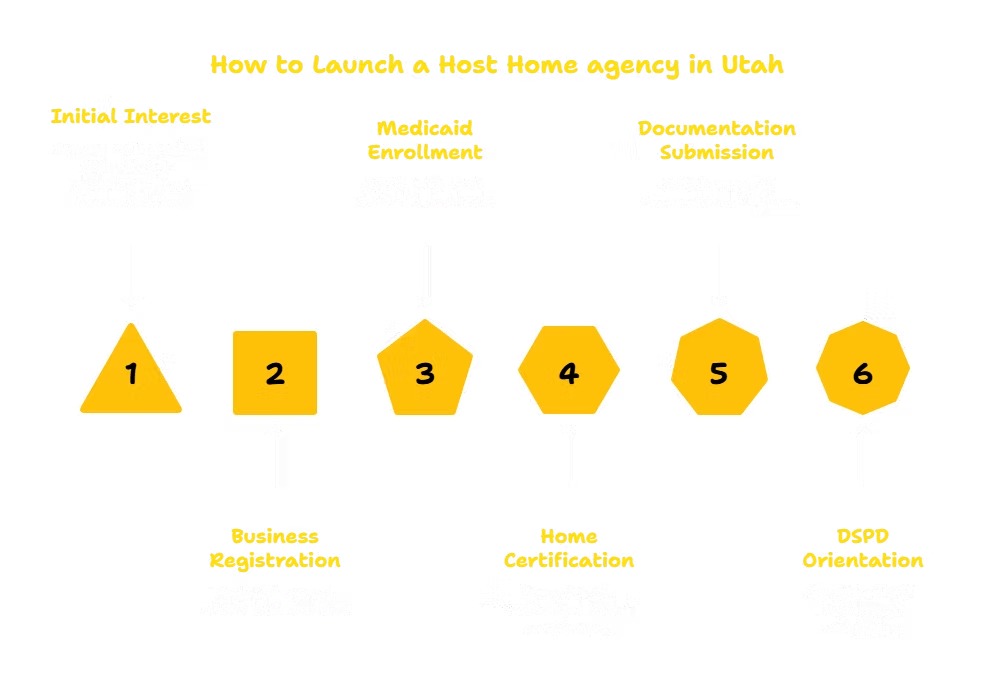
Becoming a Host Home provider is a multi-step process that requires professional rigor and meticulous documentation. If you are operating as a provider agency, you must first register your business entity with the Utah Division of Corporations. Following entity formation, you must secure an Employer Identification Number (EIN) and a Type 2 National Provider Identifier (NPI) to interface with the Medicaid billing system.
Once the business foundation is laid, you must apply for enrollment as a Medicaid waiver provider. This process runs concurrently with obtaining Host Home certification through the DSPD and the Office of Licensing (OL). A critical component of this phase involves the safety of the residence, which requires passing a fire inspection, a home safety inspection, and providing comprehensive documentation of the home’s readiness. Furthermore, all household members over the age of 18 must undergo thorough background checks and fingerprinting to ensure the safety of the participants in your care.
What Is the Required Documentation for Compliance?
Maintaining a compliant Host Home requires robust record-keeping and a well-structured policy manual. Auditors and state reviewers expect to see documentation that proves the provider is meeting the standard of care. Essential documentation includes current Medicaid and DSPD provider contracts, valid OL licenses, and up-to-date home safety reports.
Your agency or individual practice must maintain a comprehensive Host Home Services Policy Manual. This manual serves as the operational blueprint for your home and should include:
- Established protocols for participant intake, matching, and transition.
- Strict procedures for medication handling, storage, and health status tracking.
- Documentation of background checks and ongoing training for all household members and staff.
- Tools for daily schedule management, personal goal tracking, and activity logging.
- Clearly defined policies regarding participant rights, dignity, and abuse/neglect/exploitation prevention.
- Procedures for incident reporting, emergency response, and on-call availability.
- Templates and tools for ISP implementation and outcome measurement.
What Are the Staffing and Training Prerequisites?
The success of the Host Home model relies heavily on the qualifications of the Host Home Provider. Providers must be at least 21 years of age, undergo rigorous background screenings, and maintain current certification in CPR and First Aid. Beyond these baseline requirements, providers must demonstrate the willingness and capacity to deliver 24/7 care in a residential setting. In cases where an agency oversees the home, an agency case manager with a background in human services may be required to coordinate care.
All personnel involved in the care of participants must complete mandatory training modules. These typically include HIPAA and confidentiality training, Abuse, Neglect, and Exploitation Prevention (ANEP), medication assistance training, and ISP implementation procedures. For participants with complex medical or behavioral needs, specialized training in emergency response or behavioral intervention may also be required to ensure the provider is prepared for any scenario.
Frequently Asked Questions
What is the typical timeline to launch a Host Home?
The timeline varies based on preparation, but generally follows four phases: Business Registration (1–2 months), Medicaid and DSPD Enrollment (2–3 months), Home Certification and Inspections (30–60 days), and finally, participant matching, which begins once the home is fully certified.
Which Medicaid waiver programs cover these services?
Host Home services are primarily offered under the Community Supports Waiver (CSW) for adults with ID/DD. Limited placements may be available under the Acquired Brain Injury (ABI) waiver or the New Choices Waiver (NCW) for individuals transitioning out of institutional care, though these are evaluated on a case-by-case basis.
What does WCG provide in terms of start-up assistance?
WCG supports agencies and individuals in navigating the complexities of DSPD and CMS expectations. Services include guidance on OL licensing, development of operational policy manuals, intake and matching tool creation, home safety templates, and staff training packet preparation.
Key Takeaways for Prospective Providers
Launching a Host Home in Utah is a significant commitment that combines entrepreneurial effort with clinical oversight. By focusing on meticulous documentation, maintaining open communication with the Division of Services for People with Disabilities, and prioritizing the person-centered goals of the participants in your care, providers can successfully build a sustainable residential model. Adhering to the established regulatory timeline and ensuring all staff training is current are the most critical steps in securing and maintaining a provider status.
Last verified: 2024. The information provided here is for general educational purposes and does not constitute legal or professional advice. Always consult the current Utah DSPD policy manuals and Medicaid provider bulletins for the most up-to-date regulatory requirements.