HOMEMAKER SERVICES PROVIDER IN VERMONT
By Fatumata Kaba · 2026-04-09 · 6 min read
Homemaker Services in Vermont are essential non-medical supports designed to help individuals with disabilities, chronic conditions, or age-related needs maintain a clean, safe, and healthy living environment. By assisting with daily household routines, these services play a critical role in preventing or delaying institutionalization and promoting long-term independence within the community for Medicaid waiver participants.
Administered under Vermont’s Medicaid Home and Community-Based Services (HCBS) framework, these services are authorized through an Individual Support Plan (ISP) and are subject to oversight by the Department of Disabilities, Aging and Independent Living (DAIL) and the Department of Vermont Health Access (DVHA). Providers operate within this structure to ensure that all household tasks align with the person-centered needs and functional goals of the individuals they serve.
Understanding the Governing Agency Landscape in Vermont
The successful delivery of Homemaker Services in Vermont requires a clear understanding of the roles played by state agencies and local entities. The Department of Disabilities, Aging and Independent Living (DAIL) serves as the primary authority, responsible for setting service standards, overseeing provider compliance, and managing the waiver programs that authorize these services. Without proper alignment with DAIL’s clinical and operational requirements, a provider cannot effectively serve participants.
Parallel to DAIL’s regulatory role, the Department of Vermont Health Access (DVHA) manages the fiscal and administrative aspects of the Medicaid program. This includes provider enrollment, billing guidelines, and the processing of claims for services rendered. Additionally, Vermont utilizes a network of Designated Agencies (DAs) and Specialized Service Agencies (SSAs) that act as the local point of contact for service coordination. These agencies are responsible for developing the ISP, determining the specific tasks authorized for a participant, and performing ongoing quality assurance to ensure that the homemaker services meet the documented needs of the client.
Defining the Scope and Examples of Homemaker Services
Homemaker Services are strictly non-medical in nature and must be goal-oriented, directly supporting a participant’s ability to remain in their own home. These services are intended for individuals who, due to physical, cognitive, or developmental limitations, cannot manage routine household chores independently. Because these services are funded through HCBS waivers, they must be tied explicitly to the health, safety, and independence goals outlined in the participant's ISP.
Examples of covered tasks include, but are not limited to, the following activities:
- Light housekeeping, such as vacuuming, dusting, and sweeping.
- Laundry services, including washing, drying, and changing linens.
- Meal planning and preparation to ensure nutritional consistency.
- Grocery list development, with potential support for shopping when approved in the ISP.
- Dishwashing and general kitchen maintenance.
- Bed-making and the organization of essential living spaces.
- Basic errands as authorized within the specific service plan.
Navigating Licensing and Provider Approval Prerequisites
Entering the Vermont market as a Homemaker Services provider involves a structured sequence of business and regulatory steps. Before a provider can be authorized to deliver services, they must establish their business entity with the Vermont Secretary of State, obtain a federal Employer Identification Number (EIN), and secure a Type 2 National Provider Identifier (NPI). These foundational steps are necessary to ensure that the business entity is recognized by both state and federal healthcare systems.
Beyond basic registration, providers must formalize their operational capacity. This includes maintaining comprehensive general liability and workers’ compensation insurance to protect the agency and its employees. A critical component of the approval process is the development of a formal Homemaker Services Policy & Procedure Manual. This document serves as the backbone of the agency, outlining how staff will manage privacy, safety, and documentation requirements. Furthermore, providers must contract with local DAs or SSAs to integrate into the existing service delivery network or pursue direct Medicaid enrollment with the DVHA for billing purposes.
The Step-by-Step Provider Enrollment Process
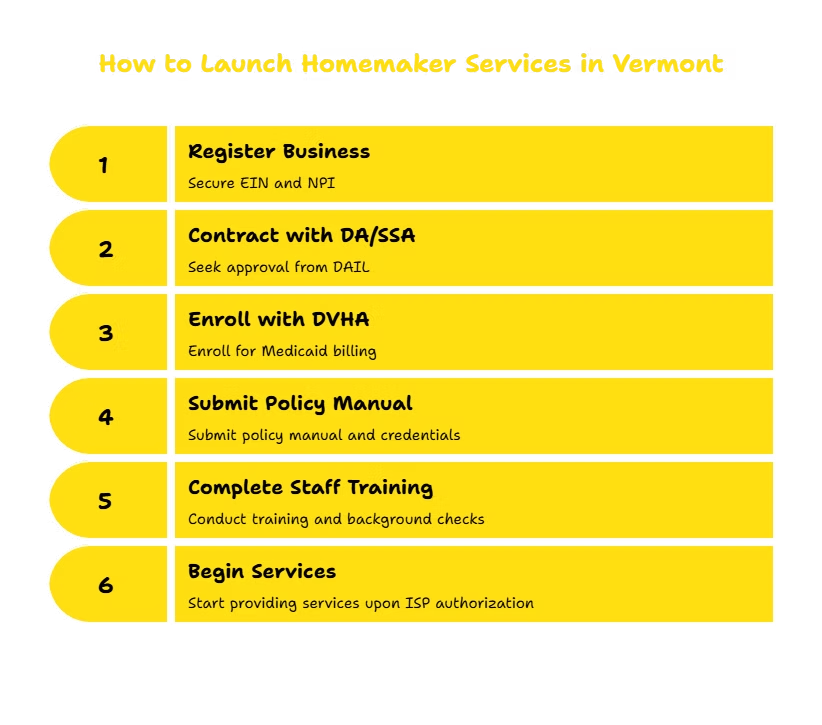
The transition from a business entity to an active Medicaid service provider involves a multi-phased approach. The process begins with the administrative setup and concludes only when an agency is fully onboarded to receive ISP assignments. Providers should expect the following roadmap:
- Step 1: Register the business, obtain the EIN, and secure a Type 2 NPI.
- Step 2: Apply for a service contract with a Designated Agency or Specialized Service Agency, or seek necessary approval from DAIL.
- Step 3: Complete the formal Medicaid enrollment process with the DVHA for reimbursement eligibility.
- Step 4: Submit the comprehensive Policy & Procedure Manual and required staff credentials for state review.
- Step 5: Execute rigorous staff training programs, conduct comprehensive background checks, and verify all credentials.
- Step 6: Initiate service delivery only after formal ISP authorization has been confirmed for the participant.
Operational Requirements: Documentation and Staffing Standards
Accountability is the cornerstone of Vermont’s HCBS program. Agencies must maintain detailed records that justify the necessity of the homemaker tasks performed. Required documentation includes, at minimum, a copy of the Articles of Incorporation, proof of Medicaid enrollment, the signed DA/SSA contract, and a robust Policy & Procedure Manual. This manual must explicitly cover safety protocols, incident reporting procedures, HIPAA compliance, and clear definitions of the scope of services provided to clients.
Staffing and personnel management are equally vital. Homemakers, or Home Support Workers, are expected to possess knowledge of safe cleaning practices and demonstrate respectful, person-centered communication. While a high school diploma or GED is recommended, the essential requirement is the completion of thorough training in client dignity, household safety, universal precautions, and HIPAA privacy standards. Additionally, the role of a Service Coordinator or Supervisor is necessary to manage staff scheduling, perform quality assurance reviews, and act as the primary liaison between the provider agency and the DAs or SSAs.
Frequently Asked Questions
Which Medicaid Waiver Programs include Homemaker Services?
Homemaker services are primarily covered under the Choices for Care (CFC) Waiver, which supports older adults and adults with physical disabilities. They may also be authorized under the Developmental Disabilities Services Waiver (DDSW) or the Brain Injury Program, depending on the functional needs of the participant. Additionally, homemaker tasks can sometimes be integrated into an approved service plan under the Attendant Services Program (ASP).
What is the typical timeline for launching a provider agency?
The timeline varies based on the provider's preparedness but generally follows a 4-to-8-month trajectory. Business setup and manual development typically take 2-3 weeks, followed by 1-2 months for DA/SSA contracting and Medicaid enrollment. Staff hiring and training usually require 2-4 weeks. Service launch only occurs after these steps are completed and an ISP authorization is secured.
What are the primary responsibilities of a Homemaker Service Provider?
The provider is responsible for ensuring that all services rendered are consistent with the participant’s Individual Support Plan. This includes maintaining proper documentation of service hours, adhering to privacy laws, following all emergency and incident reporting protocols, and providing well-trained staff who understand the specific needs and boundaries of the clients they serve.
WAIVER CONSULTING GROUP’S START-UP ASSISTANCE SERVICE — VERMONT HOMEMAKER SERVICES PROVIDER
WCG helps agencies and entrepreneurs build reliable, person-centered Homemaker Services programs that meet Medicaid standards and promote dignity and independence for Vermont’s waiver participants.
Scope of Work:
- DVHA and DA/SSA enrollment support
- Homemaker Services Policy & Procedure Manual development
- Task checklists, time logs, and shift notes
- Staff training materials and onboarding forms
- HIPAA and grievance policy templates
- Documentation and compliance support tools
Key takeaway: Success as a Vermont Homemaker Services provider is contingent upon strict adherence to DAIL and DVHA requirements, a robust internal policy structure, and the successful integration of your agency into the local Designated Agency network. By prioritizing clear documentation and person-centered care, providers can effectively bridge the gap between institutional living and community independence.
Last verified: 2024. This content is for informational purposes only and does not constitute legal, financial, or regulatory advice. Please consult with the Vermont Department of Disabilities, Aging and Independent Living (DAIL) or the Department of Vermont Health Access (DVHA) for the most current program guidelines and requirements.