HOMEMAKER SERVICES PROVIDER IN TEXAS
By Fatumata Kaba · 2026-03-30 · 6 min read
Homemaker Services in Texas provide essential non-medical support to individuals with disabilities and the elderly, ensuring they can maintain a safe, sanitary, and independent living environment within their own homes. These services are a critical component of the Texas Home and Community-Based Services (HCBS) framework, authorized and monitored by the Texas Health and Human Services Commission (HHSC) to ensure Medicaid participants receive consistent, high-quality assistance with daily household tasks.
What Are the Core Responsibilities of a Homemaker Services Provider?
Homemaker services are specifically designed to address the environmental and nutritional needs of Medicaid participants who face functional limitations. Unlike personal care services, which involve direct hands-on assistance with activities of daily living (ADLs) such as bathing, grooming, or dressing, homemaker services focus strictly on the physical maintenance of the participant's living space and basic nutritional preparation.
Providers are responsible for ensuring staff adhere to a defined scope of work that promotes health and safety in the home. By alleviating the burden of household chores, these services prevent institutionalization and support long-term community integration. It is important for agencies to maintain clear boundaries, ensuring staff understand that their role is functional and task-oriented rather than clinical.
- Sweeping, vacuuming, and light mopping to maintain sanitary floors.
- Dishwashing and sanitizing kitchen surfaces to prevent food-borne illness.
- Laundry and linen changes to ensure hygiene.
- Bathroom cleaning and deep sanitization of high-touch areas.
- Trash disposal and management.
- Meal preparation assistance (the staff member prepares the food but does not perform hands-on feeding).
- Grocery or household item organization to ensure accessibility within the home.
How Does the Texas Regulatory Environment Govern These Services?
The regulatory oversight for homemaker services in Texas is a dual-layered system involving both state and federal authorities. The Texas Health and Human Services Commission (HHSC) serves as the primary state agency responsible for overseeing Medicaid waiver programs. They set the standards for provider compliance, authorize individualized service plans, and perform ongoing audits to ensure that the services billed to Medicaid are actually rendered as authorized.
At the federal level, the Centers for Medicare & Medicaid Services (CMS) establishes the overarching rules for HCBS supports. These regulations ensure that funding provided through Medicaid waivers is utilized effectively and that participants are protected from harm. Providers must align their operational policies with both HHSC requirements and federal standards to maintain their eligibility for reimbursement.
What Are the Prerequisites for Provider Enrollment in Texas?
Establishing a business as a Medicaid homemaker services provider requires a structured approach to legal and administrative compliance. Before an agency can begin billing for services, it must establish a formal legal entity with the Texas Secretary of State and secure necessary identifiers, including an Employer Identification Number (EIN) and a Type 2 National Provider Identifier (NPI). This foundational work ensures that the business is recognized by state and federal taxing authorities.
Following the business formation, the agency must initiate the contracting process with HHSC for specific waiver programs, such as HCS, CLASS, DBMD, or STAR+PLUS HCBS. Enrollment with the Texas Medicaid & Healthcare Partnership (TMHP) is the final technical hurdle, as this is the system through which claims are submitted and processed. Maintaining comprehensive liability and workers' compensation insurance is also a mandatory step to protect the agency and the participants it serves.
- Register the business entity with the Texas Secretary of State.
- Secure federal tax ID (EIN) and Type 2 NPI.
- Apply for HHSC waiver provider contracts.
- Enroll as an official provider with TMHP.
- Develop a comprehensive Homemaker Services Policy & Procedure Manual.
What Documentation Is Required for Operational Compliance?
Success as a Medicaid provider hinges on the quality of an agency's documentation. HHSC surveyors will frequently review an agency’s Policy and Procedure Manual to ensure it covers all aspects of service delivery, from participant intake to emergency protocols. This manual must be a living document that guides staff through the complexities of Medicaid compliance, including how to document time and manage specific household tasks.
Documentation must be precise, timely, and reflective of the services authorized in the participant’s care plan. Agencies are required to keep detailed task logs and time-tracking sheets for every shift worked. These records are the primary evidence used during audits to justify Medicaid billing. Failure to maintain accurate records can lead to recoupments or the termination of provider contracts.
What Are the Staffing and Training Mandates?
The quality of a homemaker services agency depends heavily on the competency of its staff. While a clinical license is not required for non-skilled homemaker services, personnel must still meet rigorous standards. Every employee should be at least 18 years of age and undergo a thorough background check to ensure the safety of the participants. Furthermore, providers must implement a training curriculum that covers the specific nuances of working within a vulnerable population's home.
Training should be comprehensive and documented in the employee’s personnel file. Because homemakers operate in private settings, they must be highly trained in confidentiality, ethics, and the prevention of abuse, neglect, and exploitation. Regular supervision is also recommended to ensure that the household assistant remains focused on the assigned tasks and adheres to the agency's safety and infection control protocols.
- Comprehensive orientation regarding homemaker responsibilities and expectations.
- Mandatory HIPAA and participant confidentiality training.
- Detailed instruction on the prevention of abuse, neglect, and exploitation.
- Training on documentation procedures, including time sheets and task logs.
- Infection control and safe handling of household cleaning products.
Frequently Asked Questions
Do homemaker services include direct assistance with bathing or dressing?
No, homemaker services are strictly non-medical and non-skilled. They focus on tasks such as cleaning, laundry, and meal preparation. Assistance with hands-on personal care activities, such as bathing, dressing, or mobility, falls under a different category of service, typically referred to as Personal Care or Attendant Services.
What is the typical timeline to launch a homemaker agency?
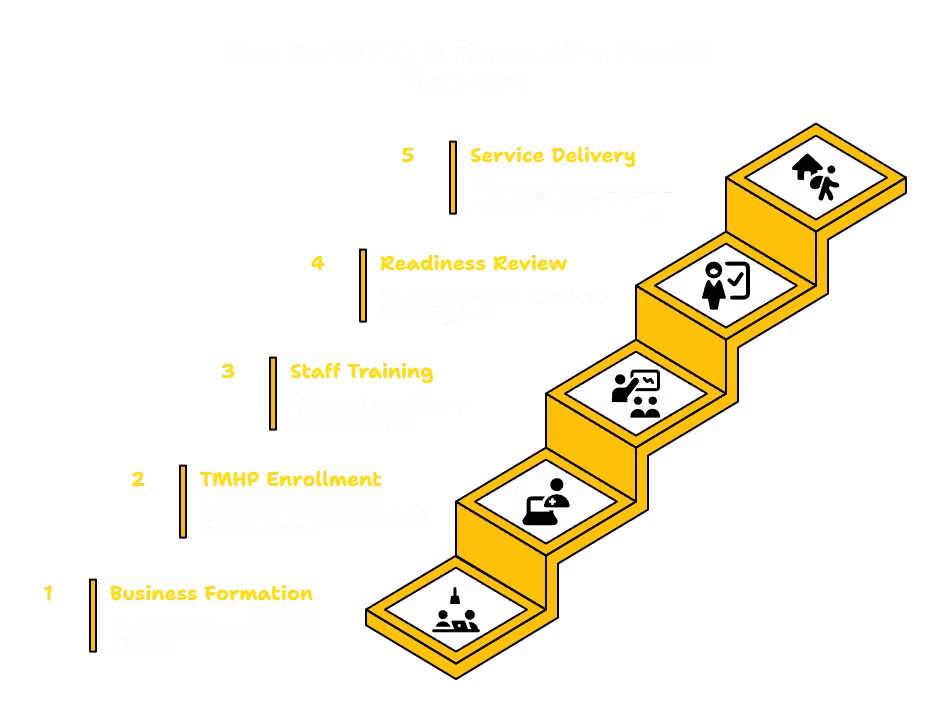
The timeline varies based on administrative readiness, but it typically takes several months. Business formation and manual preparation usually require 1–2 months, followed by 2–3 months for TMHP enrollment and HHSC contracting. Staff training and readiness reviews add an additional 30–45 days before the agency can begin service delivery.
Are homemaker services available under all Medicaid programs?
Homemaker services are specific to certain 1915(c) Medicaid Waiver Programs and managed care plans. They are commonly available through HCS, TxHmL, CLASS, DBMD, and STAR+PLUS HCBS, among others. Availability is contingent upon the specific authorized care plan developed for the Medicaid participant.
WAIVER CONSULTING GROUP’S START-UP ASSISTANCE SERVICE — TX HOMEMAKER SERVICES PROVIDER
WCG supports homemaker service providers and attendant care agencies in building compliant, person-centered operations in Texas. Our scope of work includes assistance with TMHP and HHSC waiver enrollment, the creation of robust Policy Manuals, development of task documentation logs, and the implementation of staff orientation tools to ensure total regulatory alignment.
Key Takeaway: To succeed as a homemaker services provider in Texas, agencies must meticulously manage the transition from legal entity formation to HHSC contract approval, while prioritizing the development of a bulletproof documentation system that satisfies both state and federal Medicaid audit requirements.
Last verified: October 2023. Disclaimer: This article is for informational purposes only and does not constitute legal or professional medical advice. Always consult with the Texas Health and Human Services Commission (HHSC) or a qualified consultant for the most current regulatory requirements and program rules.