HOMEMAKER SERVICES PROVIDER IN TENNESSEE
By Fatumata Kaba · 2025-10-22 · 6 min read
SUPPORTING DAILY LIVING AND INDEPENDENT LIFESTYLES FOR INDIVIDUALS WITH DISABILITIES AND CHRONIC CONDITIONS IN THEIR OWN HOMES
Homemaker Services in Tennessee provide essential, non-medical support for individuals with disabilities, the elderly, and those living with chronic conditions who require assistance with routine household activities to maintain their independence. By facilitating a clean, safe, and organized living environment, these Medicaid-funded services allow participants to remain in their own homes rather than transitioning to institutional care settings, as overseen by TennCare and the Department of Intellectual and Developmental Disabilities (DIDD).
What Are Homemaker Services and Who Do They Support?
Homemaker Services focus strictly on the instrumental activities of daily living (IADLs) that are necessary for the maintenance of a stable home environment. These services are not intended for clinical or hands-on personal care; rather, they are designed to reduce the physical burden of household management for participants whose functional limitations prevent them from completing these tasks independently. The specific scope of these services is defined within the participant’s Individual Support Plan (ISP) or person-centered care plan.
The assistance provided generally encompasses tasks that sustain the cleanliness and functionality of the residence. While these services are foundational to home and community-based support, it is critical for provider agencies to distinguish them from Personal Care Services. Agencies must ensure that staff adhere strictly to the non-medical limitations of the homemaker role, focusing on the environment rather than the individual’s direct physical hygiene.
- Light housekeeping, including vacuuming, dusting, and sweeping.
- Laundry services, including washing, drying, folding, and changing linens.
- Kitchen sanitation, such as dishwashing and general cleaning of food preparation areas.
- Meal preparation for non-specialized diets.
- Grocery shopping and essential errand running performed with or on behalf of the participant.
- General household organization, including trash removal and tidying of living spaces.
- Assistance with organizing mail and scheduling household appointments.
What Are the Governing Agencies and Regulatory Oversight?
The provision of Homemaker Services in Tennessee operates under a structured regulatory framework designed to ensure participant safety and the appropriate use of Medicaid funding. TennCare, the state's Medicaid program, serves as the primary administrator, setting the standards for service delivery and managing the overarching budget for the state’s Home and Community-Based Services (HCBS) programs. They provide the necessary oversight to ensure that services align with the federal guidelines established by the Centers for Medicare & Medicaid Services (CMS).
Operational oversight for specific populations often falls under the Department of Intellectual and Developmental Disabilities (DIDD). This agency is responsible for the vetting and approval of providers who serve individuals within their waiver programs. Providers must maintain constant compliance with both state-level requirements and the specific stipulations laid out in the CMS-approved waiver applications, ensuring that all services rendered are both authorized and documented in accordance with federal Medicaid HCBS compliance standards.
How Do You Obtain Provider Approval and Licensure?
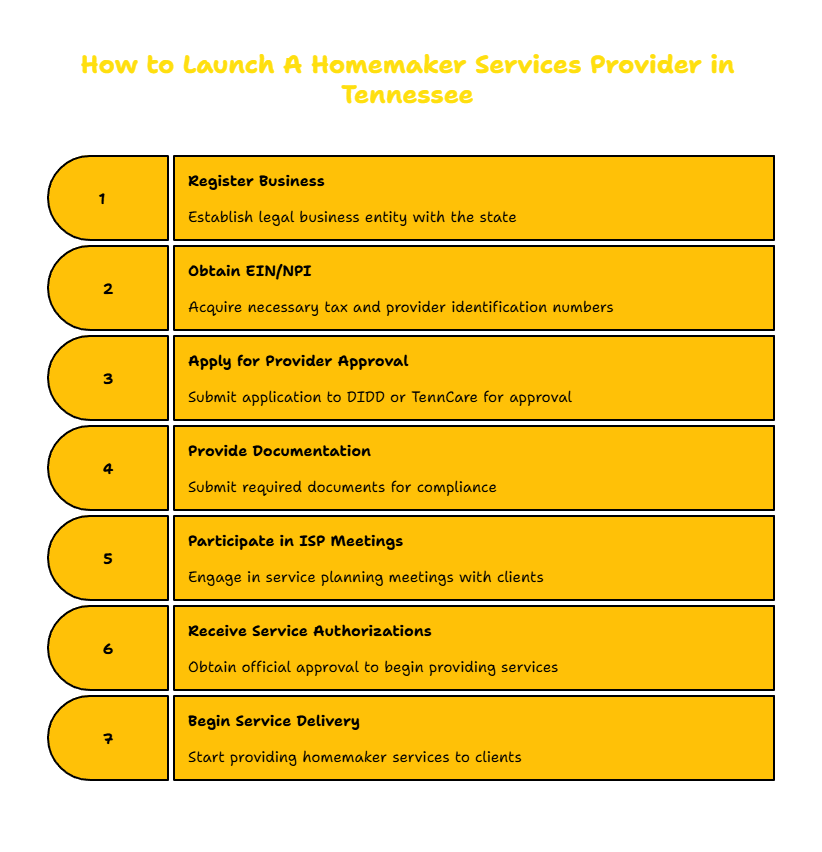
Establishing a Homemaker Services agency requires a methodical approach to business formation and regulatory compliance. The initial phase involves the standard legal registration of the business entity with the Tennessee Secretary of State, followed by the acquisition of a federal Employer Identification Number (EIN) and a Type 2 National Provider Identifier (NPI). These are the foundational credentials required for all subsequent applications and billing activities within the Medicaid system.
Once the business is legally established, the provider must submit an application for approval through the appropriate channels, which may include the DIDD or the specific TennCare Managed Care Organization (MCO) portals depending on the waiver program. Successful enrollment is contingent upon demonstrating the capacity to deliver high-quality care, which necessitates the development of a comprehensive Homemaker Services Policy & Procedure Manual. This document serves as the backbone of the agency’s operations, detailing every aspect of service delivery, risk management, and administrative function.
- Registration of the business entity with the Tennessee Secretary of State.
- Acquisition of an EIN and Type 2 NPI.
- Submission of the provider application through DIDD or relevant TennCare MCO portals.
- Procurement of adequate general liability insurance and workers' compensation policies.
- Development and finalization of a formal Homemaker Services Policy & Procedure Manual.
What Are the Requirements for Staffing and Training?
The success of a Homemaker Services agency relies heavily on the quality and preparedness of its personnel. All employees must undergo rigorous background checks to ensure the safety of the participants they serve. Furthermore, providers are responsible for implementing a standardized training curriculum that covers the fundamentals of HCBS service delivery. Staff must demonstrate competency in infection control, maintaining appropriate professional boundaries, and understanding the rights of the individuals they support.
Beyond technical cleaning skills, staff must be proficient in the documentation requirements associated with Medicaid billing. Since services are authorized through an ISP, workers are expected to maintain accurate records of the tasks performed during each visit. Training should also encompass mandatory reporting laws, ensuring that all staff are fully aware of their responsibilities regarding the identification and reporting of abuse or neglect, thereby upholding the integrity and safety of the HCBS program.
Which Medicaid Waiver Programs Include Homemaker Services?
Homemaker Services are a vital component of several Tennessee Medicaid waiver programs, each targeting specific populations to ensure they have the support required to remain in their communities. These programs include the Employment and Community First (ECF) CHOICES waiver, which provides essential support for individuals with intellectual and developmental disabilities. Other avenues include the 1915(c) waivers, such as the Comprehensive and Self-Direction (SD) waivers, which cater to a broader spectrum of individuals with disabilities and aging-related needs.
Additionally, the TennCare CHOICES program serves as a critical resource for older adults and individuals with physical disabilities who require assistance with IADLs to maintain their independence. The Katie Beckett Program (Part B) also integrates these services for eligible children with significant disabilities, ensuring that in-home support remains a viable alternative to institutionalized care. Understanding which waivers a provider is approved for is essential, as the administrative requirements for documentation and authorization can vary by program.
Frequently Asked Questions
What documents must be included in the agency Policy & Procedure Manual?
The manual must detail the scope of tasks, emergency response protocols, participant consent and service agreement templates, ISP coordination standards, staff training procedures, billing and scheduling logs, and internal incident reporting and satisfaction tracking mechanisms.
What is the typical timeline to launch a new provider agency?
The launch process generally spans several months. Business registration and manual development typically take 1–2 months, followed by a 2–3 month period for provider enrollment. Staff hiring and training usually require an additional 30–60 days before the agency can begin service delivery upon receipt of authorizations.
Are Homemaker Services the same as Personal Care Services?
No. Homemaker Services are strictly limited to non-medical household tasks such as cleaning, laundry, and meal preparation. They do not include hands-on personal care for the participant, which requires a separate scope of practice and potentially different provider approvals.
Key Takeaway
Launching a Homemaker Services agency in Tennessee requires a rigorous commitment to documentation, regulatory compliance, and staff training. By aligning business operations with the specific requirements set forth by TennCare and the DIDD, providers can effectively support the independence of vulnerable populations across the state. Success is achieved through a combination of meticulous administrative oversight and a clear understanding of the service limitations inherent in the HCBS waiver framework.
Waiver Consulting Group provides comprehensive support for launching Homemaker Services in Tennessee, from enrollment to documentation. Scope of work includes provider enrollment support through DIDD or TennCare, Homemaker Services Policy Manual development, staff training packets and scheduling templates, client service logs, consent forms, emergency response plans, compliance guidance, incident tracking tools, and HCBS documentation and billing worksheets. Last verified: October 2023. Disclaimer: This content is for informational purposes only and does not constitute legal or professional advice. Always consult directly with the relevant state agencies for the most current regulatory requirements.