HOMEMAKER SERVICES PROVIDER IN PENNSYLVANIA
By Fatumata Kaba · 2025-10-08 · 5 min read
Promoting independence and safety through non-medical supports that help individuals maintain their homes and daily routines.
Homemaker Services in Pennsylvania are Medicaid-funded supports that assist individuals with disabilities, chronic conditions, or aging-related limitations in maintaining a clean, safe, and functional home environment. These non-medical services are provided under Pennsylvania’s Home and Community-Based Services (HCBS) waivers through the Office of Long-Term Living (OLTL) and are coordinated by Community HealthChoices (CHC) Managed Care Organizations (MCOs).
Understanding the Role of Governing Agencies
Navigating the regulatory landscape for Medicaid-funded supports in Pennsylvania requires a clear understanding of the hierarchy of oversight. The Pennsylvania Department of Human Services (DHS) serves as the primary state authority, specifically through the Office of Long-Term Living (OLTL). This office manages the waiver programs that fund these vital home supports, ensuring that service delivery meets state standards for quality and accountability.
At the operational level, Community HealthChoices (CHC) Managed Care Organizations (MCOs) act as the primary point of contact for service authorization and reimbursement. Providers must coordinate closely with these organizations to ensure that client care plans align with their approved service authorizations. Additionally, the Centers for Medicare & Medicaid Services (CMS) provide federal oversight, ensuring that Pennsylvania’s HCBS waivers remain in compliance with national Medicaid guidelines. Finally, the Pennsylvania Department of State is responsible for the formal registration of the business entities providing these services.
Defining the Scope of Homemaker Services
Homemaker Services offer critical in-home assistance with household tasks and instrumental activities of daily living (IADLs). These services are designed to prevent premature institutionalization by helping individuals remain safely and independently in their own homes. By outsourcing these tasks to a professional provider, participants can focus on their health and social well-being while maintaining a clean living environment.
Approved providers generally deliver the following types of supports:
- Light Housekeeping: Dusting, sweeping, vacuuming, mopping, and general room cleaning to ensure a sanitary home.
- Laundry Support: Washing, drying, folding, and putting away clothes and linens.
- Meal Preparation: Cooking basic meals in line with dietary instructions or cultural preferences.
- Errands & Grocery Shopping: Running household errands or assisting clients with shopping needs.
- Organization: Tidying living areas, rotating seasonal clothing, and providing non-clinical medication organization.
- Companionship: Providing non-medical social interaction and light supervision for the client.
Navigating Licensing and Provider Approval Requirements
One of the most frequently asked questions regarding start-ups involves the necessity of a home care agency license. In Pennsylvania, a separate Home Care Agency license is not required if your services are strictly non-medical and do not involve activities of daily living (ADLs). However, providers must still meet strict administrative and financial prerequisites to participate in the Medicaid program.
Before launching services, a provider must register the business with the Pennsylvania Department of State, obtain an Employer Identification Number (EIN) from the IRS, and secure a Type 2 National Provider Identifier (NPI). Once these foundational steps are complete, the agency must enroll as a Medicaid provider in the PROMISe™ system and maintain sufficient liability and workers’ compensation insurance. Furthermore, every provider must develop a comprehensive Homemaker Services Policy & Procedure Manual that details operational standards compliant with OLTL and MCO requirements.
The Step-by-Step Pennsylvania Provider Enrollment Process
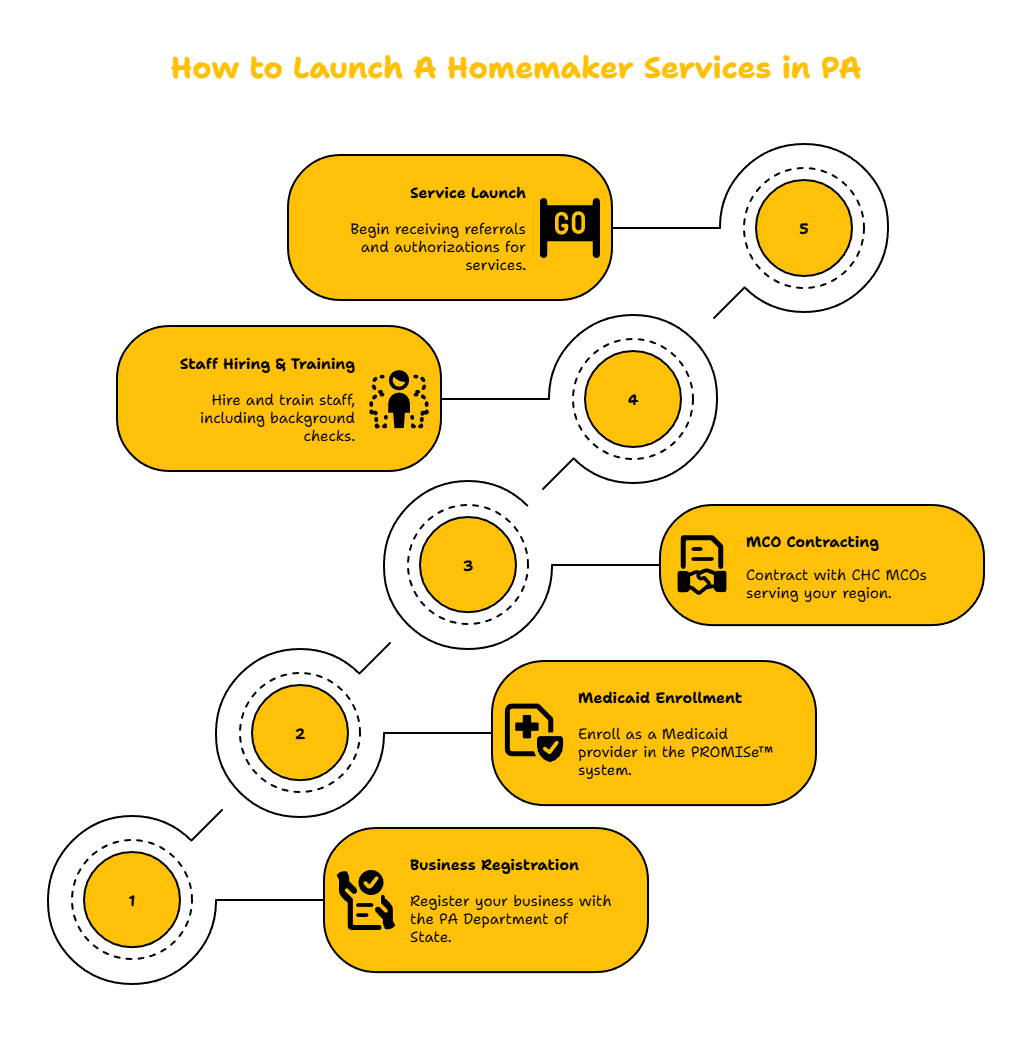
The transition from a business concept to an authorized Medicaid provider follows a structured, multi-phase sequence. This process ensures that every agency is vetted for operational capacity before receiving referrals. The following steps outline the typical progression for a new provider entering the Pennsylvania market:
- Step 1: Form a legal business entity and secure an EIN, NPI, and the necessary liability and workers’ compensation insurance.
- Step 2: Enroll in the PROMISe™ system as a provider of non-medical waiver services.
- Step 3: Contract with the CHC MCOs serving your target region, such as UPMC, PA Health & Wellness, or Keystone First.
- Step 4: Submit required documentation, including staff background checks and your service policies, to the MCOs.
- Step 5: Begin receiving referrals and authorizations from MCO care coordinators to officially launch service delivery.
Documentation and Operational Compliance
Maintaining accurate records is a non-negotiable aspect of operating as a Medicaid-funded provider. Beyond standard business documents like Articles of Incorporation, an agency must maintain rigorous administrative records. This includes detailed service verification forms, task logs, and visit notes for every encounter. These records are subject to audit and serve as the primary evidence for billing reimbursement.
The Homemaker Services Policy & Procedure Manual acts as the backbone of the organization. It must contain specific guidelines for client intake, task scheduling, and emergency protocols. It should also define how staff will handle grievances and incident reporting. In the current digital landscape, agencies must also be prepared to implement Electronic Visit Verification (EVV) systems where required, ensuring that all documentation is captured accurately and in real-time to meet MCO billing standards.
Staffing, Training, and Development
The quality of your agency rests on the competency and reliability of your staff. For the role of Homemaker or Housekeeping Aide, candidates must undergo thorough background checks. While CPR and First Aid certification are not always mandatory for non-medical roles, they are strongly recommended to ensure basic safety. The Program Coordinator or Scheduler is equally important, as this role manages the daily logistical requirements of matching aides with clients.
Ongoing training is a fundamental requirement for all employees. Staff must complete training in HIPAA compliance, participant privacy, and abuse prevention. Furthermore, it is beneficial to provide regular education on cultural competency and disability awareness. Annual performance reviews should be utilized to assess staff conduct, ensure documentation standards are being met, and reinforce the importance of professional boundaries in a client’s home.
Frequently Asked Questions
Do I need a medical license to provide Homemaker Services?
No. Homemaker services are strictly non-medical. Because they do not involve clinical care or assistance with ADLs, a home care agency license is not required. However, you must still enroll in the PROMISe™ system and maintain a valid contract with CHC MCOs.
What waiver programs fund these services?
Services are primarily funded through the Community HealthChoices (CHC) program for adults dually eligible for Medicare and Medicaid. Other pathways include the Independence, OBRA, and Aging Waivers managed by the Office of Long-Term Living (OLTL).
How long does the launch process typically take?
The timeline varies based on administrative readiness. Business registration usually takes 1–2 months, while Medicaid enrollment and MCO contracting can add another 2–3 months. Staffing and final preparation typically require an additional 30–60 days before you can accept your first referral.
Key Takeaway
Establishing a successful Homemaker Services agency in Pennsylvania requires a methodical approach that prioritizes regulatory compliance, documentation accuracy, and strong relationships with CHC Managed Care Organizations. By ensuring your business policies are robust and your staff is properly trained in the nuances of HCBS delivery, you can effectively support the dignity and autonomy of individuals across the Commonwealth.
Waiver Consulting Group (WCG) provides specialized start-up assistance for Homemaker Service providers in Pennsylvania, including support with business registration, Medicaid enrollment, MCO onboarding, and the development of comprehensive Policy & Procedure Manuals. Our expertise helps agencies navigate the complexities of the PROMISe™ system and EVV integration to ensure a compliant and sustainable launch. Last verified May 2024. This information is for educational purposes only and does not constitute legal or financial advice.