HOMEMAKER SERVICES PROVIDER IN NEW JERSEY
By Fatumata Kaba · 2025-09-05 · 5 min read
Understanding Homemaker Services in the New Jersey Medicaid Landscape
Homemaker Services in New Jersey provide critical non-medical support to individuals with disabilities, chronic illnesses, or age-related conditions, enabling them to remain safely in their own homes. These services encompass a range of essential household tasks, such as light housekeeping, meal preparation, and grocery shopping, all of which are authorized under various New Jersey Medicaid Home and Community-Based Services (HCBS) waiver programs.
For provider agencies, these services represent a core component of the state’s commitment to person-centered care. By maintaining a clean, safe, and organized living environment, Homemaker Services play a vital role in preventing institutionalization and promoting the long-term independence of program participants. Agencies looking to enter this market must navigate complex regulatory environments governed by the Department of Human Services (DHS) and the Division of Aging Services (DoAS).
Who Governs and Regulates Homemaker Services in New Jersey?
The regulatory framework for Homemaker Services in New Jersey is structured to ensure that federal standards are met while addressing the specific needs of the state's population. Oversight is split between federal authorities, who set the baseline for quality and participant protection, and state agencies, which handle the day-to-day administration of waiver funding, provider enrollment, and reimbursement.
The Centers for Medicare & Medicaid Services (CMS) provides the overarching federal oversight, ensuring that all Medicaid-funded services adhere to strict HCBS quality standards, including mandatory person-centered planning and participant safety requirements. Within the state, the New Jersey Department of Human Services (DHS) serves as the primary administrator for Medicaid waiver funding, managing the intricacies of provider enrollment and the authorization of services. Working in tandem, the Division of Aging Services (DoAS) monitors ongoing compliance, ensuring that providers consistently meet the state's rigorous quality standards for service delivery.
What Scope of Services Must a Provider Deliver?
Approved Homemaker Services are non-medical in nature and are strictly defined by the participant’s Individualized Service Plan (ISP). The primary objective is to alleviate the burdens of daily household management that might otherwise prevent a participant from living independently. Providers are responsible for delivering these services in a manner that is respectful of the participant's privacy and dignity while ensuring a safe living environment.
Providers generally include the following activities in their service offerings:
- Housekeeping: Performing light cleaning, dusting, vacuuming, and general trash removal.
- Laundry and Linen Care: Managing the washing, drying, folding, and changing of bed linens.
- Meal Preparation: Planning and cooking meals that align with the participant’s specific dietary needs.
- Grocery Shopping and Errands: Purchasing groceries, essential household items, and assisting with pharmacy pickups.
- Home Safety and Organization: Identifying potential household hazards, maintaining a clutter-free space, and providing companionship.
How to Navigate the New Jersey Provider Enrollment Process
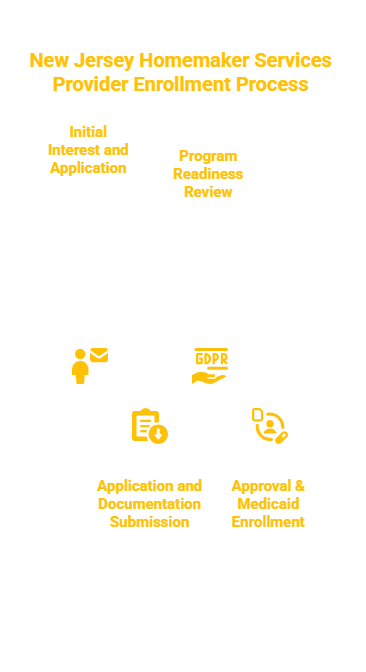
Becoming an authorized Medicaid provider requires a systematic approach to business formation and regulatory compliance. The process begins by registering the business entity with the New Jersey Division of Revenue and Enterprise Services and obtaining the necessary federal identifiers, including an Employer Identification Number (EIN) and a Type 2 National Provider Identifier (NPI). These foundational steps are prerequisites for any further interaction with the state’s healthcare billing systems.
Once the business is established, the agency must initiate the application through the New Jersey Medicaid Provider Enrollment Portal. The submission must include detailed documentation such as the agency’s Articles of Incorporation, proof of insurance (general and professional liability), and a comprehensive Policy and Procedure Manual. Following the initial application, the DHS and DoAS will conduct a program readiness review to evaluate the agency’s safety protocols, staff qualification verification, and overall preparedness to deliver compliant services. Only after final approval can an agency begin billing for services under authorized Medicaid codes.
What Are the Essential Staffing and Credentialing Requirements?
Staffing quality is the cornerstone of a successful Homemaker Services agency. Providers are responsible for ensuring that all staff meet stringent background, health, and training requirements. A Program Director must be appointed to oversee operations, ideally possessing a bachelor’s degree in a human services or healthcare administration field, along with relevant supervisory experience. This individual is responsible for maintaining the clinical and administrative integrity of the program.
Direct support staff—the homemakers themselves—must possess at least a high school diploma or GED, demonstrate basic competency in housekeeping and meal preparation, and hold current CPR and First Aid certifications. Every staff member must complete rigorous training modules that cover:
- Household safety, infection control, and emergency response procedures.
- HIPAA compliance and the protection of participant privacy.
- Adherence to participant rights and the reporting of grievances.
- Annual competency evaluations and ongoing professional development.
Frequently Asked Questions
What is the typical timeline to launch a Homemaker Services agency?
The timeline typically spans several months. Business formation and initial compliance preparation generally take 1–2 months, followed by 2–3 months for staff hiring and credentialing. The formal Medicaid provider enrollment and readiness review process often requires 60–90 days, with an additional 30–45 days required for final billing setup.
Which Medicaid waivers cover Homemaker Services in New Jersey?
These services are available under several programs, including the Community Care Program for the Elderly and Disabled (CCPED), the Supports Program Waiver, the Acquired Brain Injury (ABI) Waiver, the Personal Care Assistant (PCA) Waiver, and the general Home and Community-Based Services (HCBS) Waiver.
What documentation must be included in a Policy and Procedure Manual?
A compliant manual must detail participant intake and service planning procedures, staff training and background check protocols, documentation standards for billing, HIPAA compliance strategies, emergency safety response measures, and procedures for quality assurance and grievance handling.
WAIVER CONSULTING GROUP’S START-UP ASSISTANCE SERVICE — NEW JERSEY HOMEMAKER SERVICES PROVIDER
WCG supports agencies in launching Medicaid-compliant Homemaker Services in New Jersey, offering:
- Business registration, Medicaid enrollment, and licensing assistance.
- Policy manual development for homemaking support and household safety.
- Staff credentialing, training program templates, and service documentation guidance.
- Medicaid billing setup and audit-prepared financial management.
- Branding, website development, and community outreach strategies.
- Quality assurance systems for household safety and compliance monitoring.
- Networking with community-based organizations for referrals.
Key Takeaway: Establishing a successful Homemaker Services agency in New Jersey requires strict adherence to the standards set by the DHS and DoAS. By focusing on robust policy development, rigorous staff training, and meticulous attention to the Medicaid enrollment requirements, providers can build sustainable, compliant operations that significantly improve the lives of individuals receiving HCBS support.
Last verified: [Insert Date]. Disclaimer: This information is for educational purposes and does not constitute legal or professional advice. Always verify current requirements with the New Jersey Department of Human Services and the official Medicaid Provider Enrollment Portal.