HOMEMAKER SERVICES PROVIDER IN NEVADA
By Fatumata Kaba · 2025-09-04 · 5 min read
SUPPORTING INDEPENDENT LIVING THROUGH ASSISTANCE WITH DAILY HOUSEHOLD TASKS
Homemaker Services in Nevada serve as a critical component of the state’s Home and Community-Based Services (HCBS) infrastructure, providing essential non-medical support to individuals with disabilities, chronic illnesses, and age-related conditions. By facilitating the maintenance of a safe, sanitary, and organized living environment, these services directly reduce caregiver burden and empower participants to remain in their own homes rather than transitioning to institutional care settings.
For entrepreneurs and healthcare administrators, establishing a Homemaker Services agency involves navigating rigorous state and federal regulatory frameworks overseen by the Nevada Department of Health and Human Services (DHHS). This guide outlines the operational requirements, enrollment pathways, and compliance standards necessary to provide authorized HCBS supports within the Nevada Medicaid landscape.
What Are the Governing Bodies and Oversight Standards?
The delivery of Homemaker Services is governed by a multi-tiered regulatory structure designed to ensure participant safety and fiscal accountability. The primary state agency, the Nevada Department of Health and Human Services (DHHS), maintains overall authority, managing the distribution of Medicaid waiver funding, provider enrollment protocols, and the mechanics of service reimbursement. Adherence to DHHS guidelines is mandatory for any agency seeking to operate within the state Medicaid system.
Working in tandem with DHHS, the Aging and Disability Services Division (ADSD) focuses on the granular execution of service delivery. ADSD is responsible for monitoring quality standards and ensuring that providers remain in strict compliance with the expectations set forth under HCBS waiver programs. At the federal level, the Centers for Medicare & Medicaid Services (CMS) provides the overarching regulatory framework, ensuring that all Nevada-based Homemaker Services align with national requirements for person-centered planning, participant protection, and Medicaid-funded care quality.
What Is the Scope of Authorized Homemaker Services?
Homemaker Services are intended to provide functional support that enables independent living. These services are strictly non-medical and must be clearly defined within the participant’s Individualized Service Plan (ISP). Providers are responsible for delivering tasks that maintain the integrity and safety of the participant's home environment, ensuring that the services align precisely with the documented needs of the individual served.
Approved providers commonly deliver the following essential supports:
- Housekeeping: Performing light cleaning, vacuuming, dusting, and routine trash removal to ensure a sanitary home.
- Meal Preparation: Assisting with menu planning, grocery shopping, and food preparation to ensure adequate nutrition.
- Laundry and Linens: Managing the washing, drying, folding, and changing of bed linens and personal clothing.
- Home Safety Checks: Proactively identifying and addressing environmental hazards to prevent falls or accidents.
- Errands and Organization: Helping with essential shopping, picking up prescriptions, and decluttering personal spaces.
- Companionship: Providing necessary social interaction and emotional support during the execution of household tasks.
How Do Providers Navigate Licensing and Enrollment?
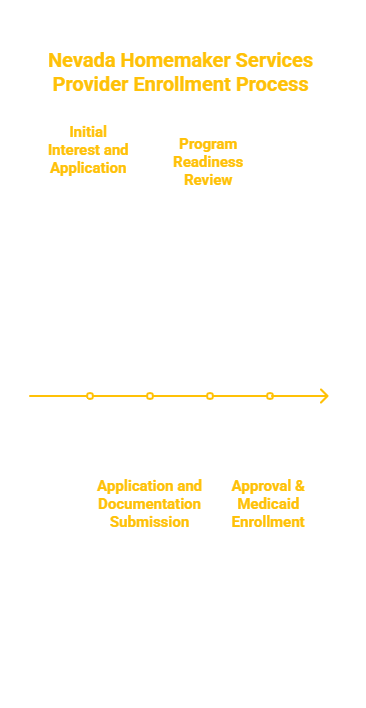
The provider enrollment process is a multi-step sequence requiring rigorous documentation and organizational readiness. Before a provider can bill Nevada Medicaid, they must first establish a legal business entity with the Nevada Secretary of State, obtain a federal Employer Identification Number (EIN), and secure a Type 2 National Provider Identifier (NPI). This foundational work ensures the agency is legally recognized and capable of conducting federal and state financial transactions.
Once the business structure is finalized, the provider must enroll specifically as a Medicaid Waiver Homemaker provider via the Nevada Medicaid Provider Enrollment Portal. This involves submitting comprehensive documentation, including professional liability and general liability insurance, and obtaining any applicable Homemaker Agency Licenses from the DHHS. Successful enrollment is contingent upon a thorough Program Readiness Review, during which the state assesses the agency's internal policies, staff training records, and safety protocols to ensure the provider is capable of meeting HCBS standards.
What Are the Essential Documentation and Policy Requirements?
Maintaining high-quality documentation is the cornerstone of regulatory compliance in the HCBS sector. An agency must develop and implement a robust Policy & Procedure Manual that serves as the blueprint for daily operations. This manual must explicitly cover participant intake procedures, assessment methodologies, and the specific protocols for housekeeping and environmental maintenance. Clear documentation standards for service tracking are vital, as these records serve as the primary evidence for Medicaid billing and audit purposes.
Beyond operational tasks, the policy manual must also address high-stakes compliance areas such as HIPAA privacy standards, participant rights, and formal grievance handling. Furthermore, the agency must have codified protocols for emergency response, infection control, and continuous quality assurance monitoring. These internal documents must be kept up-to-date and accessible for review by ADSD or other regulatory bodies during unannounced audits or state site visits.
What Are the Staffing and Training Expectations?
Staffing mandates ensure that homemakers are qualified to provide respectful and effective care. The agency must appoint a Homemaker Program Director, typically requiring a bachelor’s degree in social work, human services, or a related healthcare field, along with prior experience managing home support services. Direct support workers, or Homemakers, must hold at least a high school diploma or GED and undergo comprehensive training in household safety, infection control, and ethical standards.
Mandatory staff training protocols include:
- Core Skills: Training in homemaking techniques, meal preparation, and personal safety.
- Regulatory Compliance: Thorough instruction on HIPAA protocols and participant rights.
- Emergency Preparedness: Ongoing education regarding household hazards and emergency response.
- Competency Evaluation: Annual assessments and continuing education to ensure service delivery remains consistent with evolving state requirements.
Frequently Asked Questions
Which Medicaid waivers currently support Homemaker Services in Nevada?
Homemaker Services are covered under several key Nevada Medicaid waivers, including the Home and Community-Based Waiver for Persons with Intellectual and Developmental Disabilities (HCBS-IDD), the Frail Elderly (FE) Waiver, the Physical Disabilities Waiver, the Traumatic Brain Injury (TBI) Waiver, and the Aged and Disabled (AD) Waiver.
What is the typical timeline for launching a Homemaker Services agency?
The total timeline varies, but generally spans 6 to 9 months. Business formation and compliance preparation usually take 1–2 months, followed by 2–3 months for staff hiring. Medicaid enrollment and readiness reviews typically require 60–90 days, while final billing setup and service launch add another 30–45 days.
What is the primary role of the Program Director in this model?
The Program Director is responsible for the overall clinical and operational integrity of the agency. This includes ensuring staff remain in compliance with training requirements, overseeing the quality of service documentation, managing the intake of new participants, and serving as the primary liaison during state audits or reviews.
WCG supports agencies in launching Medicaid-compliant Homemaker Services in Nevada through comprehensive business registration assistance, policy manual development, staff training curriculum design, and Medicaid billing setup. Our team assists with audit-prepared financial management and the development of quality assurance systems designed to meet the rigorous standards of the DHHS and ADSD.
Key Takeaway: Successful navigation of the Nevada Homemaker Services landscape requires a commitment to rigorous documentation, consistent staff training, and deep adherence to the specific guidelines established by DHHS and the Nevada Medicaid Provider Enrollment Portal.
Last verified: May 2024. This information is provided for educational purposes only and does not constitute legal or professional advice. Always consult with the Nevada Department of Health and Human Services (DHHS) or the Aging and Disability Services Division (ADSD) regarding specific regulatory updates and individual provider obligations.