CASE MANAGEMENT SERVICES PROVIDER IN NEVADA
By Fatumata Kaba · 2025-09-04 · 5 min read
Becoming a Case Management Services provider in Nevada requires a strategic approach to aligning business operations with the regulatory requirements of the Nevada Department of Health and Human Services (DHHS) and the Aging and Disability Services Division (ADSD). These providers serve a critical role in the Medicaid Home and Community-Based Services (HCBS) ecosystem by facilitating person-centered care, coordinating essential community resources, and ensuring that individuals with disabilities or chronic conditions can live safely and independently.
What Is the Role of a Case Management Provider in Nevada’s Medicaid System?
Case Management Services in Nevada are designed to bridge the gap between complex health needs and available community support. By operating under the umbrella of Nevada Medicaid HCBS waivers, providers act as the primary point of contact for participants, ensuring that care is not only accessible but tailored to the specific, evolving needs of the individual. This is a person-centered model, meaning the participant’s preferences, goals, and quality-of-life objectives drive every aspect of the service plan.
The core functions performed by providers include comprehensive needs assessments, the development of an Individualized Service Plan (ISP), and ongoing care coordination. Providers are responsible for monitoring the effectiveness of these plans and pivoting when a participant’s condition changes or a crisis occurs. This advocacy-based approach ensures that Medicaid funding is utilized effectively to maintain the participant's health, safety, and community integration.
How Are Case Management Services Governed?
The regulatory framework for Case Management in Nevada is a multi-tiered system involving state and federal oversight. The Nevada Department of Health and Human Services (DHHS) serves as the primary administrative authority, managing Medicaid waiver funding, overseeing provider enrollment, and handling service reimbursement. Their role is to ensure that all administrative processes—from initial registration to billing—remain compliant with state law.
Supporting this, the Aging and Disability Services Division (ADSD) focuses on the ground-level quality of care. ADSD is responsible for verifying that providers adhere to the high standards required for HCBS programs, including participant safety and compliance with ISP documentation. At the federal level, the Centers for Medicare & Medicaid Services (CMS) provides the overarching guidelines for these waivers, ensuring that states maintain consistent standards for person-centered planning, participant rights, and protection against exploitation or neglect.
What Are the Essential Requirements for Provider Approval?
Before an agency can begin providing services, it must establish a formal business structure and obtain the necessary credentials. This begins with registering the entity with the Nevada Secretary of State and obtaining an Employer Identification Number (EIN) from the IRS. A Type 2 National Provider Identifier (NPI) is also required to facilitate billing under the agency's name.
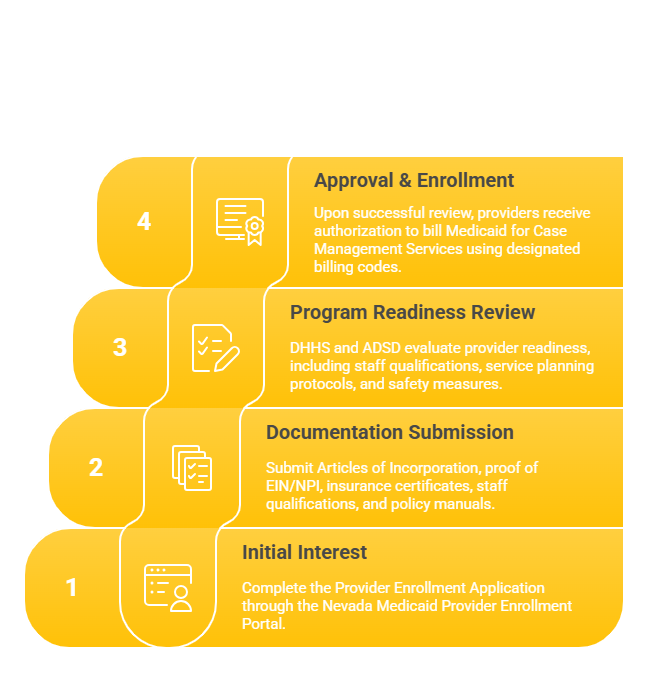
Beyond basic business registration, agencies must build a robust policy framework. This includes securing general and professional liability insurance and developing comprehensive manuals that cover intake, emergency response, HIPAA compliance, and grievance procedures. Staff must meet stringent background checks and health screenings. Finally, the agency must demonstrate readiness by submitting all required documentation through the Nevada Medicaid Provider Enrollment Portal, where DHHS and ADSD will review policies, credentialing, and overall operational capacity.
- Register the business with the Nevada Secretary of State.
- Obtain EIN and Type 2 NPI.
- Develop a Policy & Procedure Manual covering HIPAA and participant rights.
- Secure liability insurance (general and professional).
- Complete the Nevada Medicaid Provider Enrollment application.
How Can Providers Successfully Navigate the Enrollment Process?
The journey to becoming an authorized provider involves a structured sequence of milestones. After the initial application submission, the program readiness review is the most critical phase. During this time, state agencies evaluate whether the provider has the infrastructure to support complex care needs. This includes verifying that the agency’s documentation protocols meet the standard for auditing and that the staff possesses the appropriate qualifications to manage Medicaid billing.
The timeline to launch is generally divided into four distinct phases. Initially, founders spend one to two months on business formation and drafting internal compliance policies. The subsequent two to three months are dedicated to recruiting qualified staff, obtaining background clearances, and finalizing training programs. Once the application is submitted, the readiness review process typically spans 60 to 90 days. The final phase involves setting up billing systems, which takes 30 to 45 days, allowing the agency to move from enrollment to service delivery.
What Are the Mandatory Staffing Standards?
Success in this field is highly dependent on the competence of the workforce. The Case Management Program Director must hold a degree in social work, human services, or healthcare, complemented by supervisory experience and preferably a case management certification. This individual is responsible for ensuring that all staff operate within their professional scope and follow the clinical protocols established by the waiver program.
Case Managers must possess at least a Bachelor’s degree in a relevant field and demonstrate prior experience in care coordination. Case Management Assistants support these operations with a high school diploma or GED and administrative expertise. Regardless of the role, all staff are required to undergo training in person-centered planning, crisis de-escalation, and HIPAA-compliant data management. Ongoing competency evaluations are required to maintain status as an active, approved provider under the Nevada Medicaid HCBS programs.
Frequently Asked Questions
What types of Medicaid waivers allow for Case Management Services in Nevada?
Case Management Services are authorized under several key HCBS waivers, including the Home and Community-Based Waiver for Persons with Intellectual and Developmental Disabilities (HCBS-IDD), the Frail Elderly (FE) Waiver, the Physical Disabilities Waiver, the Traumatic Brain Injury (TBI) Waiver, and the Aged and Disabled (AD) Waiver.
How does an agency demonstrate readiness for a Medicaid site visit?
Readiness is demonstrated by maintaining a current Policy & Procedure Manual that covers all aspects of service, including intake, ISP development, and emergency intervention. Providers must ensure that all staff personnel files are complete with background checks, current certifications, and records of ongoing training.
What is the primary role of the individual service plan (ISP)?
The ISP serves as the foundational document for care. It outlines the participant's needs as identified during the initial assessment and provides the specific roadmap for which services, supports, and community resources the Case Manager will coordinate to ensure the participant's health and safety.
Waiver Consulting Group’s Start-Up Assistance
WCG supports agencies in launching Medicaid-compliant Case Management Services in Nevada. This support includes business registration, Medicaid enrollment guidance, and the development of policy manuals for care coordination and crisis management. WCG provides assistance with staff credentialing templates, documentation guidance, and the setup of quality assurance systems to ensure compliance with Nevada DHHS and ADSD regulations.
Key Takeaway: Establishing a Case Management agency in Nevada requires strict adherence to state-mandated administrative and clinical protocols. By focusing on robust policy development, rigorous staff training, and a clear understanding of the Medicaid enrollment timeline, providers can build a sustainable organization capable of delivering essential, person-centered care to the state's most vulnerable populations.
Last verified: 2024. This content is provided for informational purposes only and does not constitute legal or professional medical advice. Regulatory requirements are subject to change; please consult the official Nevada Department of Health and Human Services and the Nevada Medicaid Provider Enrollment Portal for the most current information and policy updates.