HOMEMAKER SERVICES PROVIDER IN NEBRASKA
By Fatumata Kaba · 2025-08-08 · 6 min read
SUPPORTING INDEPENDENT LIVING THROUGH HOUSEHOLD ASSISTANCE AND PERSONAL CARE
Homemaker Services in Nebraska provide vital household support for individuals with disabilities, chronic illnesses, or age-related conditions who require assistance to maintain their independence. These Medicaid-funded services are designed to ensure that participants can reside safely and comfortably in their own homes by receiving help with daily living tasks such as cleaning, meal preparation, and light personal care.
Authorized under the Nebraska Medicaid Home and Community-Based Services (HCBS) Waiver programs, these services are a cornerstone of the state's efforts to provide person-centered care. For prospective providers, navigating the regulatory environment requires a clear understanding of state agency mandates, provider enrollment procedures, and the operational standards necessary to remain compliant with federal and state regulations.
What Are the Governing Agencies Overseeing Nebraska Homemaker Services?
The delivery of Homemaker Services in Nebraska is governed by a multi-tiered regulatory structure. The primary authority is the Nebraska Department of Health and Human Services (DHHS), which serves as the central administrative body. DHHS is responsible for managing the state's Medicaid waiver funding, overseeing the provider enrollment process, and managing the specific service authorizations and reimbursement schedules that allow agencies to operate.
Under the DHHS umbrella, the Nebraska Medicaid and Long-Term Care (MLTC) Division provides focused oversight on quality standards. This division ensures that service delivery remains consistent with state goals for HCBS programs and monitors provider compliance through regular audits and performance reviews. Their role is to ensure that the services provided effectively meet the needs of the waiver participant while adhering to state-defined service protocols.
At the federal level, the Centers for Medicare & Medicaid Services (CMS) provides the overarching regulatory framework. CMS ensures that Medicaid-funded programs in Nebraska comply with national HCBS quality standards, person-centered planning requirements, and rigorous participant protection protocols. Providers must align their internal operations with both state directives and these federal mandates to maintain their status as eligible Medicaid providers.
What Scope of Services Can a Nebraska Homemaker Provider Deliver?
Homemaker Services are intended to support the activities of daily living that allow a participant to maintain a clean, safe, and manageable home environment. These services are never "one-size-fits-all"; rather, they are authorized based on a participant's specific Individualized Service Plan (ISP). This document outlines the exact nature and frequency of tasks that a provider is permitted to deliver.
Approved providers generally deliver a range of household and personal support, including:
- Household Cleaning: Dusting, vacuuming, sweeping, mopping, and sanitizing high-touch surfaces.
- Laundry and Linen Care: Washing, drying, folding, and organizing clothing and bed linens.
- Meal Preparation: Preparing meals in accordance with a participant’s specific dietary needs and personal preferences.
- Grocery Shopping: Assisting participants in selecting and procuring food and essential household supplies.
- Personal Care Assistance: Providing support with light personal hygiene tasks and grooming.
- Safety and Home Maintenance: Checking for environmental hazards, replacing light bulbs, and ensuring the living space remains accessible.
- Social and Emotional Support: Providing companionship to help reduce the risks of social isolation.
How Do Agencies Secure Licensure and Provider Approval?
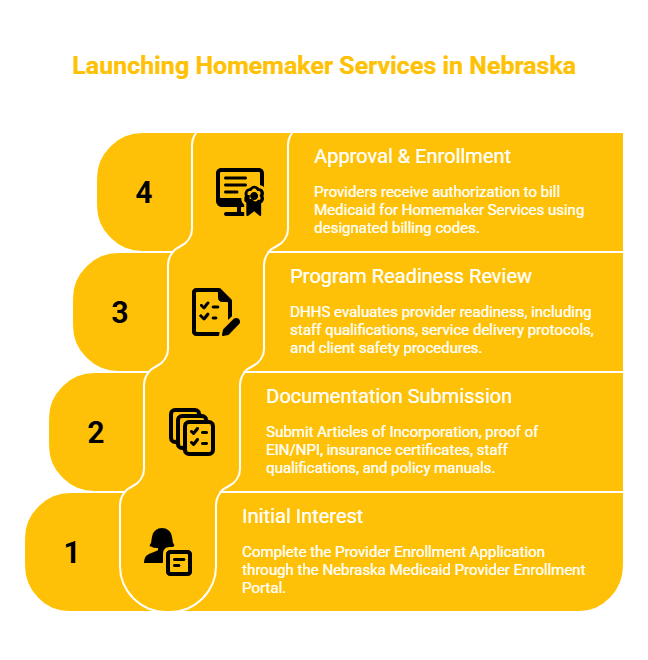
The pathway to becoming a Medicaid Homemaker Services provider begins with establishing a legitimate business entity. Before approaching the state for Medicaid enrollment, an organization must register with the Nebraska Secretary of State, obtain a federal Employer Identification Number (EIN), and secure a Type 2 National Provider Identifier (NPI). These foundational steps provide the legal and administrative basis for operating a healthcare-related business in Nebraska.
Once the business is legally formed, prospective providers must satisfy state-specific requirements. This includes seeking any necessary licensure as a Homemaker Agency through Nebraska DHHS, if applicable to the business model. Providers are also required to carry adequate general liability and professional liability insurance to protect against operational risks. A critical component of this phase is the development of robust policy manuals that govern household assistance, safety management, and emergency response, ensuring that staff conduct is predictable and standardized.
The formal enrollment process occurs through the Nebraska Medicaid Provider Enrollment Portal. During this phase, agencies must provide comprehensive documentation, including proof of insurance, staff credentials, and detailed operational policies. DHHS will conduct a Program Readiness Review to evaluate whether the agency is prepared to manage client safety, adhere to billing protocols, and execute the services described in the participant's ISP.
What Documentation and Staffing Standards Are Required?
Success as a Medicaid provider hinges on meticulous documentation and the professional competency of staff. Required documentation for enrollment and ongoing audits includes clear evidence of business registration, NPI/EIN verification, and a comprehensive Homemaker Services Policy & Procedure Manual. This manual must explicitly cover client intake and assessment, safety and hygiene protocols, personal care guidelines, HIPAA compliance, grievance procedures, and audit readiness.
Staffing requirements are strictly monitored to ensure that all personnel are capable of delivering safe and effective care. The agency must appoint a Homemaker Program Director, who typically requires a bachelor’s degree in a human services or healthcare field, along with documented supervisory experience. Homemaker Aides and support staff must hold at least a high school diploma or GED and undergo specific training in infection control, safety, basic caregiving skills, and client rights.
- Mandatory background checks and health screenings for all staff.
- Ongoing competency evaluations to ensure high-quality service delivery.
- Continuous education regarding household management and emergency response.
- HIPAA-compliant training to protect participant privacy and sensitive health information.
Which Medicaid Waiver Programs Support Homemaker Services?
Homemaker Services are integrated into several key Nebraska Medicaid HCBS waiver programs. These waivers are designed to help eligible individuals remain in their homes rather than transitioning to institutionalized care. Understanding these programs is essential for providers as they define the target population and the billing environment.
The primary waivers include:
- Aged and Disabled (AD) Waiver: Focused on assisting seniors and individuals with physical disabilities.
- Traumatic Brain Injury (TBI) Waiver: Provides specialized support for individuals recovering from brain injuries.
- Developmental Disabilities (DD) Waiver: Supports individuals with intellectual or developmental disabilities in their daily living.
- Children with Disabilities Waiver: Assists families in maintaining the care of children with specific health or developmental needs.
- Home and Community-Based Services (HCBS) Waiver: A broad program encompassing various supports to prevent institutionalization.
Frequently Asked Questions
How long does the total process take to become a provider?
The timeline varies based on an agency's existing infrastructure, but typically ranges from 5 to 10 months. This includes 1–2 months for business formation, 2–3 months for staff hiring and program development, 60–90 days for Medicaid enrollment and readiness reviews, and a final 30–45 days for billing system setup.
What is the role of the Homemaker Program Director?
The Program Director is responsible for the overall operation of the agency. This includes ensuring compliance with DHHS regulations, overseeing staff training and credentialing, managing the quality of service delivery, and serving as the primary point of contact for audits and administrative inquiries.
Are providers required to maintain specific insurance policies?
Yes, all providers must maintain general liability insurance and professional liability insurance. These policies are mandatory to protect both the agency and the participants during the delivery of services in private homes.
Key Takeaway
Becoming an approved Homemaker Services provider in Nebraska is a structured, highly regulated process that demands rigorous attention to detail and full compliance with DHHS, MLTC, and CMS guidelines. Agencies that successfully establish comprehensive policy manuals, prioritize staff training, and maintain audit-ready documentation are well-positioned to serve vulnerable populations while building a sustainable, mission-driven business within the Medicaid HCBS framework.
Last verified: 2024. The information provided herein is for educational purposes only and does not constitute legal or financial advice. Prospective providers should consult directly with the Nebraska Department of Health and Human Services (DHHS) and the Nebraska Medicaid and Long-Term Care (MLTC) Division to obtain the most current regulations, forms, and program requirements before initiating the application process.