HOMEMAKER SERVICES PROVIDER IN KENTUCKY
By Fatumata Kaba · 2025-07-25 · 5 min read
Homemaker Services in Kentucky are specialized non-medical support programs designed to assist Medicaid-eligible individuals in maintaining a clean, safe, and functional home environment. By providing essential household assistance to those with disabilities, chronic conditions, or age-related limitations, these services play a critical role in preventing institutionalization and fostering independence within the community.
What Are Homemaker Services and Who Do They Serve?
Homemaker services focus on the instrumental activities of daily living (IADLs) that allow a participant to remain in their own home rather than moving into an assisted living facility or nursing home. These services are vital for individuals who, due to physical or cognitive limitations, are unable to perform routine home maintenance tasks on their own. By ensuring that an individual’s living space is sanitary and organized, homemaker providers directly contribute to the health and dignity of the participant.
Approved providers are tasked with performing specific, non-medical activities as outlined in the participant’s Person-Centered Service Plan (PCSP). It is important for agencies to note that these services must never duplicate tasks assigned to personal care or nursing staff. Instead, the homemaker role is strictly focused on the upkeep of the home and the facilitation of essential household errands, ensuring the participant’s environment supports their specific health and safety requirements.
Which Agencies Govern Homemaker Services in Kentucky?
The delivery of homemaker services in Kentucky is overseen by a collaborative network of state and federal entities. The Kentucky Cabinet for Health and Family Services (CHFS) and its sub-agency, the Department for Medicaid Services (DMS), serve as the primary authorities, managing Medicaid enrollment and the reimbursement structure for approved providers. These agencies establish the financial and operational framework that allows the program to function statewide.
In addition to state-level oversight, the Kentucky Department for Aging and Independent Living (DAIL) is responsible for defining the requirements for Home and Community-Based Services (HCBS) waivers and monitoring the quality standards that providers must meet. Furthermore, Managed Care Organizations (MCOs) act as the operational point of contact for providers, handling the authorization of services, processing credentialing, and overseeing the billing and documentation processes. Providers must also remain compliant with the federal guidelines set forth by the Centers for Medicare & Medicaid Services (CMS) regarding non-medical, community-based care.
What Are the Core Service Delivery Requirements?
Homemaker services are defined by a specific set of tasks that providers are authorized to deliver. To remain compliant, agencies must ensure their staff strictly adheres to the tasks listed in the participant's service plan. Approved activities typically include:
- Light housekeeping, including sweeping, dusting, vacuuming, and mopping.
- Laundry services and regular linen changes.
- Dishwashing and general kitchen sanitation.
- Grocery shopping and assistance with essential errands.
- Non-skilled meal preparation and subsequent cleanup.
- Making and changing beds.
- Trash disposal and general household organization.
- Escort and support for essential errands.
What Steps Are Required for Provider Enrollment?
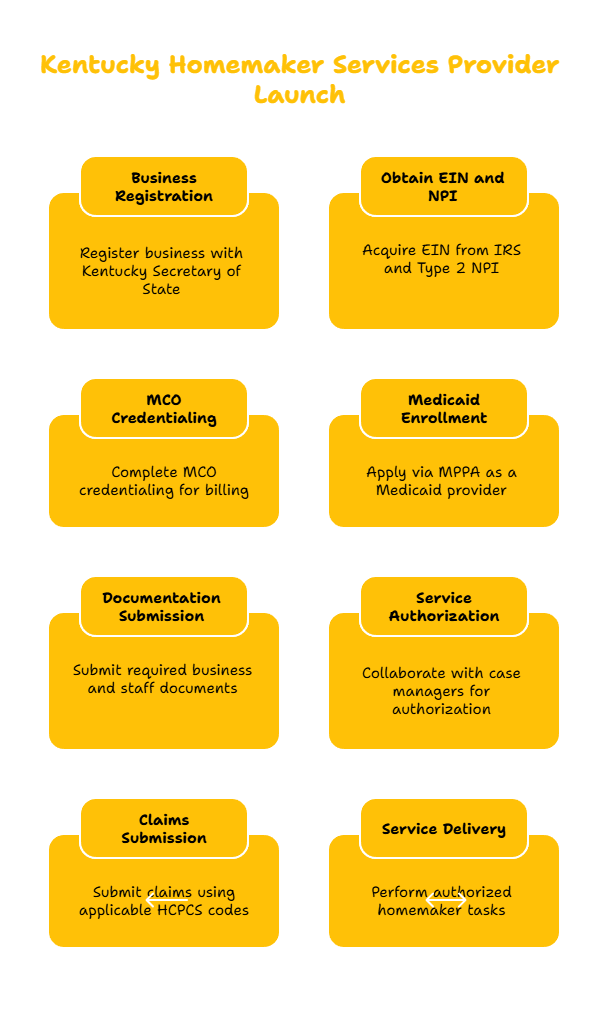
The journey to becoming a certified Kentucky Medicaid homemaker provider involves a rigorous sequence of business registration and credentialing. Initially, an entity must register as a business with the Kentucky Secretary of State and obtain a federal Employer Identification Number (EIN) and a Type 2 National Provider Identifier (NPI). Once these foundational steps are completed, the agency must enroll as a Medicaid provider through the Medicaid Partner Portal Application (MPPA).
Following successful registration in the MPPA, the agency must complete MCO credentialing to be eligible for reimbursement. This phase requires the submission of a comprehensive business package, including liability and workers’ compensation insurance documentation, service area descriptions, and a robust staffing model. Agencies must also develop a formal Homemaker Services Policy & Procedure Manual, which serves as the blueprint for daily operations, staff training, and compliance management.
How Do Agencies Ensure Compliance and Quality?
Successful agencies maintain a high standard of care through meticulous documentation and continuous staff training. Because these services are funded through Medicaid waivers such as the Home and Community-Based (HCB) Waiver, the Michelle P. Waiver (MPW), the Supports for Community Living (SCL) Waiver, or the Acquired Brain Injury (ABI) waivers, the records kept by the provider are subject to state audits. Each provider must maintain a comprehensive system for service logs, cleaning checklists, and participant intake forms.
Staffing requirements emphasize both competency and safety. Every homemaker must undergo a thorough background check and possess reliable transportation if their role includes errands. Furthermore, all staff must complete initial and annual training in HIPAA compliance, infection control, fall prevention, emergency response, and sensitivity regarding the specific needs of elderly and disabled participants. This infrastructure ensures that the provider can demonstrate compliance with both state regulations and MCO billing requirements.
Frequently Asked Questions
What is the typical timeline to launch a Homemaker agency?
The launch process generally takes several months. Business formation and the development of internal manuals typically take 1–2 months. Medicaid enrollment and MCO credentialing often require 60–90 days, followed by 1–2 months for staff hiring and 30–45 days for final service launch and claims setup.
Are homemaker services limited to specific Medicaid waivers?
Yes, these services are specific to several HCBS waivers, including the Home and Community-Based (HCB) Waiver, Michelle P. Waiver (MPW), Supports for Community Living (SCL) Waiver, Acquired Brain Injury (ABI & ABI-LTC) Waivers, and the Model II Waiver (MIIW).
What documentation is required for a Medicaid audit?
Providers must maintain organized records, including articles of incorporation, proof of insurance, detailed staff training logs, signed participant consent forms, emergency contact information, and audit-ready service logs that verify the delivery of authorized tasks.
Key Takeaway
Establishing a Medicaid-compliant homemaker service in Kentucky requires a disciplined approach to business administration, regulatory adherence, and staff management. By aligning operational policies with the standards set by CHFS, DAIL, and the various MCOs, providers can successfully build a sustainable agency that delivers essential support to vulnerable populations throughout the state.
Last verified: May 2024. This information is for educational purposes only and does not constitute legal or professional consulting advice. Prospective providers should verify all requirements directly with the Kentucky Cabinet for Health and Family Services and relevant Managed Care Organizations.