HOMEMAKER SERVICES PROVIDER IN CONNECTICUT
By Fatumata Kaba · 2025-07-08 · 6 min read
Supporting independent living for older adults and individuals with disabilities through non-medical in-home assistance, Homemaker Services in Connecticut serve as a cornerstone of the state’s long-term care infrastructure. By providing essential non-medical support, these services empower participants to remain safely in their own homes rather than transitioning to institutional care settings.
Homemaker services are authorized and reimbursed through various Connecticut Medicaid Home and Community-Based Services (HCBS) Waivers, including the Connecticut Home Care Program for Elders (CHCPE), the Personal Care Assistance (PCA) Waiver, and the Acquired Brain Injury (ABI) waivers. Administered by the Department of Social Services (DSS), these programs ensure that eligible participants receive consistent, high-quality assistance with daily activities that are critical to maintaining a healthy and functional home environment.
What Are the Governing Agencies and Regulatory Requirements for Homemaker Providers?
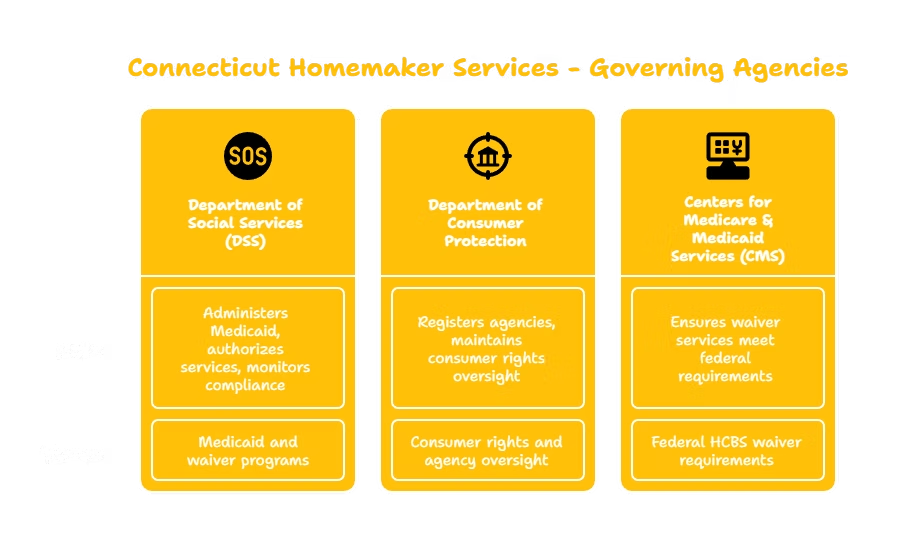
Operating a homemaker service provider agency in Connecticut requires coordination with multiple regulatory bodies to ensure legal compliance and eligibility for Medicaid reimbursement. The primary agency, the Connecticut Department of Social Services (DSS), holds the ultimate authority for administering Medicaid waiver programs, authorizing specific homemaker service plans, and monitoring ongoing provider compliance with state and federal regulations.
Additionally, if an organization intends to operate as a Homemaker Companion Agency (HCA), it must register with the Connecticut Department of Consumer Protection (DCP). The DCP maintains the registry of these agencies and provides oversight regarding consumer rights and business practices. Furthermore, the Centers for Medicare & Medicaid Services (CMS) sets the overarching federal requirements that Connecticut’s HCBS waivers must satisfy to receive federal financial participation, ensuring the safety and efficacy of community-based services.
- Connecticut Department of Social Services (DSS): Manages Medicaid, approves care plans, and monitors service quality.
- Connecticut Department of Consumer Protection (DCP): Oversees the registration of Homemaker Companion Agencies.
- Centers for Medicare & Medicaid Services (CMS): Establishes federal guidelines for HCBS waiver service delivery.
What Scope of Services Is Included Under Connecticut Medicaid Homemaker Programs?
Homemaker services are strictly defined as non-medical, supportive tasks aimed at maintaining a participant's independence within their home. These services must be clearly documented within the individual's personalized care plan as authorized by the state’s case management teams. Providers are expected to adhere strictly to these plans to ensure that the services rendered align with the participant’s functional needs.
Approved tasks focus on creating a clean, safe, and hygienic environment. While providers may offer various levels of support, all activities must be performed in accordance with established program guidelines and documented through logs that record the specific tasks completed and the time spent on each visit. Providing services outside of the approved care plan scope may result in payment denials or audit findings.
- Light housekeeping, including sweeping, mopping, and dusting.
- Laundry services and the changing of bed linens.
- Meal preparation and washing dishes utilized during the meal process.
- Grocery shopping and assistance with essential errands.
- General organization and maintenance of a safe, hazard-free home environment.
What Are the Step-by-Step Requirements for Provider Enrollment?
Launching a homemaker service agency involves a structured, multi-phase enrollment process. Founders must first establish their business legally with the Connecticut Secretary of the State and obtain necessary identifiers from federal and state authorities. Following legal formation, the focus shifts to regulatory registration and enrollment as a participating Medicaid provider.
The enrollment process typically follows a sequential path: registering the business, securing the necessary HCA registration through the DCP, and finally applying for Medicaid provider status via the DSS enrollment portal. Throughout this process, administrators must maintain meticulous records, as documentation of business registration, EIN, NPI, and HCA status will be requested during the application review.
- Register the business entity with the Connecticut Secretary of the State.
- Obtain a federal Employer Identification Number (EIN) and a Type 2 National Provider Identifier (NPI).
- Register as a Homemaker Companion Agency (HCA) through the DCP online portal.
- Complete the Medicaid provider enrollment application through the DSS portal.
How Do Agencies Maintain Compliance and Quality Assurance?
Maintaining compliance is an ongoing responsibility that requires robust internal policies and procedures. Agencies must implement rigorous protocols for staff training, background checks, and regular supervision to ensure that care is delivered ethically and in alignment with client rights. Policies regarding privacy, confidentiality, and emergency response must be codified in a comprehensive agency manual that is accessible to all staff members.
Quality assurance is supported by the consistent use of task checklists, visit logs, and grievance procedures. These tools not only protect the participant but also provide the agency with clear evidence of service delivery during state audits. By institutionalizing these processes, providers minimize risk, protect their standing with DSS, and ensure a higher standard of care for their clients.
- Comprehensive client intake procedures and documentation of service authorizations.
- Mandatory staff training on elder abuse recognition, infection control, and home safety.
- Structured complaint and grievance protocols to resolve issues promptly.
- Ongoing documentation management, including service logs and performance reviews.
What Are the Staffing and Training Mandates?
The quality of a homemaker agency is inherently tied to the quality of its workforce. Staff members performing direct services must meet specific criteria before stepping into a client's home, including the completion of mandatory background checks and health screenings, such as TB testing. Furthermore, agencies are responsible for verifying that staff members possess the necessary skills to perform their assigned tasks safely, such as valid driver’s licenses for those running errands.
Administrative staff, including supervisors and schedulers, play a critical role in logistical coordination and compliance monitoring. They must ensure that the right staff member is assigned to the right client at the right time. Both direct care and administrative staff require ongoing professional development to stay abreast of current regulations and to maintain the safety standards expected by state programs.
- Homemaker/Companion: Requires background check, TB screening, and proficiency in assigned tasks.
- Supervisor/Scheduler: Requires experience in home care coordination and operational logistics.
- Mandatory Training Topics: Elder abuse reporting, infection control, ethical service delivery, and privacy rights.
Frequently Asked Questions
How long does the provider enrollment process take?
The timeline varies by phase: business formation typically takes 1–2 weeks, HCA registration with the DCP takes 2–4 weeks, and Medicaid enrollment through DSS generally requires 30–60 days. Final onboarding and staff hiring processes can add an additional 2–4 weeks.
Is CPR/First Aid certification mandatory for all staff?
While not always explicitly mandated in the initial enrollment regulations for every waiver program, it is strongly recommended that all staff maintain current CPR and First Aid certification to ensure emergency preparedness and professional standards.
What happens if a service is provided outside of the authorized care plan?
Services must be documented and authorized by the participant's DSS care plan. Providing services not included in the plan can lead to payment rejections, audit discrepancies, or potential exclusion from the Medicaid provider network.
Key Takeaway
Success as a Connecticut Homemaker Services provider relies on a rigorous adherence to the regulatory standards set by the Department of Social Services and the Department of Consumer Protection. By focusing on structured documentation, consistent staff training, and proactive compliance with the specific requirements of the CHCPE, PCA, and ABI waivers, new agencies can build a sustainable, high-quality service model that meets the critical needs of the state's vulnerable populations.
Last verified: October 2023. This information is for general educational purposes only and does not constitute legal or professional advice. Requirements for Medicaid provider enrollment in Connecticut are subject to change by the Department of Social Services. Always consult current state regulations and official government portals for the most up-to-date program information before initiating your business startup.