HOMEMAKER SERVICES PROVIDER IN ALABAMA
By Fatumata Kaba · 2025-06-28 · 5 min read
Understanding Homemaker Services for IDD Populations in Alabama
Homemaker Services in Alabama serve as a vital component of the Home and Community-Based Services (HCBS) Medicaid waiver landscape, specifically designed to assist individuals with intellectual and developmental disabilities (IDD) in maintaining a safe, sanitary, and functional home. By providing non-medical support for routine household tasks, these services effectively promote independent living and prevent the necessity for institutional placement.
Administered under the regulatory framework of the Alabama Department of Mental Health (ADMH) and the Alabama Medicaid Agency, these services are strictly defined to ensure consistency across the state. Providers authorized to deliver these services must adhere to rigorous standards concerning staff training, documentation, and quality assurance to meet both state guidelines and federal requirements established by the Centers for Medicare & Medicaid Services (CMS).
Who Regulates Homemaker Services in Alabama?
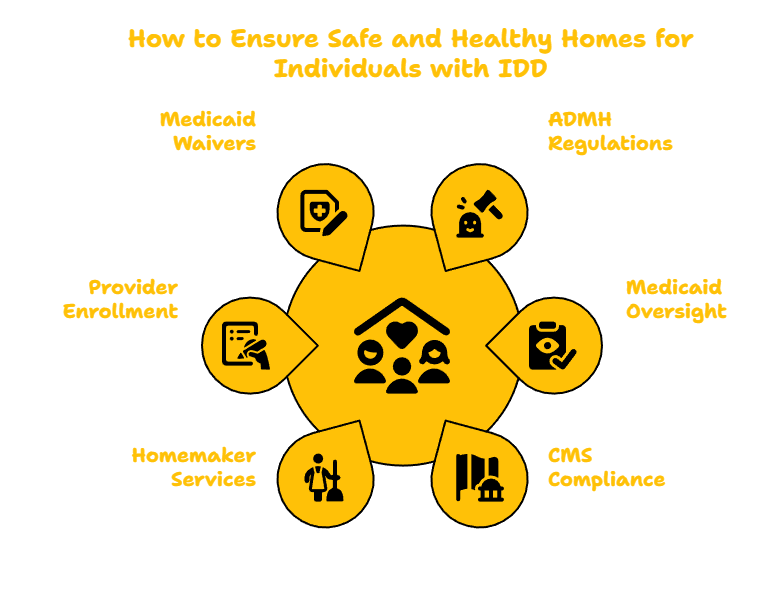
The regulatory structure for Homemaker Services involves three primary tiers of oversight, each playing a distinct role in maintaining the integrity of the Medicaid waiver system. The Alabama Department of Mental Health (ADMH) serves as the primary regulatory body for providers, setting the standards for service delivery, staff qualifications, and compliance monitoring within the HCBS waiver framework.
The Alabama Medicaid Agency manages the fiscal side of the program, overseeing the provider enrollment process, billing procedures, and the final reimbursement of claims. Finally, the Centers for Medicare & Medicaid Services (CMS) provides federal oversight, ensuring that Alabama’s waiver programs remain aligned with federal mandates for in-home support services. Providers must demonstrate ongoing compliance with the requirements set forth by all three entities to remain in good standing.
What Tasks Are Included in Homemaker Services?
Homemaker Services are explicitly non-medical in nature, focusing exclusively on maintaining a clean and safe living environment. These person-centered services must be integrated into the individual's service plan, ensuring that the assistance provided addresses the specific, identified needs of the participant. Approved providers typically assist with tasks that the individual cannot manage independently, thereby fostering a higher quality of life at home.
The scope of permitted tasks is clearly defined to ensure providers maintain professional boundaries and safety standards. Authorized activities generally include:
- Cleaning of primary living areas, including kitchens, bathrooms, and bedrooms
- Laundry services, including washing, drying, and linen changes
- Dishwashing and general kitchen sanitization
- Meal planning and preparation (note: feeding assistance is excluded)
- Trash removal and general light household organization
- Grocery shopping and errands for essential household supplies
What Are the Prerequisites for Provider Approval?
Launching a Homemaker Services agency requires meticulous attention to both business registration and clinical compliance. Potential providers must first satisfy basic administrative requirements, including registering the business with the Alabama Secretary of State, obtaining an Employer Identification Number (EIN) from the IRS, and securing a Type 2 National Provider Identifier (NPI). An operational office location or a verified mobile service capacity within Alabama is mandatory.
Beyond basic business registration, agencies must develop a robust operational infrastructure. This involves implementing comprehensive policies for documentation, staff scheduling, quality assurance, and service verification. Providers must be prepared to demonstrate that they have established reliable systems for staff supervision, which is critical for maintaining accountability and meeting the strict standards set by the ADMH.
The ADMH Enrollment and Credentialing Process
The provider enrollment process is a multi-phased journey that begins with a formal application to the ADMH. After requesting the Homemaker Services Provider Application Packet, an agency must submit a detailed service model. This document outlines task schedules, quality control procedures, staff roles, and, crucially, emergency response protocols. Supporting documentation, such as templates for service logs and consumer consent forms, must be provided for review.
Following the initial application, the agency must undergo background and credentialing reviews. This includes mandatory background checks for all direct support staff, verification of training in safe housekeeping practices, and documentation of non-medical service qualifications. The process culminates in a Program Readiness Review, where state reviewers evaluate the agency’s internal systems, including how cleaning supplies are managed, how time logs are tracked, and how consumer feedback and grievances are handled. Only upon successful completion of these phases can a provider move to finalize enrollment with the Alabama Medicaid Agency.
Staffing, Training, and Operational Compliance
Successful delivery of Homemaker Services depends heavily on the quality and preparation of the agency’s staff. The Homemaker Services Supervisor should possess a documented background in home support or disability services, with a comprehensive understanding of household safety and sanitation. Homemaker Aides are expected to have a high school diploma or GED, alongside experience in housekeeping and a commitment to completing mandatory ADMH training.
Ongoing compliance is maintained through continuous education and rigorous documentation. All staff members are required to complete an ADMH orientation and specific HCBS waiver training. Annual modules covering ethics, safety, sanitation, confidentiality, and consumer interaction are essential to maintain licensure. Additionally, agencies must maintain detailed records of these trainings and ensure that all daily service logs are accurate, as these documents are subject to audit during state reviews.
Frequently Asked Questions
Which Alabama Medicaid waivers cover Homemaker Services?
Homemaker Services are authorized under three primary Alabama Medicaid waivers: the ID Waiver (Intellectual Disabilities Waiver), the LAH Waiver (Living at Home Waiver), and the State of Alabama Community Waiver Program.
What is the estimated timeline to launch a provider agency?
The total timeline varies, but generally follows this structure: 0–1 week for business formation, 60–90 days for ADMH application review, 30–60 days for program and staff setup, and 60–90 days for final Medicaid enrollment.
Are personal care or physical assistance services included in Homemaker Services?
No. Homemaker Services are strictly non-medical. They do not include personal care, hands-on physical assistance with Activities of Daily Living (ADLs), or supervision, and must remain focused on household maintenance tasks.
Key Takeaway
Establishing a successful Homemaker Services agency in Alabama requires a rigorous commitment to ADMH and Medicaid standards, starting with formal business registration and culminating in a robust, compliance-focused operational structure. By prioritizing staff training, accurate documentation, and strict adherence to the non-medical scope of service, providers can successfully support individuals with IDD in maintaining independent, healthy home environments within the HCBS waiver system.
Last verified: [Insert Date]. This information is provided for educational purposes and should not be considered legal or medical advice. Please consult the Alabama Department of Mental Health or the Alabama Medicaid Agency for the most current regulatory guidance and official documentation requirements.